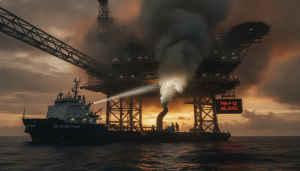
Aker BP, Höegh Evi Advance CO2 Transport
In a dynamic energy landscape increasingly defined by decarbonization mandates and volatile commodity prices, strategic pivots into cleaner technologies are becoming paramount for oil and gas majors. A recent development signals a significant step forward in the nascent but critical carbon capture and storage (CCS) sector: the Approval in Principle (AiP) granted by DNV for a next-generation liquefied CO₂ (LCO₂) carrier. This endorsement, awarded to the collaborative efforts of Aker BP and Höegh Evi, not only validates a robust technical solution for large-scale CO₂ transport but also de-risks a crucial component of the broader CCS value chain. For investors keenly watching the energy transition, this move by an established upstream player like Aker BP, partnering with a clean energy specialist like Höegh Evi, represents a tangible commitment to future-proofing their operations and unlocking new growth avenues in industrial decarbonization across Europe.
De-Risking the CCS Investment Thesis through Certified Innovation
The DNV Approval in Principle for the LCO₂ carrier is more than a mere technical nod; it’s a powerful signal to the market, significantly de-risking the investment profile of large-scale carbon capture projects. Crucially, this vessel design, developed by Höegh Evi, Aker BP, and Moss Maritime, is the first to be reviewed under DNV’s new CO2 RECOND class notation. This specialized classification, tailored specifically for CO₂ handling and conditioning, establishes a new benchmark for safety and operational integrity in LCO₂ transport. For investors, this translates into reduced technical uncertainty and enhanced project financeability across the CCS value chain. The integrated design, featuring an onboard CO₂ conditioning module and offloading capabilities, promises to minimize complexity and reduce the risk of impurity co-mingling, ensuring reliable injection into offshore reservoirs. Aker BP’s deep expertise in offshore operations, now being leveraged to mature and develop CO₂ storage solutions on the Norwegian Continental Shelf (NCS) through licenses like EXL 005 Poseidon and EXL 011 Atlas, perfectly complements Höegh Evi’s clean energy focus. This synergy, backed by a DNV AiP, offers a credible and scalable solution for connecting large European industrial emitters to permanent, secure storage, addressing a critical bottleneck in widespread CCS adoption. This development provides a tangible answer to investor questions about the long-term viability and scalability of energy transition technologies, offering a pathway for diversified growth beyond traditional hydrocarbon extraction, which is especially pertinent as our proprietary data shows investors increasingly asking about the long-term trajectory of oil prices beyond 2026.
The Economics of Scalable Carbon Transport in a Volatile Market
The proposed LCO₂ carrier offers compelling economics for industrial decarbonization, designed for cost-efficient and safe transport of captured CO₂. With two approved variants offering total capacities of up to 50,000 cubic meters of liquid CO₂, and an initial sizing to handle up to 10 million tonnes of CO₂ per annum with scalability for growing market demand, this solution addresses the need for high-volume logistics. This focus on “cost-efficient path to decarbonization” and “setting new benchmarks in safe, cost-efficient, and sustainable large-scale CO₂ transportation and storage” is critical for widespread adoption. Against the backdrop of a volatile energy market, such long-term, infrastructure-heavy investments become even more strategic. As of today, Brent crude trades at $90.38, reflecting a 9.07% decline for the day, with a wider day range of $86.08 to $98.97. Similarly, WTI crude stands at $82.59, down 9.41%. Our proprietary data shows a significant 18.5% drop in Brent prices over the past 14 days, from $112.78 to $91.87. This pronounced volatility underscores the strategic imperative for oil and gas companies to diversify revenue streams and invest in stable, long-term growth vectors like CCS. For Aker BP, leveraging its extensive offshore expertise in this new domain offers a hedge against the unpredictable swings of the crude market, aligning its business with the inevitable global push for industrial decarbonization and strengthening its position within the broader energy transition narrative.
Strategic Implications and Forward Catalysts for Investors
Aker BP’s foray into large-scale CO₂ storage and transport, in partnership with Höegh Evi, marks a significant strategic realignment for a company traditionally focused on upstream oil and gas production. This integrated solution positions Aker BP not just as a producer of energy, but as a key enabler of sustainable industrial practices, offering a full-scope carbon removal option for both large and dispersed EU emitters. The commitment to developing CO₂ storage solutions on the NCS demonstrates a proactive approach to leveraging existing geological advantages and operational capabilities in a new, high-growth market. For investors, this diversification signals a forward-thinking management team adapting to evolving energy demands and regulatory pressures. Looking ahead, upcoming energy events will continue to shape the broader investment landscape, influencing capital allocation decisions across the sector. The immediate focus will be on the OPEC+ meetings, with the JMMC scheduled for April 18th and the full Ministerial meeting on April 19th. The outcomes of these discussions on production quotas will undoubtedly impact short-to-medium term crude oil prices, providing a foundational context for all energy investments. While CCS projects operate on longer development cycles, a stable or predictable oil market environment, influenced by OPEC+ decisions, can provide companies like Aker BP the financial clarity and confidence to accelerate investments in energy transition infrastructure. Furthermore, the regular pulse of the energy market, provided by API and EIA Weekly Crude Inventory reports (April 21st, 28th, and April 22nd, 29th respectively) and the Baker Hughes Rig Count (April 24th, May 1st), will offer continuous insights into conventional energy supply and demand dynamics, allowing investors to contextualize the growth trajectory of CCS against the backdrop of traditional oil and gas activity. These calendar events, combined with the technical validation of this LCO₂ carrier, collectively point towards a future where CCS projects move rapidly from concept to commercial reality, unlocking substantial value for early movers in the carbon management space.