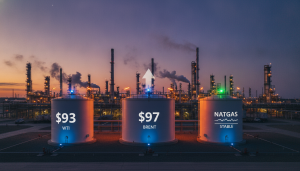
The global crude market currently finds itself at a critical juncture, navigating a complex interplay of escalating geopolitical tensions in the Middle East and persistent macroeconomic headwinds. While the specter of supply disruption from Iran looms large, threatening to inject a significant risk premium, broader demand uncertainties and central bank policy paths are creating a countervailing force, leading to a mixed outlook for energy investors. OilMarketCap’s proprietary data pipelines reveal a market grappling with these divergent pressures, where near-term supply concerns are balanced against a recent downtrend and questions about future demand elasticity.
Iran Risk Elevates Supply Concerns, Brent Price Responds
The Middle East remains a powder keg, with geopolitical developments centering on Iran posing an undeniable threat to global oil flows. As the third-largest producer within OPEC, Iran’s strategic position, particularly its proximity to the Strait of Hormuz, means any escalation carries immediate and profound implications for crude supply. Nearly one-fifth of the world’s oil transits this vital chokepoint, making it a focal point for market anxiety. While supply flows have demonstrably remained uninterrupted, the market is already pricing in a significant risk premium. Analysts widely caution that any direct targeting of oil infrastructure or interference with shipping lanes could instantly tighten supply, sending prices sharply higher.
As of today, Brent Crude is trading at $94.94, marking a marginal increase of 0.16% within a daily range of $91 to $96.89. This level reflects the heightened geopolitical premium, though it is important to note the market has seen significant fluctuations. Panmure Liberum estimates a full-blown supply event or disruption in the Strait of Hormuz could propel Brent past the $100 per barrel threshold. This scenario, once considered speculative, is now a tangible risk given the region’s volatility and the strategic significance of these maritime routes. Investors are keenly watching for any signs of operational disruption, as this would trigger an immediate and substantial re-rating of supply risk.
Brent Curve Flags Near-Term Tightness Amid Broader Price Declines
Despite the daily fluctuations, a deeper look at the Brent futures curve signals an underlying tightness in prompt supply. The front-month Brent contract’s premium over six-month futures has recently hit a six-month high, a clear indication of near-term supply fears dominating the immediate market outlook. This backwardated structure suggests traders are willing to pay more for immediate delivery than for future barrels, reinforcing the perception of constrained supply in the present.
However, this near-term tightness exists within a broader context of recent price declines. OilMarketCap’s 14-day Brent trend data reveals a significant pull-back, with prices falling from $102.22 on March 25th to $93.22 on April 14th — a substantial 8.8% reduction. This trend underscores the “mixed” nature of the current market, where geopolitical risks are being offset by other factors, preventing a sustained upward surge. The psychological $80 threshold, once seen as a significant hurdle, has been comfortably surpassed in recent weeks, yet the market struggles to maintain consistent upward momentum. Analysts caution that a sustained move into the $80-$100 range could begin to strain consumer demand and squeeze corporate margins globally, potentially limiting further upside.
Macroeconomic Headwinds and Investor Demand Concerns Create a “Delay”
The counter-narrative to escalating supply risk comes from persistent macroeconomic headwinds and the dampening effect on global demand. Rising oil prices invariably fuel inflation concerns, complicating the policy paths for major central banks. RBC estimates suggest that oil at $75 per barrel could push U.S. inflation forecasts up by 0.5%, a scenario that would undoubtedly complicate the Federal Reserve’s monetary policy decisions. Similarly, in Europe, inflation gauges are ticking higher, reigniting fears of renewed price pressures and potentially delaying any dovish pivots from the ECB.
This macroeconomic uncertainty forms the essence of the “delay” factor in the market. Investors are keenly asking for a base-case Brent price forecast for the next quarter and the consensus 2026 Brent forecast, reflecting deep concerns about the sustainability of demand amidst potential economic slowdowns. Our proprietary data shows significant investor interest in how Chinese “tea-pot” refineries are performing this quarter, highlighting the critical role of Asian demand in the global balance. Any significant slowdown in key consumption hubs, exacerbated by tight monetary policy or broader economic uncertainty, could put a ceiling on crude prices, creating a challenging environment for a sustained rally despite supply-side risks.
Navigating the Next Fortnight: Key Catalysts for Crude Prices
Looking ahead, the market will be closely watching a series of upcoming events that could significantly influence crude price dynamics over the next two weeks. On April 17th and again on April 24th, the Baker Hughes Rig Count will offer insights into North American drilling activity, providing an early signal for future supply. However, the most critical events for investors are undoubtedly the OPEC+ meetings: the Joint Ministerial Monitoring Committee (JMMC) on April 18th and the Full Ministerial Meeting on April 20th.
These gatherings will be pivotal in determining the group’s production policy and their response to both geopolitical tensions and evolving demand forecasts. Given the current market volatility and the recent price movements, any signals regarding output cuts or increases will have an immediate impact. Furthermore, the weekly API Crude Inventory reports on April 21st and 28th, followed by the EIA Weekly Petroleum Status Reports on April 22nd and 29th, will provide crucial updates on U.S. supply-demand balances. These inventory figures, often highly reactive to market sentiment, will offer a granular view of immediate market tightness or looseness. Investors are advised to monitor these events closely, as they will provide tangible data points to inform their forward-looking price forecasts and strategic positioning.