

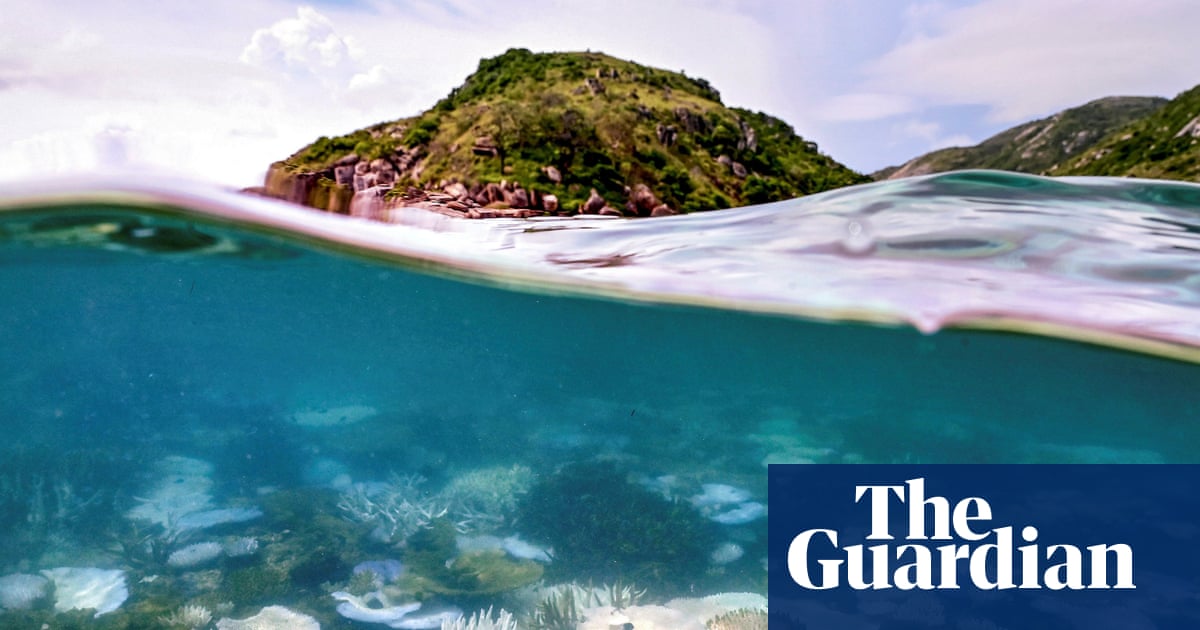
The earth has reached its first catastrophic tipping point linked to greenhouse gas emissions, with warm water coral reefs now facing a long-term decline and risking the livelihoods of hundreds of millions of people, according to a new report.
The report from scientists and conservationists warns the world is also “on the brink” of reaching other tipping points, including the dieback of the Amazon, the collapse of major ocean currents and the loss of ice sheets.
But some experts have questioned the report’s claims about the fate of coral reefs, with one saying while they are in decline there is evidence they could remain viable at higher temperatures than suggested.
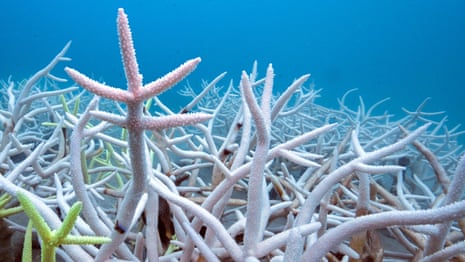
Tipping points are recognised by scientists as moments when a major ecosystem reaches a point where severe degradation is inevitable.
The world’s coral reefs are home to about a quarter of all marine species but are considered one of the most vulnerable systems to global heating.
“Unless we return to global mean surface temperatures of 1.2C (and eventually to at least 1C) as fast as possible, we will not retain warm-water reefs on our planet at any meaningful scale,” the report says.
Reefs at tipping point
Coral reefs have been in the midst of a global bleaching event since January 2023 – the fourth and worst on record – with more than 80% of reefs in more than 80 countries affected by extreme ocean temperatures. Scientists say the event has pushed reefs into “uncharted territory”.
The Global Tipping Points report, led by the University of Exeter and financed by the fund of the Amazon owner, Jeff Bezos, includes contributions from 160 scientists from 87 institutions in 23 countries.
It estimates that coral reefs hit a tipping point when global temperatures reach between 1C and 1.5C above where they were in the latter half of the 19th century, with a central estimate of 1.2C. Global heating is now at about 1.4C.
Without rapid and unlikely cuts to greenhouse gases, the upper threshold of 1.5C would be hit in the next 10 years, the report says.
“We can no longer talk about tipping points as a future risk,” said Prof Tim Lenton at the University of Exeter’s Global Systems Institute. “The first tipping of widespread dieback of warm water coral reefs is already under way.”
He said this was already impacting hundreds of millions of people who depend on reefs. The report points to reefs in the Caribbean, where marine heatwaves, low diversity and disease outbreaks have pushed reefs “towards collapse”.
However, Prof Peter Mumby, a leading coral reef scientist at the University of Queensland in Australia, said he accepted reefs were in decline but there was emerging evidence corals could adapt with some reefs remaining viable even at 2C of global heating.
He said coral reefs needed “aggressive” action on climate change and improved local management, but he was concerned some would interpret the report as saying coral reef habitats were heading for collapse, which was a position he did not support.
He said he was worried society would “give up on coral reefs” if people think they can no longer be saved.
Sign up to Clear Air Australia
Adam Morton brings you incisive analysis about the politics and impact of the climate crisis
Privacy Notice: Newsletters may contain information about charities, online ads, and content funded by outside parties. If you do not have an account, we will create a guest account for you on theguardian.com to send you this newsletter. You can complete full registration at any time. For more information about how we use your data see our Privacy Policy. We use Google reCaptcha to protect our website and the Google Privacy Policy and Terms of Service apply.
after newsletter promotion
Dr Mike Barrett, the chief scientific adviser at WWF-UK and co-author of the report, said it “demonstrates that conservation of reefs is now more critical than ever. The game has changed and the response has to be really urgent.”
He said there were some coral reefs that were known as refugia – places where climate impacts were not as pronounced – and protecting these places was paramount.
“We have to make sure we have the seeds of recovery for a future world where we have managed to stabilise the climate,” he said.
Dr Tracy Ainsworth, the vice-president of the International Coral Reef Society, said in many places reef ecosystems were changing and were either no longer dominated by corals, or were losing diversity.
“The future of coral reefs is one of transformation, ecosystem restructure and new challenges,” she said. “Our challenge now is to understand how all of these different ecosystems are reorganising and how we can ensure they continue to support diverse marine life and communities.”
In a statement, the Australian Institute of Marine Science said interpretation of global figures “should be taken with care” for two reasons – they masked significant regional variability and global temperatures had not stabilised “indicating there remains a narrow window of opportunity to act”.
Earth entering a ‘danger zone’
Lenton said parts of the west Antarctic ice sheet and the Greenland ice sheet were “looking perilously close” to their tipping point, as they were losing ice at an accelerating rate. Loss of ice that is still attached to the land causes sea levels to rise.
“We are going to overshoot 1.5C of global warming probably around 2030 on current projections,” Lenton said.
“This puts the world in a greater danger zone of escalating risk of further damaging tipping points.”
The Amazon – under pressure from the climate crisis and deforestation – was closer than previously thought to reaching a tipping point, he said.
The report does offer some hope, saying there are likely “positive tipping points” in society – such as with electric vehicle adoption – that could also have runaway effects to rapidly reduce greenhouse gas emissions.
“The race is on to bring forward these positive tipping points to avoid what we are now sure will be the unmanageable consequences of further tipping points in the Earth system,” Lenton said.
