

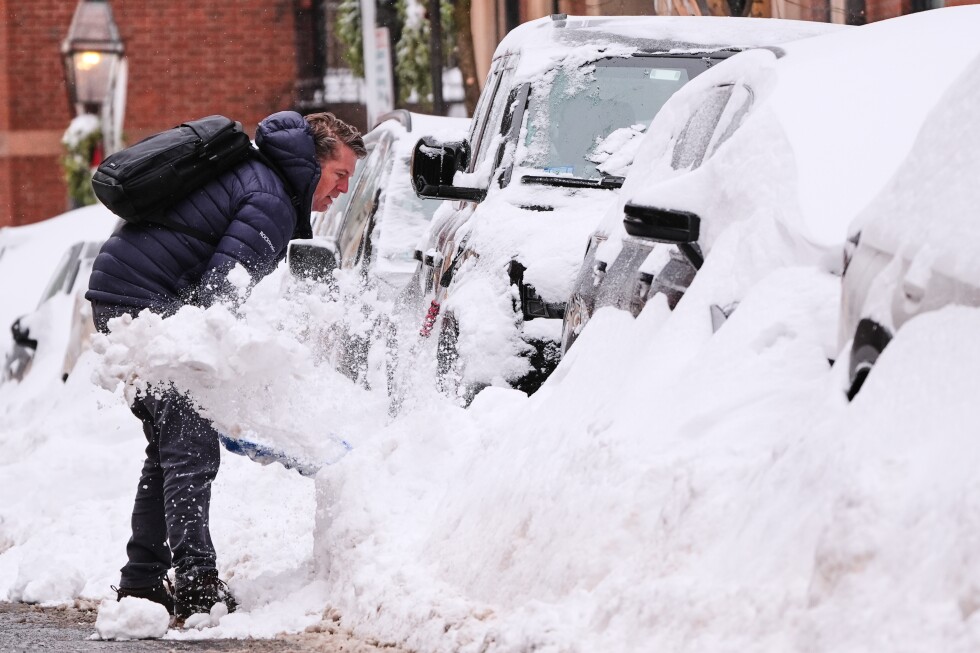
For big parts of the United States, the past few days have brought lots of snow and lots of cold. Where there’s snow and cold, there are slips, falls and ice-related injuries.
Authorities, first responders and medical professionals say that by following some common-sense rules, many of those problems can be reduced or avoided altogether.
From slowing down while driving on slick roads to imitating the slow, shuffling walk of penguins to never assuming lake ice is thick enough, changing behavior can keep people out of hospital emergency rooms.
“If there’s ice, there’s a risk,” said Dr. Robert Wahl, vice chief of Emergency Medicine at DMC Huron Valley-Sinai Hospital in Commerce Township, Michigan.
Southeastern Michigan, along with much of the eastern U.S., have been in a deep freeze for about a week as extreme cold followed by snowfall and plunging temperatures has left streets, driveways, parking lots and sidewalks hazardous.
Walk like a penguin
Wahl says that when people tumble outdoors on ice, emergency rooms typically see three major groups of injuries: closed-head, outstretched hand and wrist injuries, and hip injuries.
Closed-head injuries really can be problematic, especially for the older adults, while outstretched hand injuries from trying to break a fall are painful, but most don’t require surgery, Wahl said.
“Broken hips. Those 100% need surgery,” he said.
Dr. Alexander Cotter of the Center for Spine and Orthopedics in Denver, advises adopting the “penguin protocol” of a small, shuffling gait while leaning forward to keep your center of gravity low.
“People all the time think that if you slip it’s not going to be a big deal,” he said. “You’re in a rush, looking at your phone and all of sudden you slide. If you’re waddling, taking it slow you’re going to be safer.”
Cotter specializes in physical medicine and rehabilitation, and pain management. When falling, he says people should try not to fall on their outstretched hands to avoid serious injuries to joints like elbows and rotator cuffs.
“Stay hands-free,” he said. “Think about tucking your chin down to protect your head. Leaning forward helps prevent the backwards fall. With forward falls, a lot of times you can take it on your shoulder.”
Wearing shoes or boots with tread and traction and limiting the amount of items you carry should be considered, too.
“Maybe not trying to be a superhero and taking everything (in) at one time,” Cotter said. “When you hurry, that’s when you get injured. Be aware of what you’re doing no matter what is going on. It’s common sense stuff and not the fault of any one person to not think of these things.”
Avoid thin lake ice
Just prior to the current arctic blast, with daytime temperatures close to freezing and nighttime lows near or below zero degrees Fahrenheit (minus-17 Celsius), the Oakland County, Michigan, sheriff’s office already was busy on a few of the county’s 450 lakes.
The county borders Detroit to the north and northwest.
“Before the cold snap we had done six ice calls in nine days — people through the ice or animals through the ice,” Sheriff Mike Bouchard said Tuesday. “No ice should be considered safe just because we’ve had a few cold days or because you’ve measured in one spot.”
It’s more about what you can’t see, according to Bouchard.
“There are currents under the ice. There could be springs under the ice that melts it in one spot,” he said. “We’ve recovered two snowmobiles through the ice this year and saved two people out of a situation where they could have died.”
They’ve also seen animals perish. “We remind people if there’s an animal on the ice, even a family pet, running out there doesn’t help the pet and it certainly doesn’t help you.”
Bouchard said that people walking, fishing or riding snowmobiles on the ice should measure the ice thickness in the area where they plan to be and not assume the thickness will be the same in all spots.
Take proper weather and safety equipment, he added.
“Have ice awls in your pocket to pull yourself out of the water,” he said. “When you’re back on the ice, stay flat. You need to distribute your weight.”
Slower is safer on icy roads
When driving conditions deteriorate during a winter storm, it is important to take your time and not be in a rush, according to Kansas City Battalion Chief Riley Nolan.
“The main thing is for people to have patience,” Nolan said. “Leave in plenty of time, don’t rush to anywhere you need to go.”
Nolan also suggests making sure you bring some rock salt, a small shovel, extra warm layers of clothing that cover your hands and face to keep yourself warm if your vehicle gets stuck in snow.
“If you do breakdown on the side of the road or have an incident, stay in your vehicle. Don’t get out and wander away. Stay with your vehicle, stay warm,” Nolan said adding it is important that if you are stuck and staying warm by running your vehicle, to make sure your exhaust pipe is clear to avoid the fumes from harming you.
AAA-The Auto Club Group spokeswoman Adrienne Woodland said its also important for motorists to compensate for reduced tire traction and the distance between your vehicle and the one in front of you.
“You definitely do not want to tailgate on snowy and icy roads,” she said. “You want to allow sufficient room for maintenance vehicles. And with snow plows, stay at least 200 feet (60.9 meters) back from them.”
—————————-
Williams reported from Detroit. Ingram reported from Kansas City, Missouri.
