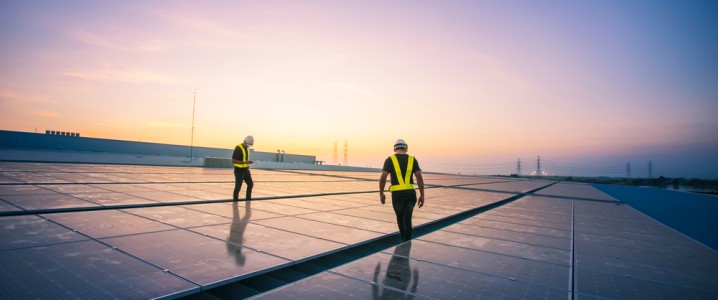
China’s Solar Policy Shift: A New Chapter for Energy Investment
The recent surge in shares of leading Chinese solar manufacturers in Shanghai signals a pivotal moment for the global energy investment landscape. Following reports of Beijing’s plans for stricter controls on the nation’s vast solar manufacturing capacity, companies like Trina Solar (SHA: 688599), JA Solar Technologies (SHE: 002459), and LONGi Green Energy Technology Co Ltd (SHA: 601012) saw their stock prices jump by over 9%, 9%, and 6.5% respectively. While ostensibly focused on renewable energy, this policy pivot by the world’s largest energy consumer holds profound implications for capital allocation across the entire energy complex, including traditional oil and gas. Investors must analyze this development not in isolation, but within the broader context of global energy demand, supply dynamics, and recent market volatility in crude markets.
Beijing’s Strategic Rationalization of Solar Manufacturing
China’s authorities are moving decisively to address the systemic issue of overcapacity within its clean technology industries, particularly solar. For too long, unbridled expansion has led to intense price wars, diminishing product quality, and substantial financial distress for manufacturers. The combined losses of six of China’s largest solar panel and cell producers doubled in the first half of 2025, reaching $2.8 billion (20.2 billion Chinese yuan), with all top equipment producers booking losses in the first quarter of 2025 alone. This unsustainable trajectory prompted a renewed governmental commitment, intensified since late 2024, to strengthen regulation and control over production capacity. The market’s positive reaction to these stricter measures suggests investors anticipate a healthier, more profitable sector moving forward. From a broader energy investment perspective, a more disciplined and profitable renewable energy sector could influence long-term demand forecasts for traditional fuels by fostering a more stable and predictable energy transition, rather than a chaotic, boom-and-bust cycle.
Crude Markets Under Pressure: A Broader Economic Read
This strategic shift in China’s industrial policy unfolds against a backdrop of significant volatility in crude markets. As of today, Brent Crude trades at $90.38, marking a sharp decline of 9.07% within the day, with a range between $86.08 and $98.97. Similarly, WTI Crude has fallen to $82.59, down 9.41%, oscillating between $78.97 and $90.34. Gasoline prices have also seen a drop to $2.93. This recent downturn is not an isolated event; Brent crude has experienced a substantial retreat over the past two weeks, moving from $112.78 on March 30 to its current level, representing a nearly 20% correction. This significant price depreciation reflects heightened global economic anxieties, which naturally impact energy demand outlooks. Investors are actively questioning the future trajectory of oil prices, as evidenced by frequent inquiries regarding predictions for oil per barrel by the end of 2026. China’s efforts to rationalize its industrial output, even in renewables, signal a broader drive for efficiency and stability in its economy, which invariably influences its overall energy consumption profile and, by extension, global crude demand.
Capital Allocation and Portfolio Resilience in a Dynamic Landscape
China’s move to impose order on its solar sector has direct implications for how capital is allocated across the energy spectrum. A more stable, less cutthroat renewable energy market in China could attract more measured institutional investment, potentially diverting some capital that might otherwise flow into traditional energy projects if renewables were perceived as excessively risky. For integrated energy companies, a common area of investor focus, this development is particularly pertinent. Questions from our readership about the performance outlook for companies like Repsol in April 2026 highlight the keen interest in how diversified energy players are adapting their portfolios. These companies must strategically balance their existing oil and gas assets with growing renewable energy segments. China’s policy signals a more mature phase of the energy transition, where efficiency and profitability are prioritized over sheer growth volume. This demands that oil and gas investors re-evaluate their risk models and consider how these macro-level policy shifts in major economies will reshape long-term energy demand and the competitive landscape for all energy sources.
Upcoming Catalysts: Shaping the Near-Term Outlook for Crude
The immediate future for crude markets will be heavily influenced by a series of critical events in the coming days. The OPEC+ Joint Ministerial Monitoring Committee (JMMC) Meeting on April 19, followed by the full OPEC+ Ministerial Meeting on April 20, are paramount. These gatherings will provide crucial insights into the cartel’s production strategy, especially vital given the recent sharp declines in crude prices and persistent reader questions about OPEC+’s current production quotas. Any decisions regarding supply adjustments will have a direct and immediate impact on market sentiment and price stability. Further guiding the market will be the API Weekly Crude Inventory reports on April 21 and April 28, complemented by the EIA Weekly Petroleum Status Reports on April 22 and April 29. These inventory data points offer a granular view of U.S. supply and demand dynamics, acting as key indicators of market balance. Additionally, the Baker Hughes Rig Count on April 24 and May 1 will shed light on future drilling activity and potential supply trajectories. Investors will be closely watching these catalysts to refine their near-term outlooks and adjust positions in a market grappling with both global economic uncertainty and strategic policy shifts from major energy players.


