China Solar Bust: Energy Sector Price War Risk
The global energy landscape is perpetually shifting, but few recent developments underscore the inherent volatility and cutthroat competition as starkly as the ongoing crisis within China’s solar manufacturing sector. What began as an ambitious drive for renewable dominance has devolved into a brutal price war, leading to staggering losses for key players. While the immediate impact is confined to the solar industry, the broader implications for the energy sector, particularly for oil and gas investors, cannot be overstated. This unfolding scenario serves as a potent reminder that even rapidly growing “green” technologies are not immune to the fundamental economic forces of supply and demand, and the lessons learned could ripple across the entire energy complex, potentially escalating price war risks in other segments.
The Solar Implosion: A Cautionary Tale of Overcapacity
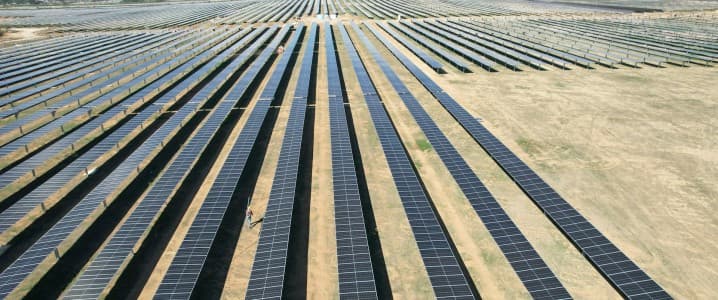
China’s solar equipment producers are reeling from an acute case of overcapacity, a phenomenon that has plunged the industry into a deep price war. The financial fallout is significant: six of China’s largest solar panel and cell manufacturers collectively reported a staggering $2.8 billion in losses during the first half of 2025. This figure represents a doubling of losses compared to the same period last year, signaling a rapid deterioration in market conditions. These companies had already posted losses for the first quarter, attributing their woes to persistently low product prices and ongoing trade and tariff disputes. For months, the China Photovoltaic Industry Association has warned of the urgent need for consolidation, recognizing that “disorderly price competition” was driving companies into a race to the bottom. Chinese authorities, after a period of observation, are now stepping up efforts to address this excess capacity. In July, the Ministry of Industry and Information Technology (MIIT) summoned executives from 14 leading solar firms, with Minister Li Lecheng explicitly calling for an end to price wars, the phasing out of outdated and underutilized capacity, and a strategic shift towards innovation and value-based competition. This concerted government intervention highlights the severity of the situation and underscores the perils of unchecked expansion, even in a sector deemed crucial for the energy transition.
Crude Markets React: A Glimpse at Current Dynamics
Despite the significant turbulence in the solar sector, crude oil markets are exhibiting their own set of dynamics. As of today, Brent crude trades at $98.34, registering a modest daily decline of 1.06%, while WTI sits at $90.02, down 1.26%. This current dip comes after a more significant downward trajectory over the past two weeks, with Brent moving from $108.01 on March 26th to $94.58 as recently as April 15th, a substantial 12.4% contraction. While the solar bust is not directly driving these crude price movements, it adds a layer of broader energy market uncertainty that investors must consider. The resilience of crude prices, even amid global economic headwinds and the ongoing energy transition narrative, speaks to persistent demand and geopolitical supply constraints. However, the precedent of a major energy commodity sector facing such severe price compression is a potent signal. It emphasizes that no energy segment is insulated from the forces of oversupply, and the potential for a “race to the bottom” can manifest across diverse energy types, albeit with different triggers and timescales.
Investor Pulse: Seeking Clarity Amidst Energy Transition Volatility
Our proprietary reader intent data reveals a heightened investor focus on core market fundamentals, with frequent queries about current Brent crude prices and OPEC+ production quotas. This intense demand for real-time market data and policy clarity is particularly telling in the context of the solar sector’s struggles. Investors are keenly aware that the energy landscape is becoming increasingly complex and volatile. The solar industry’s woes underscore that the “energy transition” is not a smooth, linear progression, but rather a dynamic process fraught with market imbalances and intense competition. For oil and gas investors, understanding the stability and drivers of crude prices, alongside the strategic decisions of major producers like OPEC+, becomes even more critical. They are seeking reliable anchors in a turbulent environment, hedging against potential shocks and re-evaluating long-term capital allocation strategies. The question of whether the “green premium” on renewables is eroding, and what that means for comparative investment attractiveness, is implicitly being asked as investors scrutinize these divergent energy sector performances.
Navigating the Next Fortnight: Key Catalysts for Crude Investors
The immediate horizon brings several crucial data points that will shape market sentiment, particularly in light of broader energy sector turbulence. The upcoming OPEC+ meetings are paramount: the Joint Ministerial Monitoring Committee (JMMC) convenes on April 18th, followed by the Full Ministerial meeting on April 20th. These gatherings will provide critical insights into production policy. Will the group maintain its cautious stance on supply, or could the broader instability in the energy complex, including the solar oversupply, influence a more conservative approach? Investors will be scrutinizing any signals regarding output levels, especially if there’s a perceived slowdown in global demand growth or an acceleration in the displacement of fossil fuels by increasingly cheap, albeit volatile, renewable energy. Furthermore, the weekly API and EIA crude inventory reports on April 21st/22nd and April 28th/29th will be closely watched. Any significant builds could amplify market concerns, especially if interpreted through the lens of a global energy market grappling with potential oversupply in various segments. Finally, the Baker Hughes Rig Count on April 17th and 24th will offer a forward-looking indicator of North American supply. Collectively, these events will provide vital clues for investors navigating the complex interplay between traditional energy markets and the broader, often tumultuous, energy transition.
Contagion Risk: Could Solar’s Bust Echo in Oil & Gas?
While solar panels do not directly substitute crude oil in many primary applications, the dramatic collapse in solar panel prices due to overcapacity creates a significant precedent for the entire energy sector. The psychological impact of a major energy commodity experiencing a severe price war is undeniable. It reminds investors that even rapidly growing, technologically advanced segments of the energy market are vulnerable to fundamental supply-demand imbalances, and that government-backed expansion can lead to market dislocations. For oil and gas, the risk lies not in immediate direct competition, but in the potential for an accelerated, indirect displacement of demand. If solar becomes extraordinarily cheap, it could further incentivize electrification in various sectors, potentially altering long-term oil demand forecasts more rapidly than anticipated. Moreover, the solar bust serves as a stark warning about the cyclical nature of all commodity markets. While oil and gas markets have their own unique geopolitical and economic drivers, the lesson from China’s solar sector is clear: unchecked supply growth, even for a “green” product, ultimately leads to price compression. Astute oil and gas investors must therefore integrate this broader energy market volatility into their risk assessments, recognizing that the dynamics of price wars, once unleashed in one part of the energy complex, can subtly influence expectations and capital flows across the entire spectrum.


