

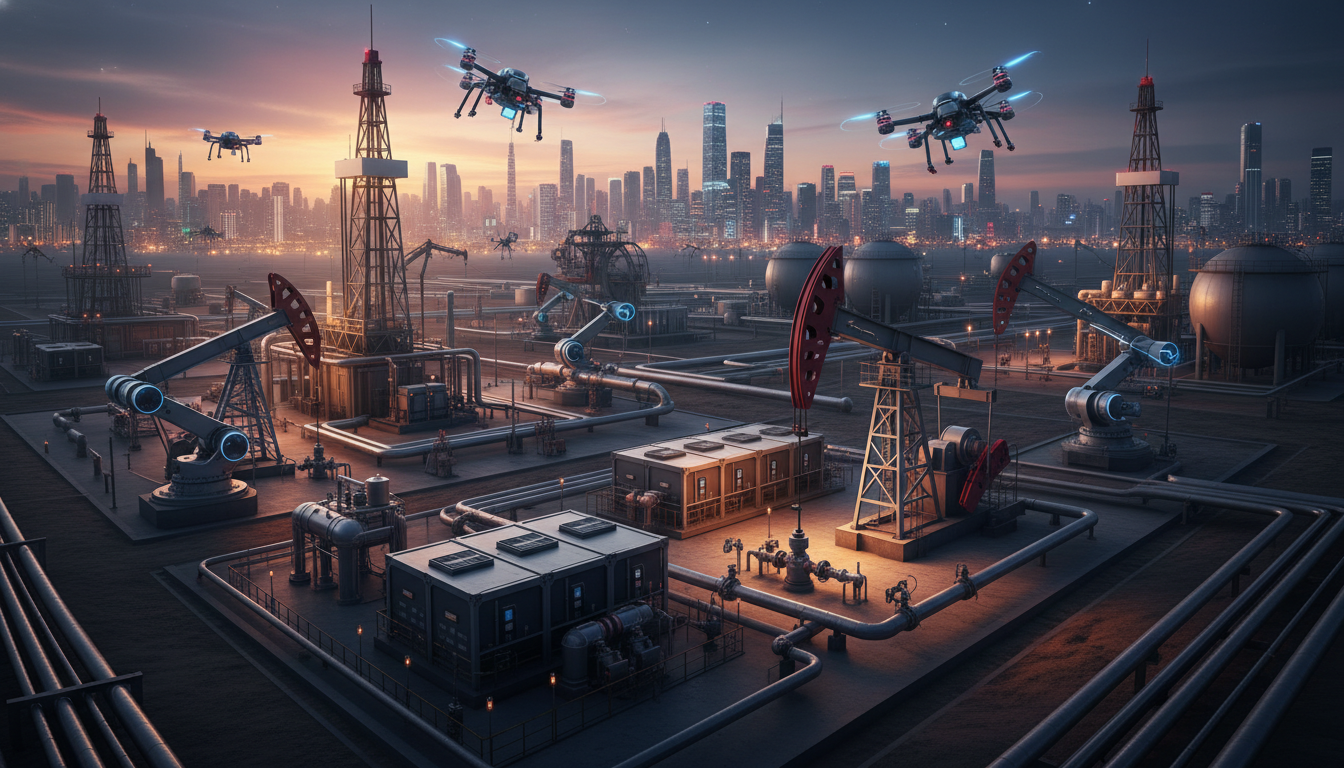
The Robotics Revolution: Why Oil & Gas Investors Must Monitor the AI Talent War
While the immediate focus of oil and gas investors traditionally centers on crude benchmarks, geopolitical shifts, and production volumes, a silent yet profound technological revolution is unfolding that demands increasingly keen observation. The global scramble for top-tier artificial intelligence (AI) talent, once confined to software giants, has now aggressively permeated the realm of robotics, signaling a fundamental shift in industrial automation that carries significant implications for the energy sector.
This escalating talent war, characterized by staggering compensation packages, underscores a rapid acceleration in the development and deployment of advanced robotics. For savvy energy market participants, understanding these dynamics is not merely an academic exercise; it’s critical for anticipating future operational efficiencies, capital expenditure trends, and long-term energy demand profiles across the vast oil and gas value chain.
China’s Aggressive Bid for Embodied Intelligence Leadership
A recent announcement from UBTech, a prominent Chinese humanoid robotics innovator, starkly illustrates the intensity of this global competition. The company, established in 2012, declared its intent to recruit a Chief Scientist specializing in “Embodied Intelligence,” offering an astonishing maximum salary of 124 million yuan, equivalent to approximately $18 million. This compensation package, ranging from 15 million to 124 million yuan ($2.2 million to $18 million), marks a decisive escalation in China’s strategy to attract elite research and development expertise.
While this figure might appear somewhat modest compared to the reported nine-figure paydays of up to $100 million seen in the fiercest talent battles between Silicon Valley titans like Meta and OpenAI, it nonetheless represents a significant departure for China’s rapidly expanding AI and robotics industries. Historically, Chinese tech firms have largely avoided such colossal payouts for scientific leadership. This aggressive move by UBTech signals a new era, indicating China’s explicit intent to dominate the next generation of industrial automation and intelligent machinery.
UBTech’s Vision: The Walker S2 and Industrial Integration
Headquartered in Shenzhen, UBTech has rapidly ascended to become one of China’s most recognized names in humanoid robotics. Its flagship creation, the 5-foot-9 Walker S2 humanoid robot, is engineered for autonomous operation, with a primary design focus on factory environments. Much like Tesla’s Optimus project, the Walker S2 is envisioned as a versatile tool capable of integrating into complex manufacturing processes. This industrial application directly resonates with the needs of the oil and gas sector, where automation promises enhanced safety and efficiency in hazardous or repetitive tasks.
Reinforcing its industrial ambitions, UBTech confirmed earlier this year a strategic agreement with Airbus to pilot its Walker S2 humanoids on factory production lines. This deployment not only validates the robot’s capabilities but also provides invaluable real-world data for further refinement. The newly sought Chief Scientist will be instrumental in accelerating UBTech’s expansion into diverse sectors, including manufacturing, service industries, and even “family companionship,” highlighting the broad applicability of advanced humanoid technology.
China’s Dominance in Humanoid Robot Deployment
The strategic importance of China’s push in robotics is further underscored by its commanding lead in deployment. Data from research firm Omdia reveals that nearly 90% of global humanoid robot shipments last year originated from Chinese enterprises. This impressive market share demonstrates not only robust manufacturing capacity but also a conducive ecosystem for the integration of cutting-edge robotics into commercial and industrial applications.
The public’s exposure to these innovations is also growing, with locally developed robots taking center stage at major national events. For instance, during China’s recent Spring Festival, a significant showcase for the nation’s technological prowess, humanoids from companies like Unitree captivated audiences with demonstrations of intricate kung-fu routines and acrobatics. This public visibility reinforces the scale of investment and the rapid pace of development.
Even Elon Musk, a key player in the autonomous robotics space, acknowledges the formidable competition emanating from China. In a January earnings call, Musk identified Chinese manufacturers as the primary rivals for Tesla’s Optimus robot, despite his expectation that Optimus, slated for mass production this year, will ultimately outperform any competing Chinese model. This acknowledgment from a visionary like Musk underscores the serious competitive landscape and the advanced state of Chinese robotics innovation.
Implications for Oil & Gas Investment and Operations
For investors deeply embedded in the oil and gas landscape, the accelerating robotics talent war and China’s strategic advancements are not peripheral news; they represent crucial indicators of future operational paradigms. The ability of humanoid robots to perform complex tasks autonomously carries immense potential for the energy sector:
- Enhanced Safety: Deploying robots in hazardous environments such as offshore platforms, remote pipeline inspections, or chemical processing plants could significantly reduce human exposure to risk, leading to fewer incidents and lower insurance costs.
- Operational Efficiency: Autonomous robots capable of continuous monitoring, routine maintenance, and precise task execution can lead to substantial gains in operational efficiency, reducing downtime and optimizing resource allocation across upstream, midstream, and downstream operations.
- Cost Reduction: Automation can drive down labor costs in specific, repetitive, or dangerous roles, allowing for a reallocation of human capital to more complex and strategic functions.
- Data Collection & Analytics: Robots equipped with advanced sensors can gather vast amounts of data in real-time, feeding into sophisticated AI systems for predictive maintenance, anomaly detection, and overall asset optimization, providing invaluable insights for energy market intelligence.
- Sustainability Goals: Optimized operations, reduced waste, and more efficient resource utilization driven by robotics can contribute significantly to environmental compliance and sustainability targets, which are increasingly important for securing capital in today’s energy investment climate.
Capital Flows and the Future Energy Landscape
The massive salaries offered in the AI and robotics sectors also highlight a broader shift in global capital allocation. Investors are pouring significant resources into these cutting-edge technologies, betting on their transformative potential across all industries. While traditional energy will always be fundamental, understanding where strategic investment is flowing provides insight into future competitive advantages and potential disruptions.
Moreover, the energy demands of a rapidly expanding robotic workforce and the AI infrastructure that powers it should not be overlooked. The vast computational power required for AI development and deployment, alongside the energy needed to manufacture, charge, and operate millions of robots, will exert new pressures on electricity grids and energy supply chains. This could create new demand drivers for reliable energy sources, potentially influencing future investment in both conventional and renewable energy projects.
Oil and gas entities that proactively integrate these robotics and AI advancements into their long-term strategies, embracing digital transformation to enhance their operational footprint, will be best positioned for sustained profitability and market leadership. The talent war in robotics is a leading indicator of an industrial future that will be fundamentally different, and the energy sector must be ready to adapt, innovate, and invest accordingly to secure its indispensable role in the evolving global economy.
