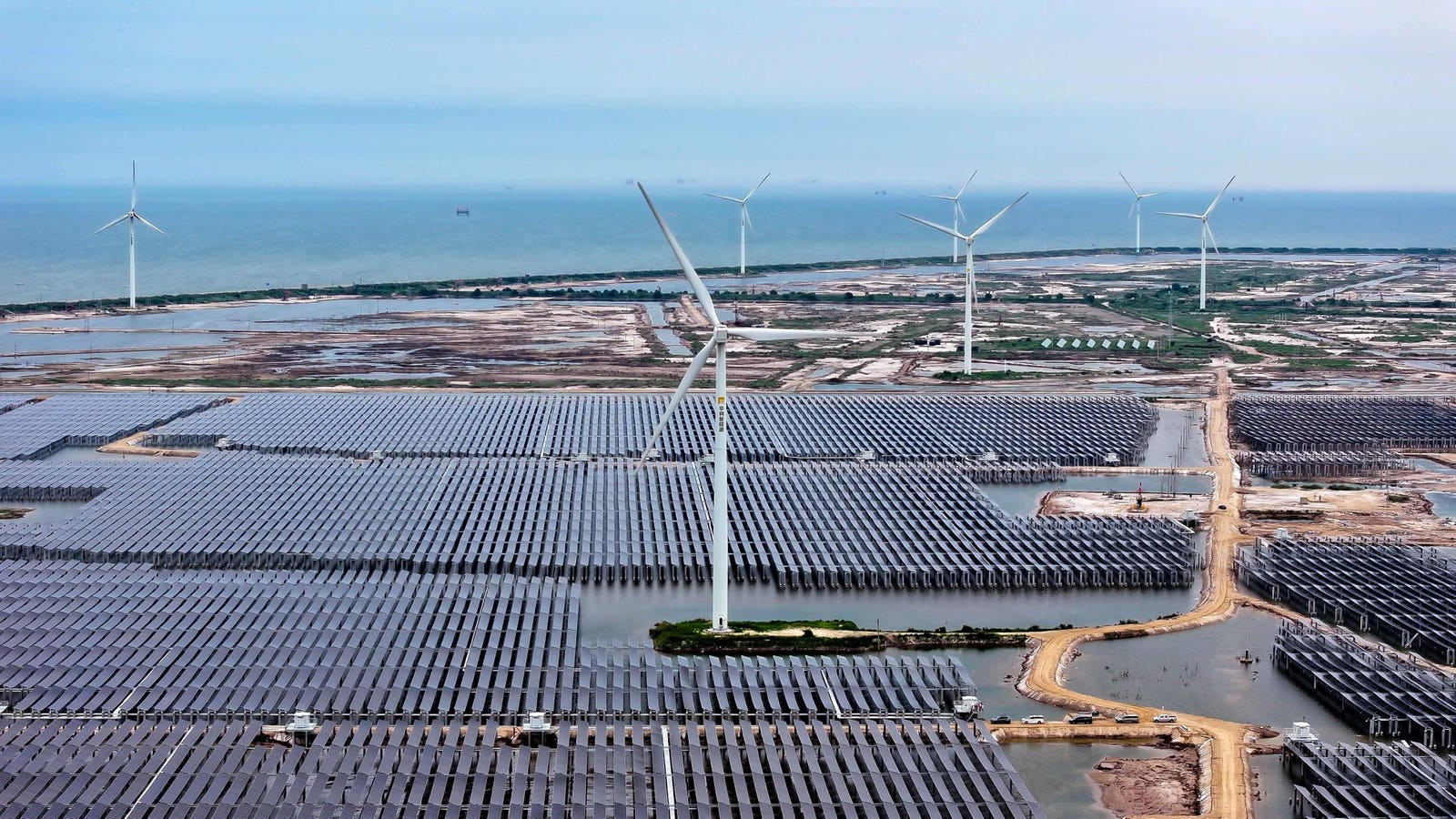
The global energy investment landscape is undergoing a profound transformation, challenging long-held assumptions about where value is generated and where future growth resides. While the concept of “American energy dominance” through fossil fuel expansion remains a potent political rallying cry, proprietary market data and shifting global demand patterns reveal a starkly different economic reality. China’s burgeoning clean energy technology exports are not just competitive; they are demonstrably outperforming U.S. carbon-based energy sales on the international stage, creating a critical divergence that investors in oil and gas can no longer ignore. This fundamental shift, coupled with recent market volatility, demands a re-evaluation of portfolio strategies to capitalize on emerging opportunities and mitigate risks.
The Evolving Global Energy Export Balance
For investors focused on the international trade of energy, the data paints a clear picture: the global appetite for clean technology is surging, and China is the dominant supplier. Through July of this year, Chinese exports of clean energy-related products reached an impressive $120 billion. This figure stands in stark contrast to the U.S., which exported just $80 billion in carbon-based energy during the same period. This isn’t an anomaly; it continues a trend established in 2024, when China’s clean energy exports totaled $180 billion, outpacing U.S. fossil fuel sales by $30 billion. The momentum is undeniable, with Chinese clean tech exports valued at $20.3 billion in August alone, suggesting the gap is widening further. This significant shift underscores a fundamental change in global energy demand, driven by the economic advantages of renewables, which are often cheaper and faster to deploy than traditional power sources. Indeed, the first half of 2025 saw additions of new solar and wind power become the fastest-growing source of electricity generation worldwide, surpassing coal for the first time.
Policy Reversals Impacting U.S. Clean Energy Competitiveness
While the global market for clean energy technology expands rapidly, U.S. domestic policy shifts are creating significant headwinds for American competitiveness. The current administration’s stance has seen billions of dollars in federal support for clean energy projects eliminated, directly reversing programs that previously stimulated a manufacturing boom across the United States. These earlier initiatives had attracted hundreds of billions of dollars in private investments and created hundreds of thousands of jobs, fostering new factories producing batteries, clean vehicles, and energy-efficient products. The withdrawal of these tax credits and other support mechanisms is now leading to project cancellations, job losses, and, paradoxically, rising utility bills for consumers, even as gasoline prices are slightly lower than a year ago. This policy environment risks pushing the U.S. further behind in what has been described as a “global arms race for clean energy jobs and investment,” diminishing the nation’s ability to compete with dominant players like China in this critical growth sector.
Navigating Crude Market Volatility Amid Key Events
Against the backdrop of these long-term energy transition trends, the traditional oil and gas market continues to present its own set of challenges and opportunities for investors. As of today, Brent Crude trades at $90.38, reflecting a significant -9.07% decline from its opening, with WTI Crude at $82.59, down -9.41%. This sharp downturn follows a notable -19.9% drop in Brent prices over the past 14 days, from $112.78 on March 30th to its current level. Gasoline prices have also seen a corresponding dip, now at $2.93, down -5.18%. This volatility is a constant feature of commodity markets, and investors must remain agile. Our proprietary event calendar highlights several immediate catalysts. Investors are keenly watching the upcoming OPEC+ Joint Ministerial Monitoring Committee (JMMC) meeting on April 19th, followed by the full Ministerial Meeting on April 20th. Any signals regarding production quotas or supply adjustments from these sessions will be critical in shaping short-to-medium term price trajectories. Furthermore, the API Weekly Crude Inventory (April 21st, 28th) and EIA Weekly Petroleum Status Report (April 22nd, 29th) will provide crucial insights into U.S. supply-demand dynamics, while the Baker Hughes Rig Count (April 24th, May 1st) will offer a pulse on drilling activity.
Investor Focus: Price Predictions and Future-Proofing Portfolios
Our proprietary reader intent data offers a direct window into the immediate concerns of our investor community. A primary query this week revolves around future price stability, with many asking: “what do you predict the price of oil per barrel will be by end of 2026?” This reflects a broader anxiety about market predictability given the current confluence of geopolitical factors, economic uncertainties, and the accelerating energy transition. While precise long-term forecasts are inherently challenging, the widening gap between U.S. fossil fuel exports and Chinese clean tech sales indicates a structural shift in global energy demand that cannot be ignored when projecting future crude prices. Strong interest in specific companies, such as “How well do you think Repsol will end in April 2026,” also highlights the need for investors to understand how individual entities are positioned within this evolving energy matrix. Companies with diversified portfolios, or those actively investing in lower-carbon solutions, may be better insulated from the long-term demand erosion facing purely carbon-intensive assets. Investors must consider not just short-term supply-demand balances, but also the increasing influence of clean energy on overall energy consumption patterns and the potential for a plateauing, or even declining, global demand for crude in the coming years.