

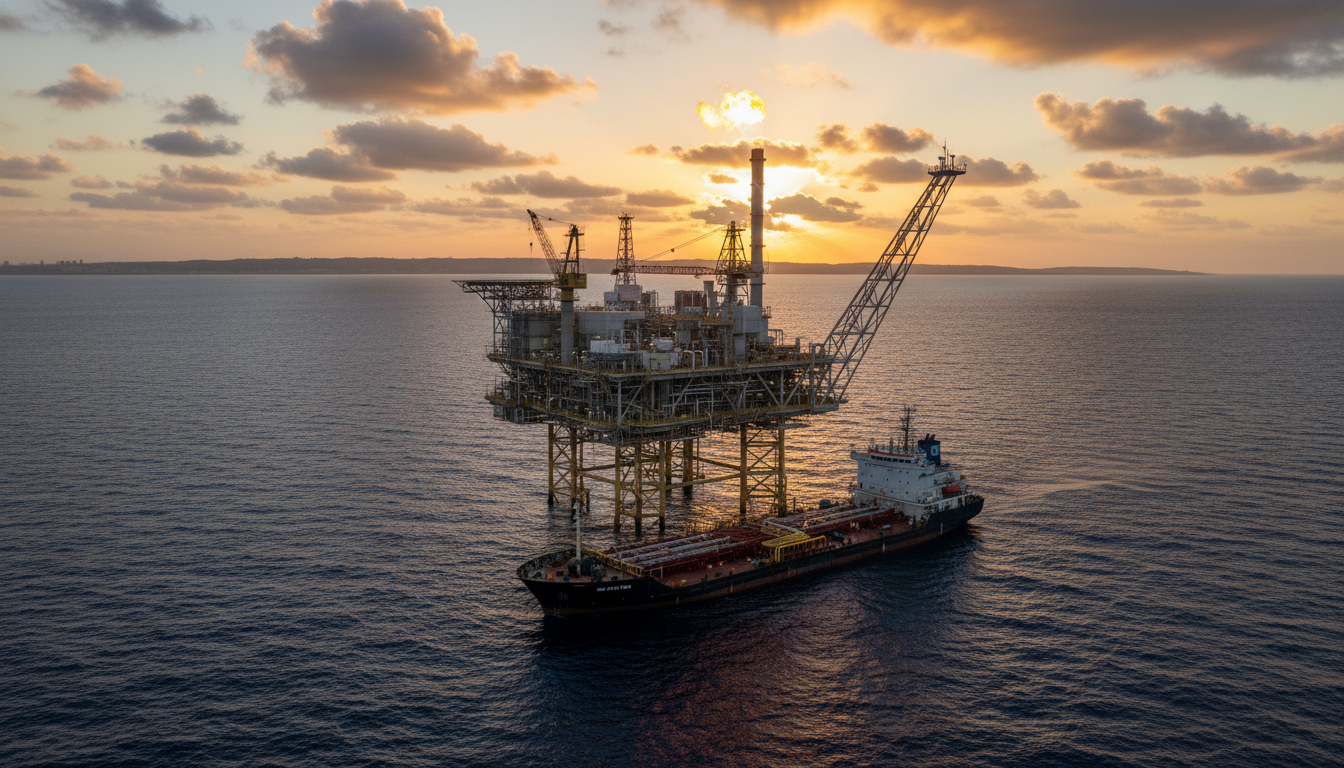
Leviathan Gas Field Restarts: A Testament to Regional Energy Resilience and Growth Potential
Chevron Corporation has successfully reinstated full production operations at the Leviathan natural gas and condensate field, located in the Eastern Mediterranean offshore Israel. This crucial restart comes weeks after the energy giant declared force majeure, a direct consequence of escalating regional geopolitical tensions. The resumption of flows, announced by consortium partner NewMed Energy LP, signals a vital return to stability for a critical energy asset that underpins regional supply and investor confidence.
The operational hiatus, prompted by a security recommendation from Israel’s energy and infrastructure minister on February 28, lasted a total of 33 days. During this period, the industry keenly watched for updates on one of the Mediterranean’s most significant gas reservoirs. NewMed Energy LP has indicated its intent to explore potential compensation from the State in connection with the production suspension, a common practice following such unforeseen events. Crucially, the Israeli partner has also communicated to investors that the temporary shutdown is not anticipated to materially impact its cash flow projections for 2026, offering a reassuring outlook on its financial resilience.
Strategic Infrastructure Enhancements Bolster Production Capacity
The successful restart is further underscored by significant infrastructure upgrades implemented concurrently with, and immediately preceding, the suspension. Just one day after confirming the production pause, NewMed Energy announced the completion of a third gathering pipeline connecting the Leviathan field to its offshore production platform. This project, a key component of Leviathan’s initial Phase 1A development, also incorporated platform enhancements, collectively boosting the field’s total gas production capacity to an impressive 14 billion cubic meters (BCM) annually.
The construction of this vital third pipeline had faced previous delays due to the conflict following Hamas’ October 2023 assault on Israel, with NewMed announcing a suspension of construction activities in October 2024. The consortium had originally targeted a mid-2025 completion for this phase. Despite these challenges, the ultimate delivery of this infrastructure expansion highlights the consortium’s commitment to enhancing Leviathan’s operational capabilities and securing long-term supply resilience in a volatile region.
Leviathan: A Pillar of Regional Energy Security
Leviathan gas plays an indispensable role in meeting domestic energy demand within Israel and serves as a pivotal export source for neighboring countries, including Egypt and Jordan. In the prior year, the field successfully delivered 10.8 BCM (381.4 billion cubic feet) of natural gas, as detailed in NewMed’s annual report. Its strategic significance in regional energy geopolitics cannot be overstated, providing a stable energy supply amidst complex political landscapes.
The Leviathan consortium comprises a powerful alliance of energy players. Chevron Mediterranean Ltd., a subsidiary of Chevron Corp., operates the field with a substantial 39.66 percent stake, leveraging its extensive global expertise. NewMed Energy LP, majority-owned by Israel’s Delek Group, holds a significant 45.34 percent interest, reflecting its deep commitment to the nation’s energy future. Completing the triumvirate is Ratio Energies LP, another Israeli entity, holding the remaining 15 percent.
Ambitious Growth Trajectory: Phase 1B and Beyond
Discovered in 2010 off the coast of Haifa, Leviathan commenced production in December 2019 under its initial Phase 1A development. The consortium is now vigorously pursuing ambitious expansion plans, with a strong focus on Phase 1B’s first stage. Last January, the partners made a Final Investment Decision (FID) committing $2.36 billion towards this next significant growth phase. This substantial investment underscores the long-term confidence in Leviathan’s reserves and market demand.
Phase 1B, Stage 1, is slated to begin operations in the second half of 2029. This strategic expansion is designed to elevate Leviathan’s total production capacity to approximately 21 BCM per year, representing a substantial increase that will further solidify its position as a major global gas supplier. Investor optimism is further bolstered by the fact that Israel’s Energy and Infrastructures Ministry had already granted approval for Phase 1B in August 2025, providing regulatory certainty for this multi-billion-dollar project.
Cementing Regional Export Partnerships: The Expanded Egypt Deal
Beyond its domestic and existing export commitments, Leviathan is also expanding its international footprint through enhanced agreements. Coinciding with the FID for Phase 1B Stage 1, NewMed Energy confirmed the fulfillment of all conditions for an amended agreement with its current Egyptian customer, Blue Ocean Energy. This revised deal, initially announced by NewMed in August 2025, marks a significant milestone, committing to raise gas exports to Egypt by an additional cumulative volume of 130 BCM.
Further demonstrating robust governmental and regulatory backing, the Leviathan consortium received official approval from Israel’s Energy and Infrastructures Ministry for these increased gas exports to Egypt in December 2025. This series of approvals and investment decisions paints a clear picture of a resilient and expanding operation, strategically positioned to capitalize on rising regional and global demand for natural gas.
Investor Takeaway: Resilience Amidst Volatility
The prompt resumption of operations at the Leviathan field, coupled with ongoing capacity expansion projects and strengthened export agreements, sends a powerful message to investors. Despite the inherent geopolitical risks of the Eastern Mediterranean, Chevron and its partners have demonstrated robust operational resilience and a steadfast commitment to long-term growth. For those tracking global energy assets, Leviathan represents a compelling investment narrative, balancing immediate operational stability with significant future growth potential in a gas-hungry world.
