Conflicting Oil Demand Forecasts Create Market Volatility for Investors
Global oil markets are currently navigating a landscape of significant uncertainty, with major forecasting agencies presenting starkly divergent outlooks for crude demand growth in the coming year. This disparity, particularly between producer-led organizations and independent analysts, creates a complex environment for energy investors grappling with future price trajectories and strategic allocation decisions.
Recent projections highlight this divide. The International Energy Agency (IEA) has revised its global oil consumption growth forecast downwards, now anticipating an increase of just 700,000 barrels per day (b/d). This adjusted figure represents the slowest growth rate since 2009, excluding the unprecedented disruptions of the coronavirus pandemic, a notable cut from its previous estimate of 720,000 b/d. Echoing a more conservative stance, the US Energy Information Administration (EIA) also released its short-term outlook, projecting an 800,000 b/d increase in oil consumption for 2025, offering a slightly more optimistic, yet still cautious, perspective.
In sharp contrast, the OPEC+ alliance, which collectively accounts for approximately 40 percent of the world’s crude oil supply, maintains a considerably more bullish outlook. The cartel forecasts global oil demand to expand by 1.3 million b/d this year, a view publicly reinforced by Saudi Aramco chief executive Amin Nasser at a recent OPEC seminar in Vienna. This significant difference in projections underscores a fundamental disagreement on the underlying strength of global energy consumption.
Historical Inaccuracies and Political Undercurrents in Demand Projections
Scrutiny of past forecasts reveals a recurring pattern of inaccuracies from both sides, suggesting that these projections are not purely data-driven but may carry inherent biases. For instance, in December 2023, OPEC+ initially predicted a robust 2.2 million b/d growth in oil demand for the subsequent year. However, this figure underwent multiple downward revisions, ultimately settling at an estimated annual growth of 1.6 million b/d by the close of 2024. Similarly, the IEA, in March 2024, initially projected a 1.2 million b/d increase for 2024, only to reduce that estimate to approximately 1 million b/d by mid-year.
While precise oil demand modeling remains an intricate challenge, the persistent and substantial divergence between these major forecasts raises questions about political motivations. While OPEC+ leadership has often criticized the IEA for perceived political leanings, market observers generally recognize that the producer group possesses a more direct financial interest in promoting higher demand figures, given its mandate to manage global supply and prices to the benefit of its member states. This “skin in the game” dynamic means investors must critically evaluate all forecasts, understanding the potential for strategic messaging within the numbers.
Market Implications: OPEC+ Cuts and Price Pressure
The discrepancy in demand outlooks carries profound implications for crude oil prices, particularly as OPEC+ embarks on unwinding 2.2 million b/d of its long-standing production cuts. The cartel’s rationale for this move is predicated on the belief that the global market can comfortably absorb the additional supply. However, if the more conservative demand forecasts from the IEA and EIA prove accurate, the market could face a significant surplus in the latter half of the year.
Most market participants and analysts anticipate that if demand fails to materialize at OPEC+’s projected levels, this surplus supply will exert considerable downward pressure on prices. Some analysts are already forecasting a scenario where Brent crude, the international benchmark, could fall below $60 per barrel in the fourth quarter. Such a price decline would have substantial financial repercussions for upstream producers, impacting revenue, profitability, and future capital expenditure decisions. Investors are therefore closely monitoring these demand forecasts, recognizing their direct influence on commodity valuations and the overall health of the oil and gas sector.
Canada’s “Grand Bargain” on Oil: A Shifting Investment Landscape
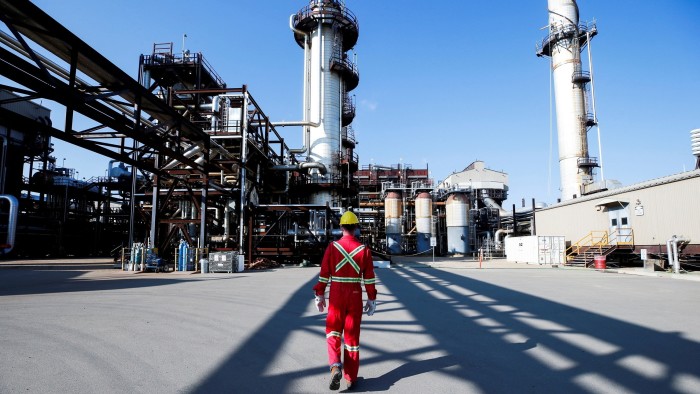
Shifting focus to North America, Canada’s ambitious attempt to redefine its relationship with the vital Alberta oil industry faces considerable headwinds. Prime Minister Mark Carney’s initiative, dubbed the “grand bargain,” aimed to reset Ottawa’s engagement with the sector, but it has encountered a rocky start. The endeavor arrives years after Carney entered office with a promise to elevate Canada to an “energy superpower,” a vision partly spurred by the protectionist trade policies and tariffs enacted by the US administration under President Donald Trump.
However, the promised collaboration has quickly devolved into a stand-off, primarily centered on contentious climate policy and the critical question of who will bear the financial burden for achieving “decarbonized oil.” This dispute highlights the inherent tension between Canada’s significant oil and gas reserves and its national climate commitments. For energy investors, this evolving dynamic in Canada is crucial. The lack of clarity and consensus between the federal government and the major producing province of Alberta introduces regulatory uncertainty, which can deter new capital investment and impact the long-term viability of existing projects.
The success, or failure, of Carney’s “grand bargain” will significantly shape the investment climate for Canadian energy assets. Clarity on climate policy frameworks, carbon pricing mechanisms, and government support for decarbonization technologies will be paramount for attracting and retaining investment in one of the world’s largest oil-producing nations. Investors seeking exposure to Canadian oil and gas must carefully weigh these political and policy risks alongside traditional market fundamentals, as the nation navigates its path towards a more sustainable, yet still energy-rich, future.