

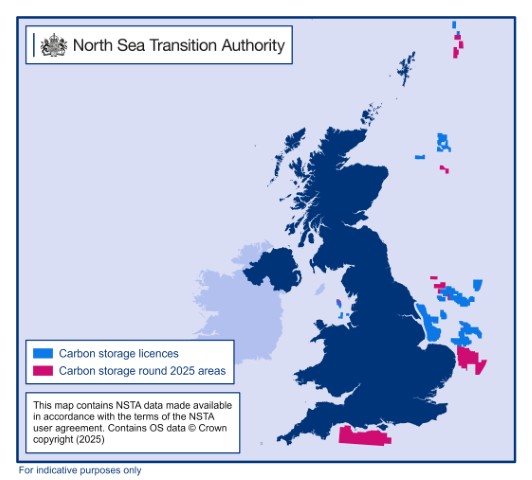
The areas which will be offered fall into two broad categories – depleted hydrocarbon fields selected by the NSTA – and saline aquifer sites identified following a ‘Call for Nominations’ which earlier this year enabled industry partners to indicate sites of interest which offered a greater chance of successful project delivery.
These areas were chosen following extensive consultation with The Crown Estate and Crown Estate Scotland, among others. Five areas will be in Scottish waters, with nine off the coast of England. Successful applicants for a carbon storage licence from the NSTA will require a seabed agreement from either Crown Estate Scotland or The Crown Estate in English waters, before a project can progress.
The Licensing Round will run until Tuesday 24 March 2026 after which applications will be reviewed with a view to awarding licences in early 2027.
Gus Jaspert, Managing Director, Marine at The Crown Estate, said, “Carbon capture is vital in supporting hard to abate industries to decarbonise and a core element of the UK’s energy transition. We have worked with the NSTA to ensure the interests of other vital sectors including offshore wind, aggregates, cables and nature were considered. We look forward to continuing to work together and collaborating through our Marine Delivery Routemap programme as we evolve our approach to seabed leasing for carbon capture and storage to support the sector’s development.”
The NSTA will continue to work with both Crown Estate Scotland and The Crown Estate to explore opportunities to align licensing and leasing approaches in order to streamline application processes for developers.
Th UK’s first carbon storage licensing round in September 2023 saw the award of 21 carbon storage licences. The NSTA subsequently awarded the first storage permits to two projects – Endurance and HyNet – allowing them to proceed towards first injection.
The Endurance site, off the coast of Teesside, which could store up to 100 million tonnes of CO2, received a permit in December 2024, and Liverpool Bay-based HyNet, which could also store up to 100 mt CO2 over 25 years, received three permits in April 2025.
The projects, funded from the UK’s government’s commitment of up £21.7bn, could contribute around £5 billion per year of gross value to the UK economy by 2050 and create 50,000 jobs long-term.
Ronan O’Hara, Chief Executive of Crown Estate Scotland, said, “CCS is an increasingly well-established process with the potential to play a key role in reducing carbon dioxide emissions, especially in hard to abate industries, which is why we are pleased to be working closely with CCS developers, the North Sea Transition Authority, The Crown Estate and governments to ensure that deployment is co-ordinated to make the most of Scotland’s unique geological storage and to provide new economic opportunities for Scotland and the wider UK by inviting expressions of interest alongside NSTA licence applications.”
Offshore Energies UK welcomed the news, OEUK’s Head of Energy Policy, Enrique Cornejo, said, “The UK has 78 gigatons of carbon storage – the largest in Europe. This gives us a huge opportunity to cut emissions, meet our climate goals, and create high-quality jobs. With decades of expertise in the oil and gas sector, we already have the skills and infrastructure to make this a success.”
“Right now, only a handful of projects are connected to storage sites, and delays mean we’re not fully using the capacity we have. Over 100 licences will ultimately be needed to meet net zero, and it is vital existing licences have a clear route to market. Moving faster to match carbon storage with emitter needs will not only secure the UK’s leadership in Europe but also drive significant investment and job growth across our industrial regions.”
“CCS isn’t just about cutting emissions, it’s about securing the future of UK industry, supporting regional growth, and positioning Britain as a global leader in clean technologies. This is a once-in-a-generation opportunity we can’t afford to miss.”
.jpg)
Carbon Storage licence round (new areas shown in red)
