
Close Menu
  • Home
  • Market News
    • Crude Oil Prices
    • Brent vs WTI
    • Futures & Trading
    • OPEC Announcements
  • Company & Corporate
    • Mergers & Acquisitions
    • Earnings Reports
    • Executive Moves
    • ESG & Sustainability
  • Geopolitical & Global
    • Middle East
    • North America
    • Europe & Russia
    • Asia & China
    • Latin America
  • Supply & Disruption
    • Pipeline Disruptions
    • Refinery Outages
    • Weather Events (hurricanes, floods)
    • Labor Strikes & Protest Movements
  • Policy & Regulation
    • U.S. Energy Policy
    • EU Carbon Targets
    • Emissions Regulations
    • International Trade & Sanctions
  • Tech
    • Energy Transition
    • Hydrogen & LNG
    • Carbon Capture
    • Battery / Storage Tech
  • ESG
    • Climate Commitments
    • Greenwashing News
    • Net-Zero Tracking
    • Institutional Divestments
  • Financial
    • Interest Rates Impact on Oil
    • Inflation + Demand
    • Oil & Stock Correlation
    • Investor Sentiment

Subscribe to Updates

Subscribe to our newsletter and never miss our latest news

Subscribe my Newsletter for New Posts & tips Let's stay updated!

What's Hot

How ‘Heated Rivalry’ Took Over the Internet

January 15, 2026

Woodside, JERA Finalize Winter LNG Deal for Japan

January 15, 2026

India’s Coal Output Jumped 3.6% in December

January 15, 2026
Facebook X (Twitter) Instagram Threads
Oil Market Cap – Global Oil & Energy News, Data & Analysis
  • Home
  • Market News
    • Crude Oil Prices
    • Brent vs WTI
    • Futures & Trading
    • OPEC Announcements
  • Company & Corporate
    • Mergers & Acquisitions
    • Earnings Reports
    • Executive Moves
    • ESG & Sustainability
  • Geopolitical & Global
    • Middle East
    • North America
    • Europe & Russia
    • Asia & China
    • Latin America
  • Supply & Disruption
    • Pipeline Disruptions
    • Refinery Outages
    • Weather Events (hurricanes, floods)
    • Labor Strikes & Protest Movements
  • Policy & Regulation
    • U.S. Energy Policy
    • EU Carbon Targets
    • Emissions Regulations
    • International Trade & Sanctions
  • Tech
    • Energy Transition
    • Hydrogen & LNG
    • Carbon Capture
    • Battery / Storage Tech
  • ESG
    • Climate Commitments
    • Greenwashing News
    • Net-Zero Tracking
    • Institutional Divestments
  • Financial
    • Interest Rates Impact on Oil
    • Inflation + Demand
    • Oil & Stock Correlation
    • Investor Sentiment
Oil Market Cap – Global Oil & Energy News, Data & Analysis
Home » Carbon Capture Journal
Carbon Capture

Carbon Capture Journal

omc_adminBy omc_adminNovember 17, 2025No Comments4 Mins Read
Share
Facebook Twitter Pinterest Threads Bluesky Copy Link


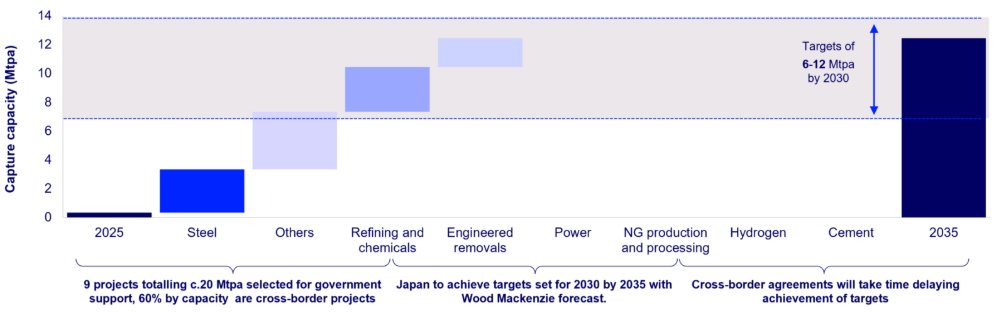
Japan’s CCUS sector is entering a rapid expansion phase, with capacity projected to surge from current demonstration levels of 0.3 Mtpa to nearly 12.5 Mtpa by 2035, according to Wood Mackenzie. This 30-fold increase positions Japan at the forefront of Asia-Pacific’s industrial decarbonisation efforts. 


However, achieving full government targets will require accelerated development of cross-border storage partnerships. Wood Mackenzie forecasts Japan will reach its 2030 targets by 2035, with cross-border agreements requiring additional time to finalise. 


Japan’s capture capacity build up 


Source: Wood Mackenzie Lens Carbon 


Note: Engineered removals predominantly include Direct Air Capture (DAC) and Bioenergy and carbon capture, utilisation and storage (BECCS) today. Others include projects covered under sectors like paper and pulp, ethanol and other industrial sectors to name a few. 


Cross-border collaboration key to Japan’s CCUS ambitions 


Japan’s CCUS development is increasingly driven by industrial applications, particularly in hard-to-abate sectors like steel, petrochemicals. Among the nine advanced Carbon Capture and Storage (CCS) projects shortlisted by the government, totalling over 20 million tons per year (Mtpa) of potential capacity, nearly 60% of this capacity relies on international cross-border storage partnerships.   


“Cross-border collaboration is not just an option, but a necessity, even though 2035,” said Hetal Gandhi, Lead – CCUS, Asia Pacific at Wood Mackenzie. “While there are countries well positioned in terms of storage policy and project pipeline, costs challenges remain for cross border carbon transport. For instance, transporting captured emissions from Japan domestically versus to Australia could cost 7–9 times more. However, early movers securing the right storage fields and partnerships could limit overall cost increases to around 15–20%. Bilateral agreements will be a critical area to watch as nations race to achieve competitive advantage.” 


Policy framework strengthens commercial viability 


Japan now ranks second in Asia Pacific for CCUS policy readiness, trailing only Australia, according to Wood Mackenzie’s Policy Readiness Index. The country scores particularly strongly on two key parameters: the quantum and specificity of CCUS targets, and access to low-cost funding. 


Japan’s legislated net-zero targets and robust storage regulatory regime position it alongside global leaders. The transition of Japan’s GX ETS from voluntary to mandatory status, combined with fuel tax levy implementation, is creating stronger economic incentives for CCUS adoption across industrial sectors. 


Cross-border transport is the next frontier 


The emergence of cross-border CO2 transport represents a transformative trend, particularly relevant for Japan’s island geography. Wood Mackenzie has developed a new assessment framework evaluating country readiness for cross-border CO2 transport across six parameters, from CCUS infrastructure foundations to regionally traded carbon pricing. The analysis shows Japan is well-positioned to lead this emerging market segment, with potential storage partnerships under discussion with Australia, Indonesia, and Malaysia. 


However, cost challenges remain significant. Transport costs from Japan to Australia could be 7-9 times higher than domestic transport. Early-mover advantages and strategic partnerships could limit overall cost increases to 15-20%, but bilateral agreements will be critical to establishing competitive frameworks. 


Gandhi added “multiple storage hubs in the Asia-Pacific region are developing capabilities specifically designed for cross-border services. Japan’s early-mover positioning in bilateral agreements and strategic partnerships will be critical to securing advantaged storage access.” 


Investment requirements and government support 


According to Wood Mackenzie, Japan will require at least USD 10 billion in government support for CCUS implementation through 2050, assuming carbon prices reach USD 69 per unit by mid-century. This support is essential given the current profitability landscape for CCUS projects globally. 


Analysis of 200 CCUS projects across multiple geographies shows that even best-in-class incentives and emissions trading system (ETS) revenues often fall short of covering full project costs when considered individually. Successful project economics require “stacking” multiple support mechanisms: combining capital and operational grants, tax incentives, ETS revenues, and potential product premiums for low-carbon materials. Focus on lowering cost is also important. 


“Japan’s focus on high-value industrial applications and technology development will need to create pathways to commercial viability that go beyond basic carbon pricing,” Gandhi concluded. “The integration of domestic innovation with strategic cross-border partnerships will be key to optimize the value equation.” 


Source link

Share. Facebook Twitter Pinterest Bluesky Threads Tumblr Telegram Email
omc_admin
  • Website

Related Posts

Carbon Capture Journal

January 14, 2026

Carbon Capture Journal

January 6, 2026

Carbon Capture Journal

December 30, 2025
Add A Comment
Leave A Reply Cancel Reply

Top Posts

Citigroup must face $1 billion lawsuit claiming it aided Mexican oil company fraud

July 1, 20077 Views

LPG sales grow 5.1% in FY25, 43.6 lakh new customers enrolled, ET EnergyWorld

May 16, 20255 Views

Trump’s 100 days, AI bubble, volatility: Market Takeaways

December 16, 20075 Views
Don't Miss

BP Sees Up To $5B Impairments Tied to Low Carbon Assets

By omc_adminJanuary 15, 2026

BP PLC said Wednesday it expects to book $4-5 billion in write-downs primarily related to…

Virtual auctions aim to bring transparency to oil and gas royalty markets

January 14, 2026

Oilfield services jobs edge lower to close 2025, EWTC data shows

January 14, 2026

Eco Atlantic engages Guyana on Orinduik Block licence continuation

January 14, 2026
Top Trending

EPA to stop calculating money and lives saved by curbs on air pollution | Trump administration

By omc_adminJanuary 14, 2026

Salesforce Signs Deals to Purchase Carbon Removal from 19 Early-Stage Suppliers

By omc_adminJanuary 14, 2026

EU Financial Regulators Release Guidelines for Integrating ESG Risks Into Stress Tests

By omc_adminJanuary 14, 2026
Most Popular

The 5 Best 65-Inch TVs of 2025

July 3, 202510 Views

The Layoffs List of 2025: Meta, Microsoft, Block, and More

May 9, 202510 Views

‘Looksmaxxing’ on ChatGPT Rated Me a ‘Mid-Tier Becky.’ Be Careful.

June 3, 20257 Views
Our Picks

Woodside, JERA Finalize Winter LNG Deal for Japan

January 15, 2026

MidOcean Energy in Talks to Join Argentina LNG

January 15, 2026

Oil Slips After Trump Signals Iran De-Escalation

January 14, 2026

Subscribe to Updates

Subscribe to our newsletter and never miss our latest news

Subscribe my Newsletter for New Posts & tips Let's stay updated!

Facebook X (Twitter) Instagram Pinterest
  • Home
  • About Us
  • Advertise With Us
  • Contact Us
  • DMCA
  • Privacy Policy
  • Terms & Conditions
© 2026 oilmarketcap. Designed by oilmarketcap.

Type above and press Enter to search. Press Esc to cancel.