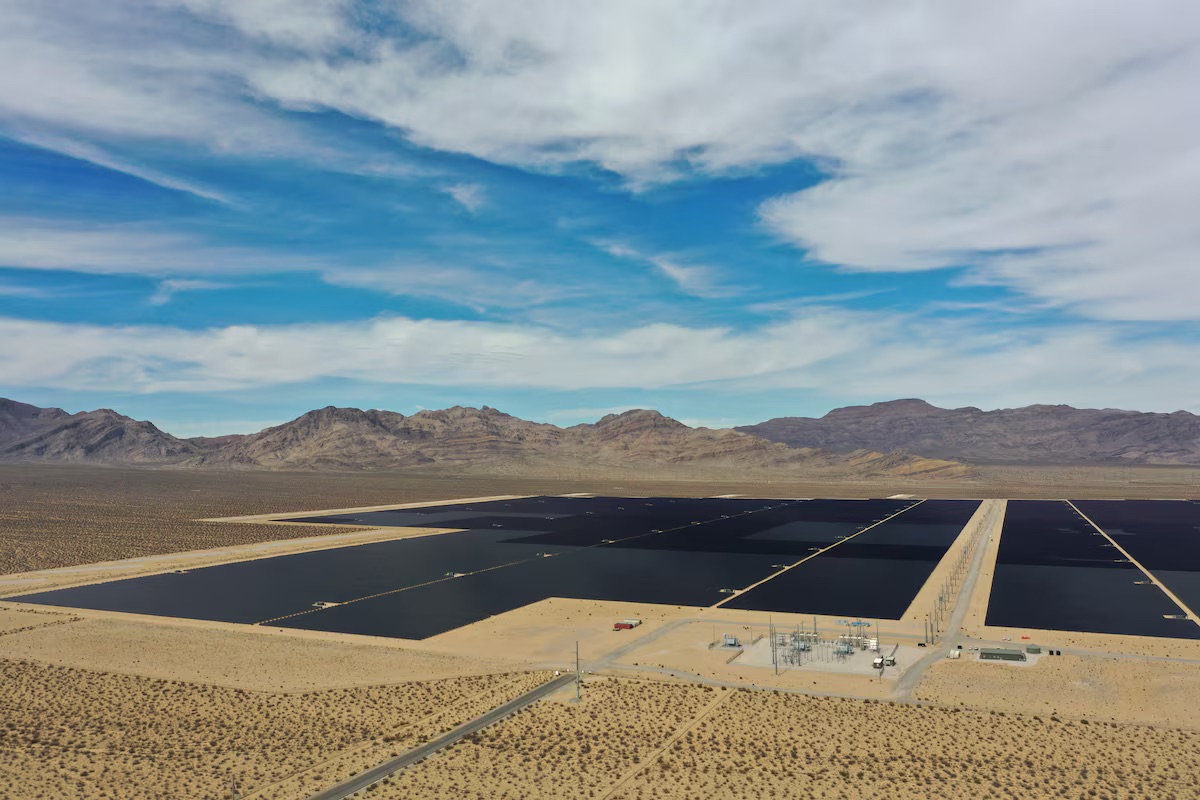
Although overshadowed so far by booming data center demand and the U.S. government’s gutting of clean energy policies, California’s rapid scaling of solar farms and battery systems may yet emerge as 2025’s most significant power story.
California’s mammoth solar farms have generated more electricity than the state’s fossil fuel power plants for a record-long stretch so far in 2025, setting a new marker for energy transition progress in the United States.
Topped up by batteries charged by excess solar output in the middle of the day, the swell in California’s solar-powered electricity supplies has triggered the state’s largest-ever year-over-year drop in fossil fuel-fired power output.
California’s electricity output from solar power vs fossil fuels
Even after years of historic growth, the jumps in California’s solar and battery system output are remarkable, and will likely act as blueprints for power roadmaps in other states even as U.S. federal lawmakers scrap support for clean energy.
CLEAN PUSH
California’s electricity supplies from solar farms during January to July jumped by 15% from the same months in 2024 to a record 54,709 gigawatt hours (GWh), Ember data shows.
That year-over-year jump of roughly 7,200 GWh of solar electricity supplies was supplemented by a roughly 75% rise in California’s battery storage capacity, according to LSEG, and allowed utilities to slash fossil fuel-fired generation by 21%.
In terms of the share of California’s electricity generation mix, solar farms accounted for a record 39% of total utility-supplied generation during January to July, up from 33% during the same period in 2024.
For comparison, the state of Texas, which has the second-largest solar power footprint in the U.S., secured 10.4% of its electricity from solar farms so far this year.
California’s electricity output from solar power vs fossil fuels during January to July
As the solar share of California’s electricity mix has climbed, the electricity generation share from fossil fuels has steadily fallen and hit new lows of just 26% so far in 2025.
That compares to a national average fossil fuel share of 55% so far in 2025, and cements California’s position as by far the leading state in terms of clean electricity deployment.
CRITICAL MASS
California’s utilities have rapidly built out capacity of battery storage systems alongside solar power output since 2022, so that the state’s abundant solar power can be deployed to maximum effect.
In previous years, California’s power system was frequently overrun by the massive solar output levels generated during the middle of the day, which was when solar output peaked just as total state power consumption neared its daily lows.
Thanks to a nearly threefold rise in battery storage capacity since 2022 to more than 14,000 megawatts (MW), according to data portal Cleanview, California’s utilities can now store some of that excess solar output and deploy it when demand peaks.
FOSSIL FALLS
The growing scale of California’s solar plus battery networks is allowing utilities to scale back fossil fuel reliance at an unprecedented pace.
Historically, California’s use of fossil fuels peaked during the summer when use of power-hungry air conditioners is highest.
Thanks to rapidly rising solar and battery capacity, however, California’s utilities have been able to make major cuts to fossil fuel deployment even during peak demand periods.
California’s seasonal electricity output from solar power vs fossil fuels
In July 2025, total fossil fuel electricity output was just 36,416 GWh, according to Ember.
That total marked a 40% plunge from July 2024, and was 36% below the July average from 2019 through 2024.
Such a steep drop in fossil generation had a commensurate impact on associated emissions, which in July 2025 were 2.1 million metric tons of CO2 less than in July 2024, and by far the lowest for that month on record.
PRICED IN?
Following the years-long retooling of California’s power system in favour of clean energy over fossil fuels, the state’s electricity costs are starting to reflect the hefty impact of solar power within its generation mix.
While still sharply above the national average, California’s electricity costs have climbed by less than the national average so far this year, posting a 1% rise compared to a 3.3% rise nationally, according to the U.S. Energy Information Administration.
Going forward, the price-depressing impact of the hefty share of solar power within California’s generation system is expected to act as a drag on overall electricity costs, even as power bills are expected to keep climbing elsewhere.
California’s high levels of solar radiation and abundant areas of sparsely populated desert also mean the state is better positioned than most to deploy solar farms at massive scale.
Even so, several other U.S. states across the South and Southwest can expect similar cuts to fossil fuel reliance if they also rolled out large solar and battery systems.
And with supplies of solar and battery systems steadily rising just as system costs steadily decline, state utilities that can pull the trigger on expansions to solar and battery systems can expect quick returns on their investments.
At the same time, with benchmark U.S. natural gas prices this year averaging around 37% more than 2024’s levels, according to LSEG, states that can cut use of natural gas can expect significant savings in their fossil fuel purchase bills.
Few other states can match the scale of California’s solar and battery networks, but those that are looking to cut back on fossil fuel dependence and boost output of clean, home-grown power will use the Golden State as a guide.
The opinions expressed here are those of the author, a columnist for Reuters.
Enjoying this column? Check out Reuters Open Interest (ROI), your essential new source for global financial commentary. ROI delivers thought-provoking, data-driven analysis of everything from swap rates to soybeans. Markets are moving faster than ever. ROI can help you keep up. Follow ROI on LinkedIn and X.