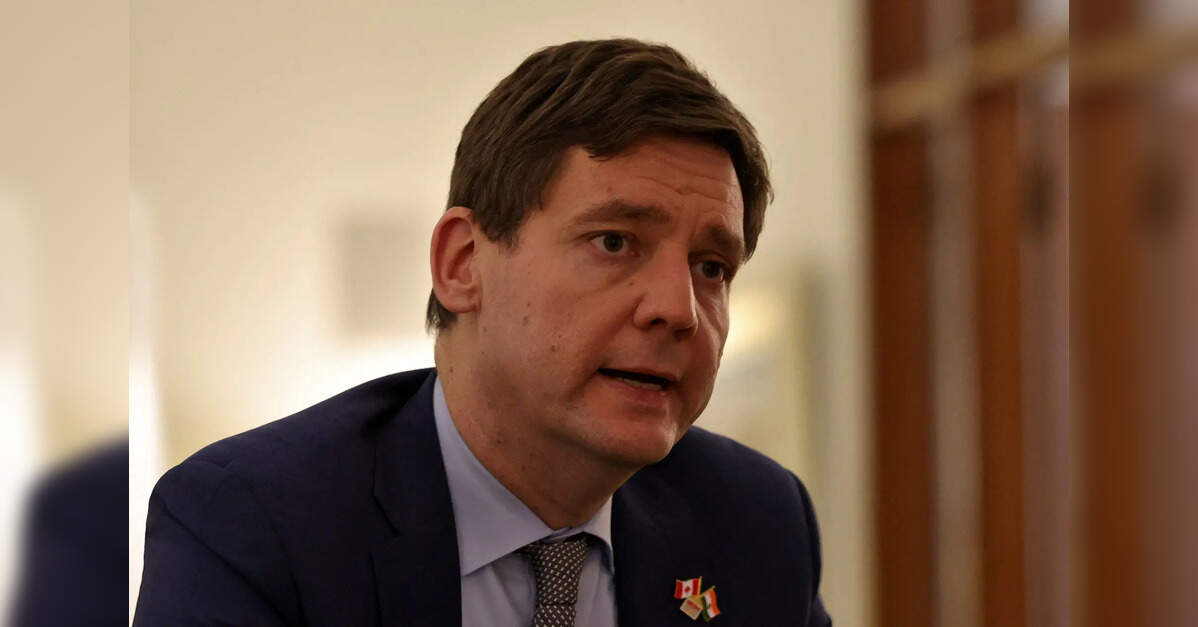
New Delhi: India and British Columbia have a shared interest in energy such as liquefied natural gas and hydrogen, life sciences and critical minerals including copper and nickel, said the Canadian province’s premier David Eby.
Eby, who is leading a trade mission to India from January 12-17, told ET in an interview that the province is trying to develop more opportunities with India to diversify trade, which has been hit by the US tariffs.
Asked whether the efforts to develop more opportunities with India are part of a trade diversification strategy in view of the US tariffs, he said, “I don’t know if they say in India, but the elephant in the room is obviously the United States.”
The US has imposed 50 per cent tariffs on India and 35 per cent on Canada, but the tariffs don’t apply to goods compliant with the US-Mexico-Canada Agreement on trade.
“And particularly our soft wood sector has been very hard hit by tariffs that are in excess of 50 per cent, in some cases. For some companies, that has resulted in significant impact, loss of jobs and reduced revenue for forestry companies. Another product that we are promoting here is Canadian wood,” Eby told ET, adding that the delegation led by him, will discuss opportunities related to furniture and construction.
“Many of the companies that we’re talking with also have a strong desire to diversify their trading relationships and reduce their exposure to the US. It’s a very significant market that can’t be entirely replaced, but if we can reduce our dependence, we’ll be better off,” he said.
Canada is interested in selling its agricultural products but it does not seek to displace any domestic producers here. Rather, it is keen to supplement and ensure that food security is achieved in India for the growing population, he said.
These issues will come up in the India-Canada free trade agreement (FTA) talks, which are expected to restart next month.
On the FTA, Eby said: “Our understanding is that the work is happening in the background on the FTA with India, and we’re certainly very hopeful. We’ve seen India sign agreements with many other countries and (the one) with the EU upcoming, we hope and certainly that would assist with trade between British Columbia and India, even just to have certainty for exporters and importers about what the rules are, for the medium and long term would be very helpful.”
British Columbia, he said, buys a lot of processed food and packaged food from India.