

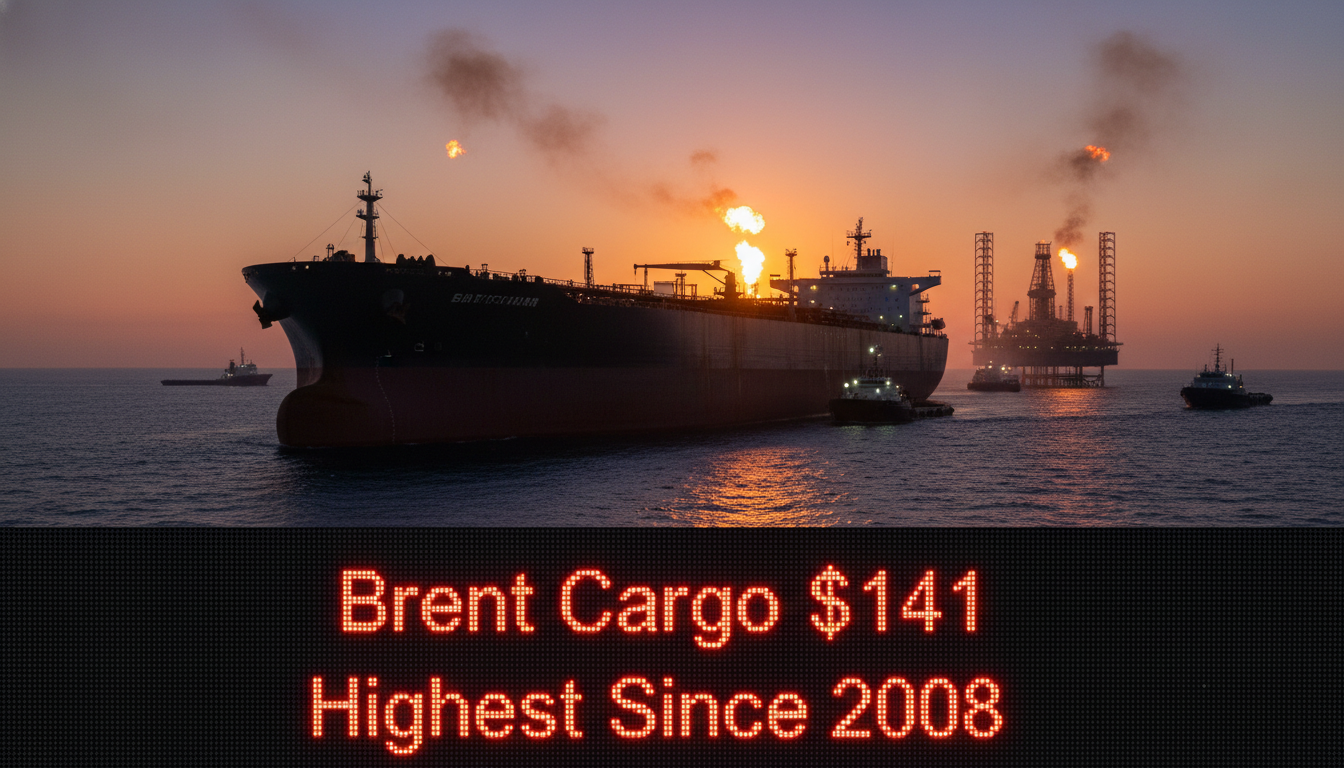
Investors tracking the global energy landscape witnessed a significant surge in the physical crude oil market this week, signaling profound underlying supply challenges. The spot price for immediate physical cargoes of Brent crude rocketed to $141.36, a level not seen since the peak volatility of the 2008 financial crisis. This dramatic ascent, meticulously tracked by industry data providers, underscores an acute tightness in global oil inventories, driven by critical geopolitical developments.
The price for Brent crude, slated for delivery within the next 10 to 30 days, serves as a crucial barometer for the real-time demand-supply balance. Its current elevation points directly to a severe scarcity of readily available physical crude, exacerbated by the substantial disruption stemming from Iran’s decision to close the Strait of Hormuz. This choke point is a vital artery for global oil shipments, and its constraint immediately reverberates through the supply chain, impacting immediate access to barrels.
Compounding the urgency of the physical market, a striking divergence has emerged between spot prices and their futures counterparts. The June delivery contract for Brent crude futures concluded Thursday at $109.03. This creates an unprecedented spread of $32.33 between the cost of oil needed now and oil projected for delivery in a few months. Such a significant premium for immediate supply signals a market under intense pressure, where buyers are willing to pay considerably more for prompt barrels than for forward commitments.
Unpacking the Spot-Futures Disparity
The substantial difference between the immediate spot price and the futures contracts presents a critical analytical challenge for energy investors. On one hand, the futures market, often perceived as a forward-looking indicator, appears to suggest a degree of future normalization or at least a less dire situation than the present. However, leading experts are cautioning against complacency. Amrita Sen, a prominent founder in energy market analysis, articulated this concern, noting that the futures pricing structure might be “almost giving a false sense of security that things are not that stressed.” She emphasized that “the financial market is almost masking the true tightness that everywhere else is showing up.” This commentary highlights a potential disconnect where financial instruments, by their nature, might not fully capture the immediate, tangible strain on physical supply chains.
For savvy investors, this disparity demands careful scrutiny. It suggests that while the broader market sentiment reflected in futures might anticipate a future easing, the current reality of immediate demand outstripping available supply is creating immense upward pressure on physical crude. This dynamic can have profound implications for refiners needing prompt feedstocks, for national strategic reserves considering replenishments, and for any entity requiring immediate access to crude oil to maintain operations. The market is effectively signaling a scramble for barrels today, a condition that often precedes broader price adjustments across the entire curve.
The Immediate Crisis: Strait of Hormuz Impact
The strategic importance of the Strait of Hormuz cannot be overstated in the context of global oil flows. As a narrow maritime passage connecting the Persian Gulf to the open ocean, it facilitates the transit of a significant portion of the world’s crude oil. Its closure, as seen in the current scenario, creates an immediate and undeniable bottleneck that reverberates across the entire energy complex. The disruption is not theoretical; it directly impedes the movement of millions of barrels of oil that would otherwise be destined for global markets, especially those reliant on Middle Eastern supply.
This physical impedance translates directly into the soaring spot prices we observe. When major shipping routes are compromised, the logistical challenges become immense, and the cost of securing alternative supplies, or even continuing with existing commitments, escalates dramatically. Buyers requiring oil within the 10-to-30-day window are facing severely constrained options, leading to competitive bidding that drives prices for these prompt deliveries to historic highs. The Strait of Hormuz situation, therefore, is not merely a geopolitical headline; it is a tangible impediment to the physical flow of oil, directly influencing the immediate availability and cost of crude globally.
Financial Markets Underestimating Physical Stress?
The warnings from industry titans further underscore the potential for financial markets to misinterpret or lag the severity of physical market disruptions. Mike Wirth, CEO of a major integrated energy company, publicly cautioned last week that the prevailing futures prices were not adequately reflecting the true scale of the oil supply disruption instigated by the Strait’s closure. Speaking at a prominent industry conference in Houston, he stated unequivocally that the market was operating on “scant information” and primarily guided by “perception” rather than the hard realities of physical supply constraints.
Mr. Wirth’s direct assessment highlighted the significant gap between abstract financial trading and the tangible challenges faced by companies managing real crude oil flows. He elaborated that “very real, physical manifestations of the closure of the Strait of Hormuz are working their way around the world and through the system that I don’t think are fully priced into the futures curves on oil.” This perspective is crucial for investors. It suggests that while trading screens might offer one outlook, the operational ground truth – the actual movement, availability, and cost of physical barrels – tells a far more urgent story. An underestimation of these physical realities could lead to greater market volatility and upward price corrections in the futures market as it eventually aligns with the physical tightness.
Broader Economic Repercussions: The Diesel Dilemma
The impact of tightening crude supply extends far beyond headline oil prices, deeply penetrating refined product markets and, by extension, the broader economy. A stark example of this is the current price of diesel in Europe, which has escalated to nearly $200 per barrel. Diesel is not just a fuel for personal transportation; it is the lifeblood of global commerce, powering trucking fleets, shipping vessels, industrial machinery, and agricultural equipment. Such an exorbitant price for this critical fuel directly translates into increased operational costs for virtually every sector of the economy.
For investors, this elevation in refined product costs signals inflationary pressures that can ripple through supply chains, affecting manufacturing, logistics, and consumer goods. Higher diesel prices reduce profit margins for transportation companies, increase input costs for farmers, and ultimately contribute to higher prices for consumers, potentially dampening economic growth. The high cost of diesel is a direct consequence of both tight crude supply – which makes feedstock more expensive for refineries – and potentially constrained refining capacity or localized distribution challenges. It serves as a tangible manifestation of the physical market stress, showcasing how crude oil disruptions quickly translate into direct economic challenges.
Navigating Volatility: Investor Outlook
In this environment of unprecedented physical market tightness and a significant divergence between spot and futures prices, investors in the oil and gas sector must exercise heightened diligence. For upstream exploration and production (E&P) companies, the elevated spot prices could signal robust near-term revenue potential, but also underscore the importance of secure, flexible supply chains and hedging strategies. Downstream operators, particularly refiners, face both opportunity and risk: while high refined product prices like diesel can boost margins, the extremely high cost of physical crude feedstock presents a significant challenge to profitability and working capital management.
The current market dynamics emphasize the critical need to look beyond the immediate futures screen and delve into the underlying physical market fundamentals. Understanding the real-time availability of physical barrels, the resilience of global supply routes, and the geopolitical factors influencing these flows is paramount. Investors should consider the potential for sustained high prices as long as physical supply remains constrained and key choke points like the Strait of Hormuz remain under threat. This period demands a nuanced approach, prioritizing companies with strong balance sheets, diversified asset bases, and proven capabilities to navigate extreme market volatility, ensuring their portfolios are robust against both immediate shocks and potential longer-term structural shifts in energy supply.
