

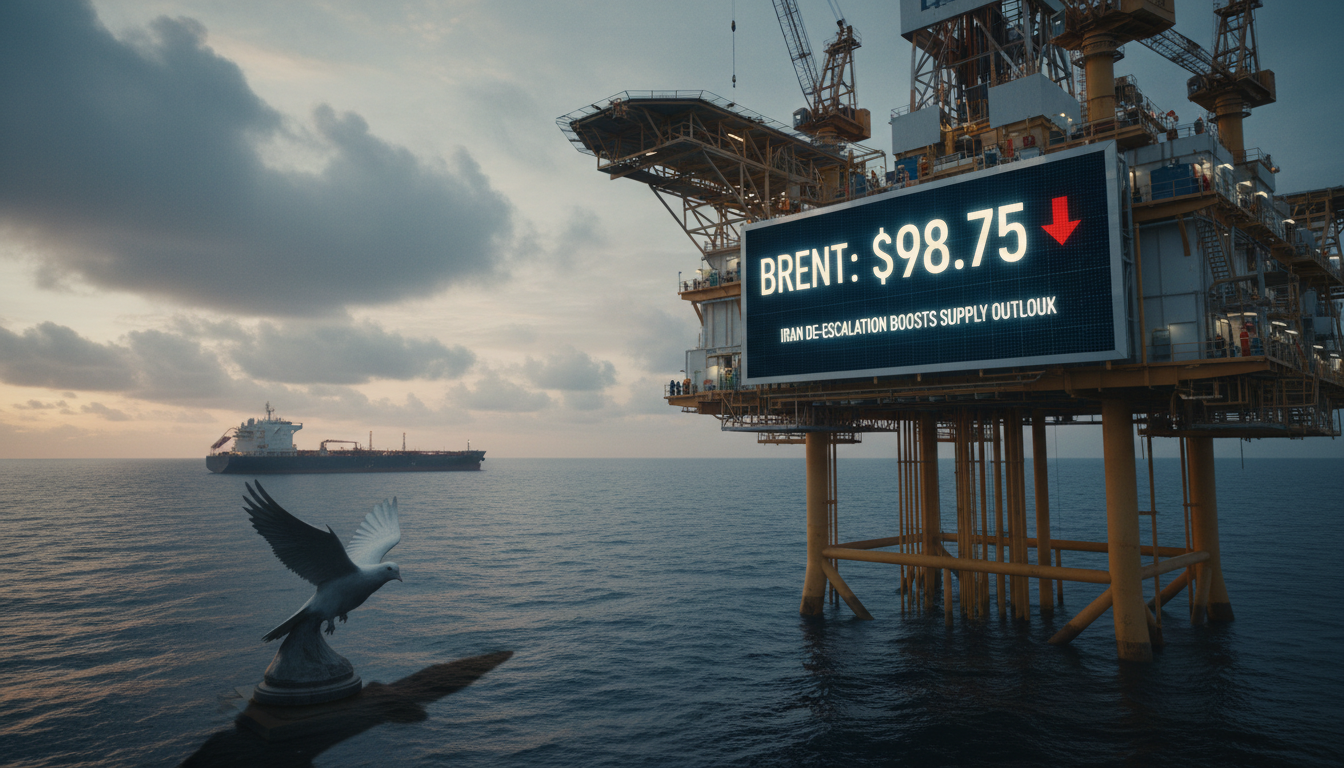
Global crude oil benchmarks experienced a sharp downturn in early Wednesday trading, as significant geopolitical developments stemming from the United States’ stance on Iran rapidly reshaped market sentiment. Brent Crude futures plummeted by approximately 4%, breaching the critical $100 per barrel threshold for the first time in a week. This dramatic shift was directly attributable to U.S. President Donald Trump’s public statements suggesting a potential swift end to military engagement in the region, possibly within mere weeks.
As European markets opened for the day, the financial impact was stark. Brent Crude registered a substantial decline of 4.52%, settling at $99.20 per barrel. Concurrently, West Texas Intermediate (WTI) Crude, the North American benchmark, mirrored this downward trend, shedding 4.04% to trade at $97.30 per barrel. This immediate sell-off underscores the market’s acute sensitivity to geopolitical risk premiums, particularly concerning major oil-producing regions.
President Trump’s Declarations Catalyze Market Reversal
The catalyst for this significant price correction originated from President Trump’s remarks late Tuesday. Speaking from the Oval Office, the President indicated that the United States intended to withdraw from Iran “very soon,” projecting a timeline of “two or three weeks” for military actions to conclude. These statements represent a considerable shift in rhetoric, signaling a potential de-escalation that markets quickly priced in as a reduction in immediate supply disruption risk.
President Trump articulated his rationale, telling reporters at the White House, “We leave because there’s no reason for us to do this. We’ll be leaving very soon.” This assertion, implying an imminent disengagement, immediately diminished the perceived geopolitical risk that had been bolstering crude prices in recent weeks. The prospect of a rapid U.S. exit introduced a new dynamic into the energy markets, prompting investors to reassess their positions and recalibrate risk exposure.
Further solidifying the immediate attention on this developing situation, White House Press Secretary Karoline Leavitt announced that President Trump would deliver an “Address to the Nation to provide an important update on Iran” at 9 p.m. ET on Wednesday. This scheduled address added another layer of anticipation and potential volatility, as investors awaited further clarity on the administration’s strategic direction and the concrete implications for regional stability and global oil supply.
Shifting Diplomatic Landscape: A Potential Unilateral Withdrawal
Beyond the timeline for military disengagement, President Trump’s comments also hinted at a fundamental change in diplomatic strategy. After weeks of public and private insistence on ongoing negotiations with Iran, the President suggested late Tuesday that the U.S. might not require a formal deal. Instead, he proposed the possibility of simply declaring victory and withdrawing, irrespective of a new agreement.
Addressing the necessity of a deal, President Trump stated, “No, they don’t have to make a deal with me when we feel that they are, for a long period of time, put into the Stone Ages, and they won’t be able to come up with a nuclear weapon. Then we’ll leave whether we have a deal or not. It’s irrelevant now. It’s possible that we’ll have a deal because they want to make a deal.” This powerful statement signals a potential shift from a negotiation-centric approach to a more unilateral disengagement, provided U.S. objectives regarding Iran’s nuclear capabilities are perceived as met.
This evolving narrative had an immediate and profound impact on oil prices. The market’s initial reaction was to shed the accumulated risk premium, as the specter of direct military conflict and its potential disruption to oil flows seemed to recede. However, beneath the surface of this rapid price adjustment lies a layer of uncertainty regarding the practical implications of such a withdrawal, particularly concerning crucial maritime transit points.
Strait of Hormuz: A Gradual Path to Normalization
A primary concern for global energy markets during periods of heightened tension in the Middle East is the status of the Strait of Hormuz. This vital chokepoint, through which a significant portion of the world’s seaborne oil passes, has been a focal point of anxiety. While the prospect of reduced conflict might imply a swift return to normal traffic, expert analysis suggests a more gradual process.
Commodities strategists Warren Patterson and Ewa Manthey from ING provided a pertinent perspective, noting, “Even if the Strait reopens, clearing the vessel backlog would take time, with production, exports, and LNG flows normalising only gradually rather than immediately.” This insight is crucial for investors, as it tempers expectations of an immediate, seamless return to pre-crisis operational levels. Logistical challenges, insurance considerations, and the sheer volume of delayed shipments mean that any normalization of supply chains through the Strait will be an extended undertaking. This implies that while the immediate risk premium may dissipate, the full operational efficiency of global oil trade through the region may not be restored instantly.
Investor Outlook: Navigating Persistent Volatility
The current market dynamics underscore the persistent influence of geopolitical events on crude oil prices. For energy investors, the immediate takeaway is the heightened sensitivity of the market to political rhetoric and policy shifts from major global powers. The sudden drop in prices, driven by the prospect of de-escalation, highlights how quickly investor sentiment can pivot based on new information.
Looking ahead, investors must remain vigilant. The President’s upcoming 9 p.m. ET address will be a critical juncture, potentially offering more concrete details on the administration’s plans. Beyond the rhetoric, actual troop movements, diplomatic engagements, and the response from Iran will dictate the true trajectory of regional stability and, consequently, global oil supply dynamics. While the short-term outlook suggests a potential easing of supply fears, the long-term implications of a U.S. withdrawal, including regional power vacuums or shifts in alliances, could introduce new forms of geopolitical risk.
Investing in the energy sector remains complex, characterized by the interplay of fundamental supply-demand metrics and unpredictable geopolitical forces. Prudent investors will scrutinize every development, understanding that while current news points to de-escalation, the path to sustained stability in the Middle East and its impact on global oil markets is rarely linear. Careful analysis of both stated intentions and on-the-ground realities will be paramount for navigating the inherent volatility in the oil and gas investment landscape.
