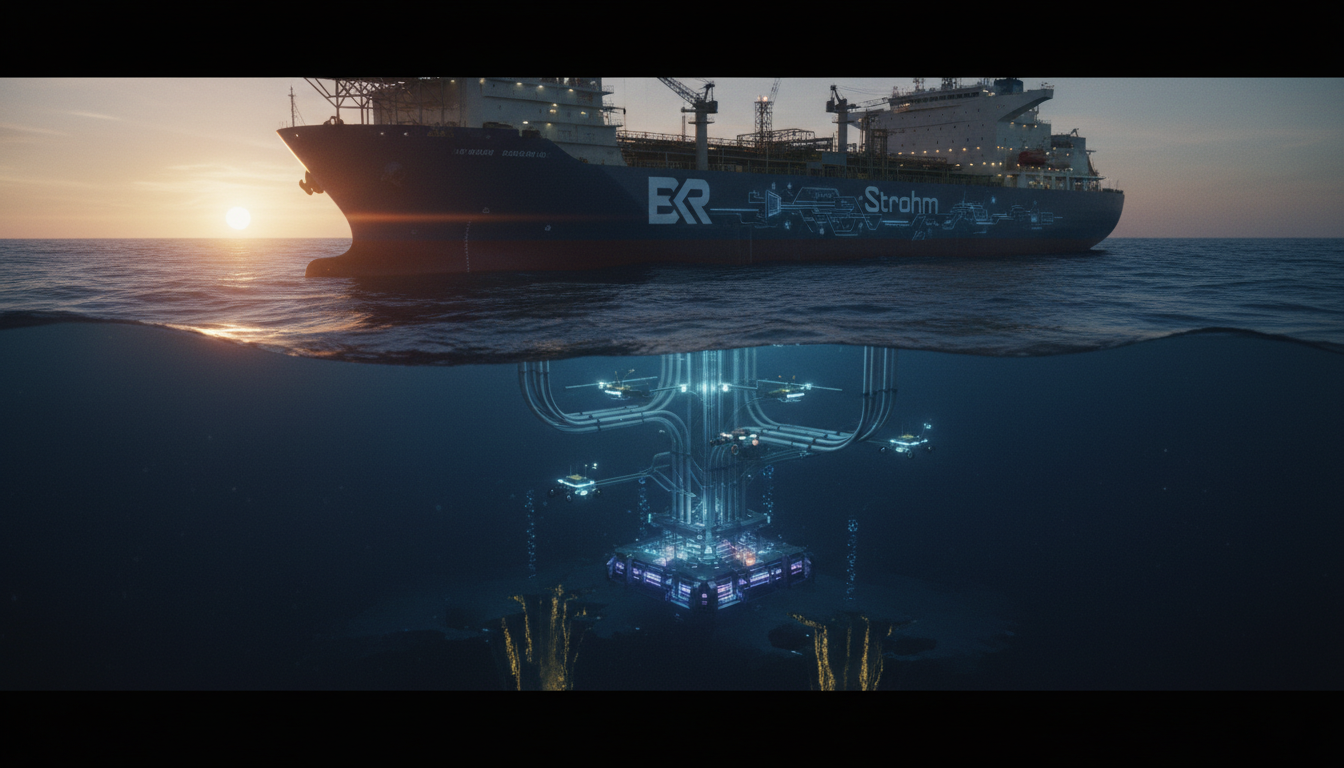
Innovating Subsea: Baker Hughes and Strohm Forge a Lighter Path to Deepwater Hydrocarbons
The global energy sector continues its relentless pursuit of efficiency and cost optimization, especially in the capital-intensive realm of ultra-deepwater hydrocarbon development. In a significant move set to reshape subsea infrastructure, industry titans Baker Hughes and Strohm have announced a strategic collaboration focused on revolutionizing flowline and riser systems. This partnership aims to introduce a groundbreaking hybrid flexible pipe (HFP) specifically engineered to unlock the next generation of ultra-deepwater projects with unprecedented economic viability.
For investors keenly monitoring the offshore oil and gas landscape, this innovation represents a pivotal step towards mitigating the formidable challenges inherent in deepwater exploration and production. By addressing critical issues like installation costs, material longevity, and operational complexity, the HFP technology stands to enhance project economics for exploration and production (E&P) companies, ultimately driving greater shareholder value across the subsea supply chain.
Unpacking the Hybrid Flexible Pipe: A Technical Edge with Financial Upside
The core of this transformative initiative lies in the development of a hybrid flexible pipe system that intelligently fuses established flexible pipe design principles with cutting-edge thermoplastic composite pipe (TCP) technology. Traditionally, flexible pipes in subsea applications are complex structures comprising multiple layers, including an internal carcass, a liner, and robust pressure armor, all encased within tension armor and terminated by specialized end fittings.
The HFP re-engineers this architecture by strategically replacing the heavy and often corrosion-prone carcass, liner, and pressure armor layers with advanced TCP materials. Crucially, the system retains the proven tension armor and end fittings, ensuring structural integrity and compatibility with existing subsea infrastructure. This ingenious integration is not merely a material swap; it represents a paradigm shift designed to deliver the inherent strength and reliability of conventional flexible pipes while simultaneously inheriting the profound benefits of TCP: significantly reduced weight and superior resistance to corrosion.
From an investor’s standpoint, the implications are substantial. The enhanced corrosion resistance of TCP promises extended operational lifespans for subsea assets, translating directly into reduced maintenance expenditures and increased uptime over the life of a field. This long-term durability mitigates operational risks and provides a more predictable return on investment for deepwater projects.
Driving Down Costs in Challenging Environments
Perhaps the most compelling financial advantage of the HFP lies in its dramatic weight reduction. Engineers project the hybrid flexible pipe to be approximately 50% lighter than its conventional counterparts. This half-reduction in weight has a cascading positive effect on the logistical and financial aspects of ultra-deepwater operations.
In water depths exceeding 3,000 meters, which characterize many frontier deepwater basins, the HFP is expected to reduce the suspended weight of risers and flowlines by about 40%. This substantial decrease in weight directly translates into critical capital expenditure (CAPEX) savings during the installation phase. Heavier conventional pipes necessitate highly specialized and often prohibitively expensive installation vessels equipped with powerful lifting and tensioning capabilities.
By drastically cutting the suspended weight, the HFP technology fundamentally eases installation constraints. This allows E&P operators to leverage a much broader spectrum of existing installation vessels, circumventing the need for costly upgrades or the chartering of premium-tier heavy-lift vessels. The ability to utilize a wider fleet directly impacts project budgets, offering significant cost reductions, accelerated project timelines, and enhanced flexibility in logistics planning. For an industry perpetually focused on driving down the breakeven costs of deepwater barrels, this represents a major leap forward.
Market Trajectory and Investment Horizon
Daniel Wright, Global Business Leader for Flexible Pipe Systems at Baker Hughes, emphasized the strategic importance of such advancements, stating, “Baker Hughes’ flexible pipe systems are helping customers produce subsea resources safely and efficiently, even in the most demanding environments.” His comments underscore the commitment of major service providers to deliver solutions that empower operators to tackle increasingly complex and remote deepwater frontiers.
The development of the HFP is currently progressing through rigorous qualification testing, a crucial phase that validates the system’s performance and reliability under extreme subsea conditions. Both Baker Hughes and Strohm are targeting commercial availability for the HFP solution by 2028. This timeline aligns with the anticipated escalation in demand for more cost-efficient and technically advanced solutions necessary for the sustained development of ultra-deepwater resources globally.
As the energy transition progresses, deepwater oil and gas will continue to play a vital role in meeting global energy demand, especially given the typically lower carbon intensity of deepwater production compared to some onshore alternatives. Innovations like the HFP are instrumental in ensuring the economic competitiveness and environmental performance of these long-life assets.
Strategic Implications for Energy Investors
For investors, this collaboration between Baker Hughes, a diversified energy technology company, and Strohm, a leader in composite pipe technology, signals a powerful synergy. It highlights the strategic imperative for subsea technology providers to innovate continuously to support the long-term viability of deepwater projects. Companies that can deliver solutions reducing CAPEX and OPEX for E&P operators are poised for significant growth and market share expansion.
The HFP technology promises to enhance the return on investment for deepwater developments by streamlining installation, extending asset life, and reducing operational risk. As E&P companies increasingly prioritize capital discipline and project efficiency, solutions like the hybrid flexible pipe will become critical differentiators. Investors should view this development as a key indicator of where technological innovation is driving value creation in the offshore energy landscape, offering compelling opportunities for those positioned in the subsea infrastructure and advanced materials sectors.


