

Close Menu
  • Home
  • Market News
    • Crude Oil Prices
    • Brent vs WTI
    • Futures & Trading
    • OPEC Announcements
  • Company & Corporate
    • Mergers & Acquisitions
    • Earnings Reports
    • Executive Moves
    • ESG & Sustainability
  • Geopolitical & Global
    • Middle East
    • North America
    • Europe & Russia
    • Asia & China
    • Latin America
  • Supply & Disruption
    • Pipeline Disruptions
    • Refinery Outages
    • Weather Events (hurricanes, floods)
    • Labor Strikes & Protest Movements
  • Policy & Regulation
    • U.S. Energy Policy
    • EU Carbon Targets
    • Emissions Regulations
    • International Trade & Sanctions
  • Tech
    • Energy Transition
    • Hydrogen & LNG
    • Carbon Capture
    • Battery / Storage Tech
  • ESG
    • Climate Commitments
    • Greenwashing News
    • Net-Zero Tracking
    • Institutional Divestments
  • Financial
    • Interest Rates Impact on Oil
    • Inflation + Demand
    • Oil & Stock Correlation
    • Investor Sentiment

Subscribe to Updates

Subscribe to our newsletter and never miss our latest news

Subscribe my Newsletter for New Posts & tips Let's stay updated!

What's Hot

OPEC+ Approves Modest Output Hike as Iran War Jolts Oil Markets

March 1, 2026

Oil tankers attacked near Strait of Hormuz as Iran conflict disrupts shipping

March 1, 2026

OPEC+ to boost oil production 206,000 bpd as Iran conflict threatens supply

March 1, 2026
Facebook X (Twitter) Instagram Threads
Oil Market Cap – Global Oil & Energy News, Data & Analysis
  • Home
  • Market News
    • Crude Oil Prices
    • Brent vs WTI
    • Futures & Trading
    • OPEC Announcements
  • Company & Corporate
    • Mergers & Acquisitions
    • Earnings Reports
    • Executive Moves
    • ESG & Sustainability
  • Geopolitical & Global
    • Middle East
    • North America
    • Europe & Russia
    • Asia & China
    • Latin America
  • Supply & Disruption
    • Pipeline Disruptions
    • Refinery Outages
    • Weather Events (hurricanes, floods)
    • Labor Strikes & Protest Movements
  • Policy & Regulation
    • U.S. Energy Policy
    • EU Carbon Targets
    • Emissions Regulations
    • International Trade & Sanctions
  • Tech
    • Energy Transition
    • Hydrogen & LNG
    • Carbon Capture
    • Battery / Storage Tech
  • ESG
    • Climate Commitments
    • Greenwashing News
    • Net-Zero Tracking
    • Institutional Divestments
  • Financial
    • Interest Rates Impact on Oil
    • Inflation + Demand
    • Oil & Stock Correlation
    • Investor Sentiment
Oil Market Cap – Global Oil & Energy News, Data & Analysis
Home » Australia’s worst heatwave since black summer made five times more likely by global heating, analysis finds | Australia news
Climate Commitments

Australia’s worst heatwave since black summer made five times more likely by global heating, analysis finds | Australia news

omc_adminBy omc_adminJanuary 22, 2026No Comments3 Mins Read
Share
Facebook Twitter Pinterest Threads Bluesky Copy Link


Human-caused global heating made the intense heatwave that affected much of Australia in early January five times more likely, new analysis suggests.

The heatwave earlier this month was the most severe since the 2019-20 black summer, with temperatures over 40C in Melbourne and Sydney, even hotter conditions in regional Victoria and New South Wales, and extreme heat also affecting Western Australia, South Australia and Tasmania.

In Victoria, the heat preceded bushfires that burned through 400,000 hectares and destroyed almost 900 buildings.

Sign up: AU Breaking News email

A report by World Weather Attribution (WWA) suggests that the effect of greenhouse gas emissions outweighed the effects of a weak La Niña, which usually means milder temperatures across most of mainland Australia.

The report’s authors suggest that the climate crisis made the extreme heat about 1.6C hotter, while the La Niña likely lowered maximum temperatures by between 0.3 and 0.5C.

“There was definitely a signal of human-induced climate change behind this event,” said report co-author Prof Sarah Perkins-Kirkpatrick, a climate scientist at the Australian National University.

Heatwaves – defined as three consecutive days where maximum temperatures are higher than average – cause more deaths in Australia than all other natural hazards combined.

“When people are affected by extreme heat, it is very insidious,” Perkins-Kirkpatrick said. “It’s not something that happens straight away … it’s something that comes to light in a number of days after the event, and may also be due to the exacerbation of underlying diseases.”

“The mentality here of ‘suck it up, she’ll be right’ does not fly any more,” she said. “[The heat] is getting worse and whether we like it or not … there’s ultimately a limit to what we can actually physically cope with.”
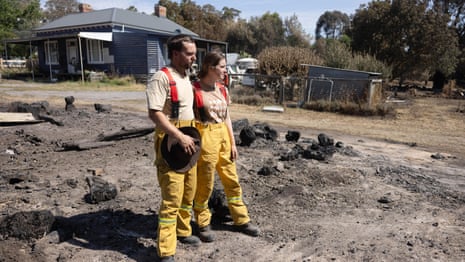
A home just saved, a cafe in ashes: residents return to find destruction by Victoria fires – video

Perkins-Kirkpatrick added that the “temperature profile and also the driving weather system” for January’s extreme heat was reminiscent of the 2009 south-east Australian heatwave, which “exacerbated adverse bushfire weather during that time”.

In the current climate, Australians should expect heatwaves similar to the January event about once every five years, the analysis suggests. The report’s authors warn that similar heat events could be expected every second year if the world warms 2.6C above the preindustrial average, which is predicted to be reached by the end of the century based on current carbon emissions.

WWA co-founder Friederike Otto, a professor of climate science at Imperial College London, said: “As extreme heat is one of the deadliest extreme weather events that is changing very fast with global warming … it is important to highlight these rapid changes, even if the results are not surprising at all.”

WWA, an international collaboration of scientists, uses weather observations and climate models to analyse the role human-caused global heating plays in extreme weather events.

Otto noted that while the techniques the group uses are well established, “as we make the results available in the days and weeks after the event, the [heatwave] study itself is not peer reviewed yet”.


Source link

Share. Facebook Twitter Pinterest Bluesky Threads Tumblr Telegram Email
omc_admin
  • Website

Related Posts

Winter getting shorter in 80% of major US cities, new data shows | US weather

February 27, 2026

Trump officials move to kill system that protects US from chemical disasters | US Environmental Protection Agency

February 27, 2026

US ‘bullying’ could scupper carbon levy on shipping, warn experts | Shipping emissions

February 26, 2026
Add A Comment
Leave A Reply Cancel Reply

Top Posts

Federal Reserve cuts key rate for first time this year

September 17, 202513 Views

Inflation or jobs: Federal Reserve officials are divided over competing concerns

August 14, 20259 Views

Oil tanker rates to stay strong into 2026 as sanctions remove ships for hire – Oil & Gas 360

December 16, 20258 Views
Don't Miss

Oil tankers attacked near Strait of Hormuz as Iran conflict disrupts shipping

By omc_adminMarch 1, 2026

(Bloomberg) – Two tankers were attacked near the mouth of the Persian Gulf, increasing the…

OPEC+ to boost oil production 206,000 bpd as Iran conflict threatens supply

March 1, 2026

Oil markets on edge after Trump strike on Iran threatens Hormuz flows

March 1, 2026

How will strikes on Iran affect global energy flows?

February 28, 2026
Top Trending

ESG Today: Week in Review

By omc_adminMarch 1, 2026

Winter getting shorter in 80% of major US cities, new data shows | US weather

By omc_adminFebruary 27, 2026

Trump officials move to kill system that protects US from chemical disasters | US Environmental Protection Agency

By omc_adminFebruary 27, 2026
Most Popular

The 5 Best 65-Inch TVs of 2025

July 3, 202515 Views

AI’s Next Bottleneck Isn’t Just Chips — It’s the Power Grid: Goldman

November 14, 202514 Views

The Layoffs List of 2025: Meta, Microsoft, Block, and More

May 9, 202510 Views
Our Picks

PDVSA, African Energy Chamber sign MoU to boost oil and gas investment

March 1, 2026

Talos Losses Deepen | Rigzone

March 1, 2026

Tankers Halt Near Hormuz After Attacks

February 28, 2026

Subscribe to Updates

Subscribe to our newsletter and never miss our latest news

Subscribe my Newsletter for New Posts & tips Let's stay updated!

Facebook X (Twitter) Instagram Pinterest
  • Home
  • About Us
  • Advertise With Us
  • Contact Us
  • DMCA
  • Privacy Policy
  • Terms & Conditions
© 2026 oilmarketcap. Designed by oilmarketcap.

Type above and press Enter to search. Press Esc to cancel.