

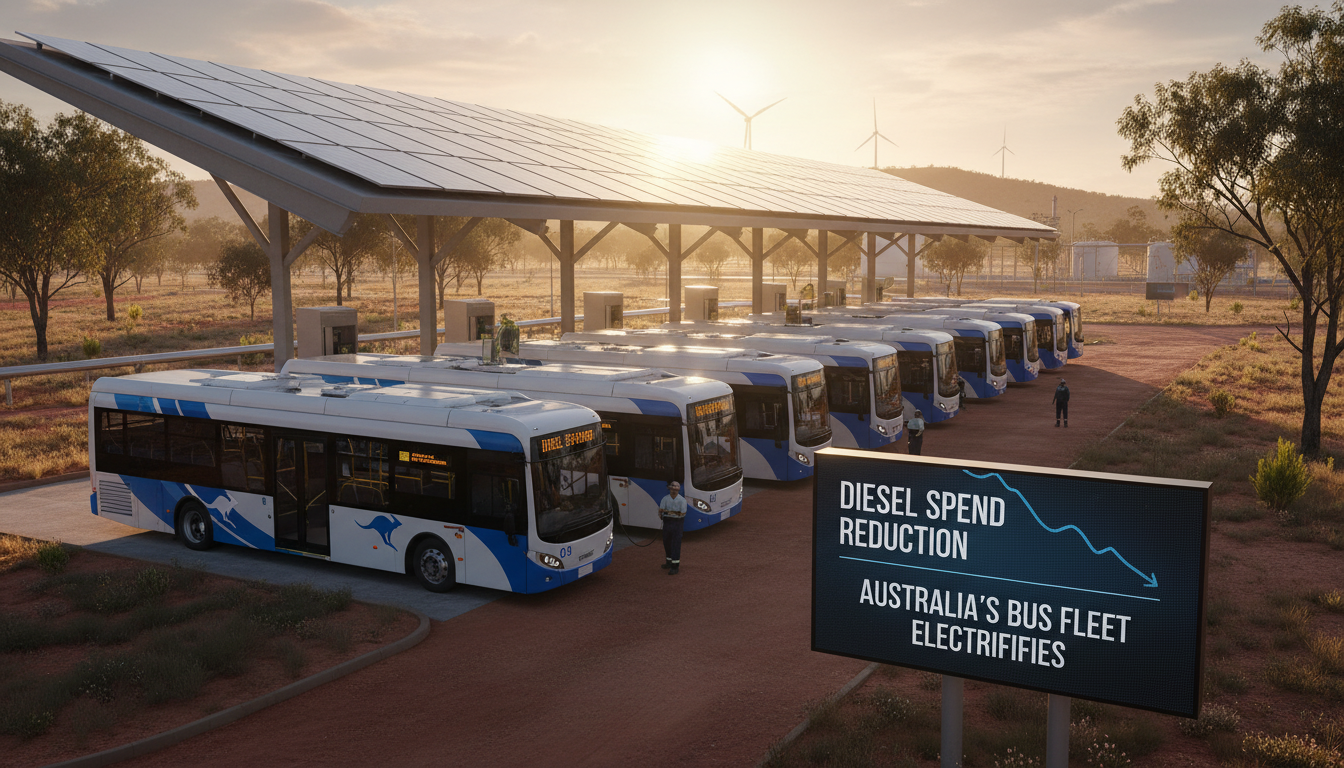
Australia’s Fuel Security Imperative: The Investment Case for Electric Buses Amid Surging Diesel Prices
The Australian transportation sector faces a critical inflection point as diesel prices breach the $3 per litre mark, intensifying scrutiny on national fuel security. For investors tracking energy market shifts and infrastructure opportunities, the nascent transition to electric buses presents a compelling narrative, signaling a significant divergence from traditional oil and gas dependency within a vital public service.
Australia’s current reliance on diesel for its extensive bus network stands in stark contrast to global leaders. Electric buses constitute a mere 1% of the nation’s urban fleet, a figure dwarfed by China’s impressive 80% penetration, the Netherlands’ 25%, and the United Kingdom’s 12%. This substantial gap highlights not only a lag in sustainable transport adoption but also a significant future investment corridor.
While urban rail systems largely operate on electricity, buses—the backbone of Australia’s public transport, carrying over half of all passengers—annually consume a staggering 530 million litres of diesel. This immense demand exposes the economy to volatile global oil markets and geopolitical risks, underscoring the urgent strategic importance of diversification.
Strategic Shift: Prioritizing Electrification for Resilience
Industry stakeholders are vociferously advocating for the prioritization of bus fleets within Australia’s national fuel security agenda. This perspective emphasizes that securing fuel supply for public transport extends beyond operational continuity; it fundamentally underpins social equity and community resilience, connecting students, workers, and regional communities daily. The current fleet composition, with government data for 2025 indicating approximately 42,800 registered diesel buses versus just 629 battery-electric models—representing only 1% of the heavy bus fleet—underscores a profound infrastructural deficit.
However, momentum is building. State and territory governments across Australia have initiated ambitious targets for fleet electrification. Canberra and Greater Sydney, for instance, are targeting fully electric bus operations by 2040. Notably, the Australian Capital Territory (ACT) already showcases leadership, with electric buses comprising about 24% of its fleet. ACT transport officials highlight the economic and environmental advantages, confirming that each electric bus operates on 100% Australian-produced renewable electricity, benefits from lower running costs, and eliminates reliance on foreign fuel sources.
Investment Hotspots: Regional Progress and Infrastructure Needs
Other states are also demonstrating tangible progress, creating focused investment opportunities. South Australia anticipates its electric bus count will reach 81 this year, representing approximately 8% of its total fleet. Western Australia recently deployed its 100th electric bus, while Victoria has mandated electric models for all new bus purchases. These regional commitments signify a burgeoning market for electric vehicle manufacturers, component suppliers, and charging infrastructure developers.
Experts consistently point to electric buses as the most impactful avenue for decarbonizing public transport. Beyond emission reductions, the strategic advantages for investors are manifold. Electrified fleets reduce dependence on volatile global oil supplies, such as those transiting the Strait of Hormuz, fostering greater energy independence. Furthermore, the operational shift to electric power mitigates urban air pollution, improving public health outcomes and enhancing the quality of life in communities—a factor increasingly important for ESG-conscious investors. The reduction in noise pollution also significantly benefits both commuters and residential areas.
Building the Future: Charging Infrastructure and Depot Conversion
The transition to electric buses is not solely about vehicle procurement; it necessitates substantial investment in supporting infrastructure. This includes the strategic planning and deployment of charging networks and the conversion of existing bus depots. Victoria offers a glimpse into this future, with bus operator Kinetic recently inaugurating a purpose-built depot featuring advanced overhead charging infrastructure in Melbourne. Similarly, New South Wales has completed the first of 11 planned electric depot conversions, indicating a considerable pipeline of infrastructure projects.
Australia’s pace of electric bus adoption has historically lagged behind international counterparts. However, the current global energy crisis, characterized by rising fuel prices and supply uncertainties, is rapidly recalibrating the cost-benefit analysis. This environment significantly enhances the attractiveness of electric buses as a resilient investment. Industry analysis suggests a growing premium for energy independence—the assurance that Australia’s bus fleets can operate reliably on domestic electricity, irrespective of international disruptions.
Market Agility: Buses as a Flexible Transport Solution
Buses offer inherent flexibility, providing a crucial mechanism to rapidly respond to evolving transport needs and energy challenges. Unlike fixed-line rail infrastructure, which demands extensive lead times and capital, bus routes can be adapted quickly to meet demand fluctuations and expand service coverage into underserved areas. This operational agility presents a compelling case for accelerated investment in electric bus fleets as a strategic transport solution, capable of delivering immediate impact and future-proofing urban mobility.
Community advocacy in areas like Melbourne’s west highlights the urgent demand for improved bus services. Residents seek more efficient, grid-like routes to enhance accessibility to essential services, schools, and transit hubs. The transition to electric buses, in this context, offers not only a pathway to enhanced service delivery but also a tangible improvement in passenger experience through quieter, smoother rides. For communities, especially those with lower incomes or migrant families, expanded and electrified bus services can be genuinely transformative, reducing reliance on expensive private vehicle ownership.
Innovative initiatives like the community-run e-bus pilot in Gippsland, Victoria, demonstrate the expansive potential of electric transport, even in regional settings. Since 2024, two mini e-buses, “Sandy” and “Sunny,” have provided essential, inclusive transport for hundreds of passengers in a region where car ownership traditionally dictates mobility. This volunteer-led service exemplifies how localized electric transport solutions can enhance well-being and combat social isolation.
The current fuel crisis provides an undeniable impetus, accelerating the broader imperative for a zero-carbon transport transition. For astute investors, recognizing transport system security as a core national security question opens new avenues for capital deployment in sustainable infrastructure, energy solutions, and advanced vehicle technologies. This period of heightened energy volatility compels a strategic re-evaluation, solidifying the investment case for electric buses as a critical component of Australia’s future energy landscape and economic resilience.
