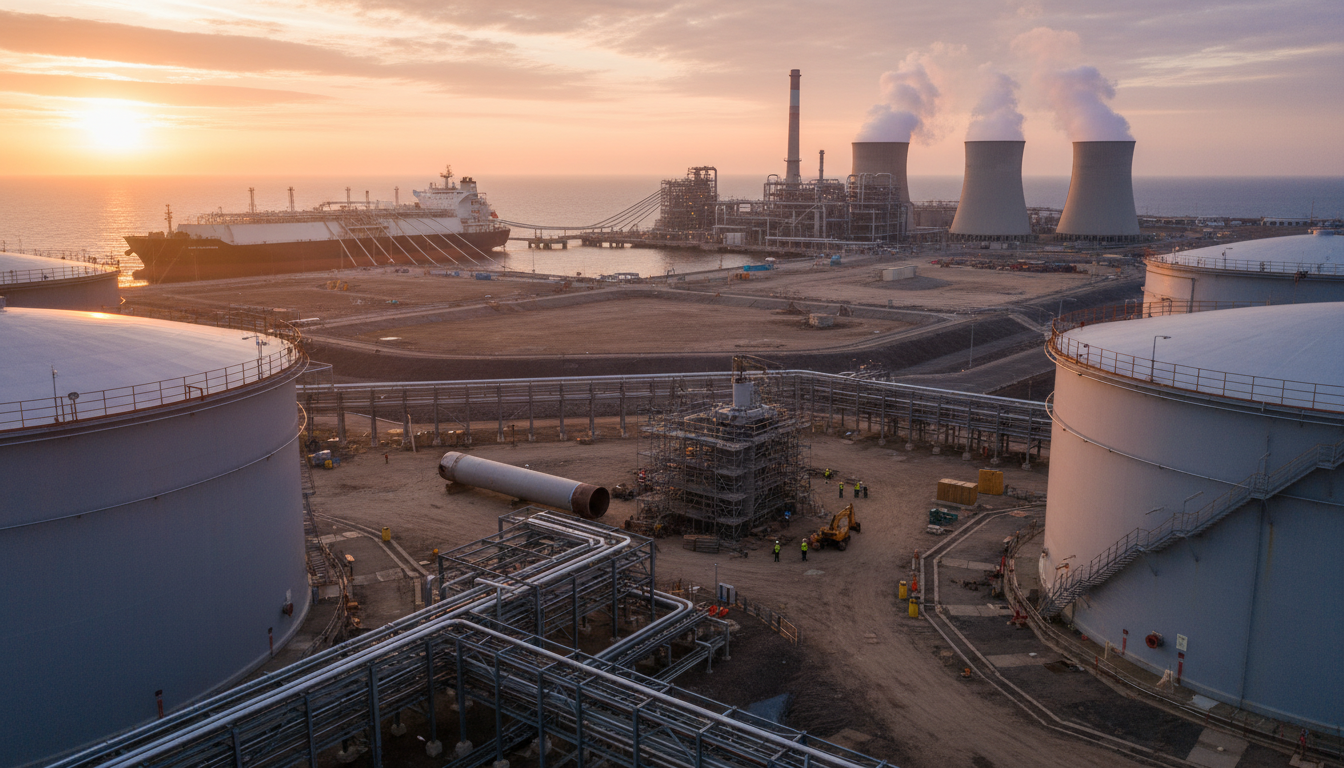
The global liquefied natural gas (LNG) market is once again demonstrating its inherent volatility, with a significant operational disruption in Australia sending fresh ripples through an already strained supply chain. This latest development, centered on Santos’ newly commissioned Barossa LNG project and its associated Darwin export terminal, adds another layer of complexity for energy investors. While the immediate focus is on Australia, this localized issue intensifies a pre-existing global supply crisis, driven largely by persistent geopolitical turmoil in the Middle East. Understanding the interplay between these regional shocks and broader market dynamics is crucial for investors positioning their portfolios in the current energy landscape.
Australia’s Barossa Blip: A Test of Operational Resilience
Just two months after dispatching its inaugural cargo, the Barossa LNG project, a cornerstone asset for Australian producer Santos, has been forced into an unexpected shutdown. This critical operational halt is due to the necessity of replacing essential equipment on the offshore production vessel, consequently idling the vital Darwin LNG export terminal. The swift transition from initial commercial success to an unforeseen cessation of operations underscores the inherent risks in large-scale energy infrastructure. While Santos has confirmed the temporary nature of the shutdown, a definitive timeline for the resumption of production at Barossa and subsequent exports from Darwin remains unclarified. This ambiguity introduces a significant element of uncertainty, leaving market participants to factor in extended delays in the crucial supply from a region often touted for its energy stability. For investors, this incident highlights the importance of scrutinizing operational execution and contingency planning within their energy holdings, particularly for new and complex projects.
Global LNG Under Siege: Middle East Woes Compound Supply Pressure
The Australian outage arrives at a time when the global LNG supply landscape is already stretched thin. Worldwide LNG exports have recently plummeted to a six-month low, a stark indicator of the significant constraints gripping the market. This decline is predominantly attributed to severe disruptions originating from key Middle Eastern producers, where geopolitical tensions have effectively choked crucial shipping lanes, most notably the Strait of Hormuz. Qatar, a dominant force in the global LNG arena, has seen its liquefaction production and export capabilities severely curtailed following devastating damage to its infrastructure, specifically the Ras Laffan LNG complex. This facility, recognized as the world’s largest single LNG-producing hub, faces an estimated annual revenue loss of approximately $20 billion, with recovery projected to be a multi-year endeavor. Similarly, the United Arab Emirates has experienced significant disruptions, with its shipments struggling to navigate the de facto closed Strait of Hormuz. These concurrent, large-scale supply losses from two of the world’s most critical LNG regions create a formidable challenge, elevating global energy security concerns and driving up the cost of securing supply.
Crude Markets and Investor Sentiment: What Today’s Prices Tell Us
While the immediate focus remains on LNG, the broader crude oil market provides essential context for investor sentiment across the energy complex. As of today, Brent crude trades at $92.37, reflecting a -0.93% dip within a daily range of $91.39 to $94.21. Similarly, WTI crude is priced at $88.75, down -1.03%, oscillating between $87.64 and $90.71. This slight downward movement today contrasts with a more significant trend over the past two weeks, where Brent crude has shed approximately 7% of its value, falling from $101.16 on April 1st to $94.09 by April 21st. This broader market softening, despite escalating geopolitical risks and new supply shocks in LNG, indicates a complex interplay of demand concerns, inventory data, and macroeconomic factors influencing investor psychology. The persistent volatility in crude prices directly impacts the economics of associated gas production and overall energy investment strategies, making the current pullback a point of careful consideration for portfolio managers.
Navigating Forward: Investor Questions and Upcoming Catalysts
The prevailing uncertainty has our readers keenly focused on future market direction. A prominent question echoing through our channels is: “Is WTI going up or down?” and “What do you predict the price of oil per barrel will be by the end of 2026?” These inquiries underscore the pressing need for forward-looking analysis in a dynamic environment. Investors are seeking clarity, and upcoming calendar events offer potential catalysts. The EIA Weekly Petroleum Status Report, scheduled for release tomorrow, April 22nd, and again on April 29th and May 6th, will provide crucial insights into crude oil, gasoline, and distillate inventories, impacting short-term price movements. Further guidance will come from the Baker Hughes Rig Count on April 24th and May 1st, offering a pulse on drilling activity and future supply trends. Perhaps most significant for long-term outlooks, the EIA Short-Term Energy Outlook on May 2nd will offer official projections that could significantly influence market expectations for the rest of 2026. Given the current LNG supply shocks and ongoing geopolitical risks, these reports will be scrutinized for any indications of further tightening or easing in global energy balances, directly informing investor decisions on the trajectory of crude and natural gas prices through the remainder of the year and beyond.


