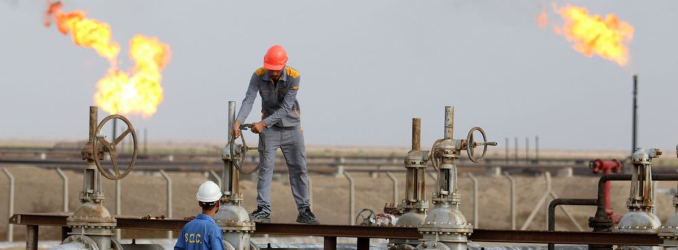
The global oil market is once again confronting a significant supply challenge stemming from Iraq’s Kurdistan Region, as the Association of the Petroleum Industry of Kurdistan (APIKUR) confirms ongoing production suspensions following attacks on member company facilities. These incidents, which occurred on July 15 and July 16, 2025, have led to a collective halt of over 200,000 barrels per day (bpd) of crude oil production. For investors keenly watching supply-side dynamics, this disruption introduces a fresh layer of geopolitical risk and uncertainty into an already complex energy landscape, demanding careful consideration of its potential impact on price stability and regional investment outlooks.
Kurdistan’s Production Halt: A Critical Supply Squeeze
The recent attacks on oil production sites operated by APIKUR member companies in the Kurdistan Region of Iraq have triggered an immediate and substantial supply curtailment. Following the July 2025 incidents, operators reported damage to critical field facilities and, more importantly, a direct threat to the safety of their predominantly Iraqi and expatriate staff. This forced suspension, affecting more than 200,000 bpd, represents a material loss to global crude supply. While individual production volumes may seem modest in the context of overall global output, sustained outages of this magnitude invariably tighten market balances and can exacerbate price volatility, especially when compounded by broader geopolitical tensions. APIKUR’s urgent appeal to both the Government of Iraq and the Kurdistan Regional Government underscores the severity of the security situation and the imperative for robust protective measures to ensure personnel safety and operational continuity.
Navigating Current Market Dynamics Amidst Regional Instability
Despite the significant 200,000 bpd disruption in Kurdistan, the broader crude oil market has shown a somewhat muted immediate reaction. As of today, Brent crude trades at $94.7 per barrel, registering a slight daily decline of 0.24% within a narrow range of $94.7 to $94.91. Similarly, West Texas Intermediate (WTI) crude is priced at $90.97, down 0.35% for the day. This current snapshot reflects a market grappling with multiple forces. Interestingly, this localized supply shock unfolds against a backdrop of a notable downward trend in Brent prices over the past two weeks, which saw Brent slide from $102.22 on March 25th to $93.22 by April 14th—a substantial decrease of nearly 9%. This suggests that other global demand or supply factors, or perhaps a perception that the Kurdistan outage is temporary, might be currently outweighing the bullish impact of the regional supply loss. Investors are weighing the immediate risk premium against broader macroeconomic indicators and the potential for a swift resolution to the KRG’s production challenges.
Investor Focus: Price Forecasts and the Path to Resumption
Oil and gas investors are naturally focused on how such disruptions impact future price trajectories. A common question among our readers this week revolves around building a base-case Brent price forecast for the next quarter, and the ongoing Kurdistan situation adds considerable complexity to that analysis. The key to unlocking the suspended 200,000 bpd lies not just in enhanced security, but critically, in a political resolution. APIKUR spokesman Myles B. Caggins III explicitly stated that member companies are “committed to resume oil production and sales as soon as possible” and stand ready to utilize the Iraq-Türkiye Pipeline “once agreement is reached between Baghdad, Erbil and the companies.” This highlights the enduring challenge: the necessity of a tripartite agreement to restart exports through the vital pipeline. Until this political deadlock is broken, the substantial volume remains offline, posing an ongoing risk to supply stability and potentially influencing price forecasts upwards should the impasse persist longer than anticipated by the market. The long-term viability of investment in the region hinges on a dependable framework for production and export.
Upcoming Events: Shaping the Q2 Outlook
Looking ahead, the next two weeks will feature several pivotal events that could further shape crude oil market sentiment, potentially amplifying or mitigating the impact of the Kurdistan disruption. The upcoming OPEC+ Joint Ministerial Monitoring Committee (JMMC) meeting on April 18th, followed by the Full Ministerial meeting on April 20th, stands out as a critical juncture. While these meetings primarily focus on member quotas and global supply strategies, the persistent loss of over 200,000 bpd from a key non-OPEC+ producer could certainly factor into their deliberations. Any discussions around market rebalancing or potential adjustments to production targets will undoubtedly consider the impact of such outages. Beyond OPEC+, regular data releases will provide crucial insights into market health: the Baker Hughes Rig Count on April 17th and April 24th will indicate North American drilling activity, while the API Weekly Crude Inventory (April 21st, April 28th) and the EIA Weekly Petroleum Status Report (April 22nd, April 29th) will offer real-time snapshots of U.S. supply and demand dynamics. Investors will be closely watching these reports for any signs of market tightening or loosening, which will interact directly with the geopolitical risks presented by the Kurdistan supply halt.