

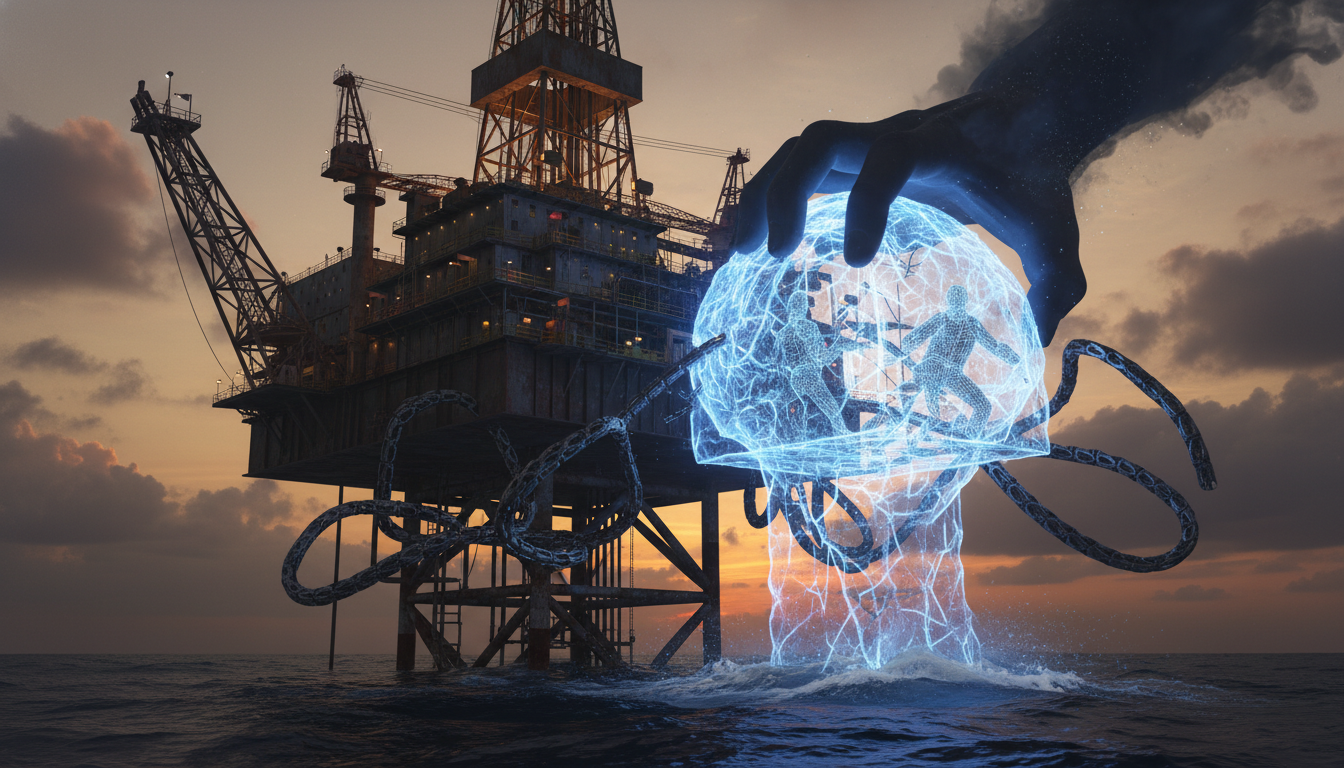
Intellectual Property Under Siege: Lessons for Energy Investors from the AI Frontier
In the high-stakes world of technology, where innovation drives valuation and competitive edge, the security of proprietary information is paramount. This truth recently played out dramatically in the artificial intelligence sector, offering critical lessons for investors in all industries, including oil and gas, as digital transformation accelerates across the energy landscape. The incident involved Anthropic, a prominent AI developer, and the unexpected public exposure of a segment of its prized Claude Code source code.
On a recent Tuesday, a portion of Anthropic’s highly regarded AI agent, Claude Code, surfaced on GitHub. The immediate aftermath was a flurry of activity, as software engineers globally scrambled to access and scrutinize the leaked material. The intention was clear: to glean insights, understand advanced architectural approaches, and potentially integrate learnings into their own projects. This rapid absorption of external intelligence to enhance proprietary systems strikingly mirrors the long-standing practice within the AI industry itself, where companies, including Anthropic, routinely leverage vast datasets of pre-existing content to train their large-language models (LLMs).
The irony of the situation was not lost on industry observers. Anthropic, a firm that has benefited immensely from the extensive use of publicly available and often copyrighted content, swiftly moved to protect its own intellectual property. The company promptly issued a Digital Millennium Copyright Act (DMCA) takedown notice, demanding the removal of the leaked code from the GitHub repository and all its subsequent forks. An Anthropic spokesperson confirmed the action, underscoring their commitment to safeguarding their creations.
The Paradox of Protection: AI’s Copyright Conundrum
This episode highlights a significant paradox at the heart of the AI industry, one with profound implications for how intellectual property (IP) is created, utilized, and protected across all tech-driven sectors, including energy. Anthropic, alongside rivals like OpenAI and Google, has faced numerous legal challenges for its alleged unauthorized use of copyrighted materials. These materials span a vast array, from published books and academic articles to scientific journals and other online content, all reportedly consumed without explicit permission for the purpose of training their sophisticated AI models.
Authors, artists, and publishers, recognizing the commercial value derived from their creative works, have increasingly turned to copyright law to seek accountability and financial redress. In a landmark ruling last September, Anthropic was ordered to pay a staggering $1.5 billion in damages. This decision stemmed from a class-action lawsuit initiated by a collective of authors and publishers, including lead plaintiffs Andrea Bartz, Charles Graeber, and Kirk Wallace Johnson. The core allegation was that Anthropic utilized pirated books and “shadow libraries” as foundational training data for its Claude AI.
The legal battles extend beyond traditional media. Last June, social media giant Reddit initiated legal action against Anthropic, alleging the unauthorized scraping of immense volumes of user-generated content from its platform. More recently, the music industry weighed in, with Universal Music Group, Concord, and ABKCO filing a suit just last month. Their claim: Anthropic illegally downloaded over 20,000 copyrighted songs, again, for the express purpose of model training. For investors, these multi-billion-dollar liabilities represent a tangible risk that can significantly impact a company’s financial health and future growth prospects.
Assessing the Damage: More Embarrassment Than Detriment?
With the tables now dramatically turned, Anthropic is vigorously employing the very copyright laws it has frequently been accused of infringing upon to shield its own technological innovations. “We’re rolling out measures to prevent this from happening again,” an Anthropic spokesperson affirmed, signaling a renewed focus on internal security protocols. For oil and gas investors eyeing the burgeoning energy tech sector, this demonstrates the critical need for robust internal controls and preemptive security strategies.
Fortunately for the company, the immediate fallout from the leak might not be as dire as initially feared. Paul Price, a seasoned cybersecurity specialist and founder of ethical hacking firm Code Wall, offered a more nuanced assessment. Price, whose firm recently exposed vulnerabilities in McKinsey’s internal chatbot, Lilli, indicated that the Anthropic leak did not compromise truly critical elements of its AI infrastructure. “It’s more embarrassing than detrimental,” Price noted. “Most of the real juicy stuff is in their internal source models and that wasn’t leaked.”
Price clarified that the inadvertently exposed component was primarily Anthropic’s “harness” – a software infrastructure designed to connect large language models to their broader operational context. He lauded Claude Code’s harness as “one of the best-designed agent harnesses out there,” acknowledging that the leak could provide valuable competitive intelligence to rival firms by revealing how Anthropic tackles complex integration challenges.
Strategic Implications for Energy Sector Investors
This incident vividly underscores a prevailing paradox within the accelerating AI hype cycle: the same sophisticated tools that enable rapid product development and deployment also inherently facilitate the swift leakage, replication, and widespread dissemination of sensitive information. For investors in the capital-intensive and data-rich oil and gas industry, where proprietary algorithms, seismic data, drilling optimization software, and operational intelligence represent significant competitive advantages, the lessons from Anthropic’s experience are invaluable.
Protecting Core Intellectual Property
The distinction between Anthropic’s leaked “harness” and its secure “internal source models” serves as a crucial reminder for energy companies. Protecting core algorithms, geological models, and predictive maintenance programs, which represent years of R&D and billions in investment, is paramount. Investors must scrutinize how energy tech firms differentiate and protect their mission-critical IP versus more peripheral integration layers. A breach of core IP could irrevocably damage market position and valuation.
Cybersecurity as a Fundamental Investment Criterion
As oil and gas operations become increasingly digitized and interconnected, from smart fields to AI-driven refineries, the attack surface for cyber threats expands exponentially. The Anthropic leak, while not catastrophic, highlights the constant vulnerability to digital exposure. Investors assessing energy companies incorporating advanced AI/ML solutions must place cybersecurity measures, data governance frameworks, and incident response capabilities high on their due diligence checklist. A robust cyber defense is no longer optional; it is a foundational element of enterprise value.
The Rising Cost of Data Acquisition and Compliance
The multi-billion-dollar lawsuits faced by Anthropic serve as a stark warning about the financial ramifications of mismanaging data rights and intellectual property. As energy companies increasingly leverage vast datasets – from sensor readings to satellite imagery and market intelligence – to train their AI models, the legal landscape surrounding data ownership and usage will only grow more complex. Investors should evaluate a company’s strategy for ethical data acquisition, compliance with evolving privacy and copyright laws, and potential exposure to costly litigation. The cost of “free” data, if legally challenged, can be astronomical.
Ultimately, the unfolding narrative around Anthropic’s leaked code and its ongoing legal battles offers a compelling case study. It reminds energy investors that while technological innovation promises immense returns, it simultaneously introduces new vectors of risk. Understanding these intertwined dynamics—the value of intellectual property, the imperative of cybersecurity, and the financial exposure from data governance—is critical for making informed investment decisions in the rapidly evolving intersection of energy and technology.
