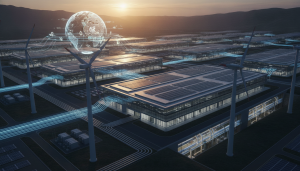
The narrative surrounding Artificial Intelligence often oscillates between revolutionary potential and fears of an impending “bubble.” While some prominent investors draw parallels to past speculative frenzies, a deeper analysis reveals that the current AI expansion is fundamentally different. It’s not merely a software phenomenon driven by fleeting trends or inflated advertising metrics; it is, at its core, the most significant energy-driven infrastructure build-out of our modern era. For oil and gas investors, understanding this distinction is crucial, as AI’s insatiable demand for power is poised to become a structural tailwind for the energy sector, challenging conventional valuation models and reshaping long-term forecasts.
AI: An Energy Infrastructure Play, Not Just Software
The prevailing mental model for evaluating technology often defaults to traditional software economics, where scalability comes with diminishing marginal costs and rapid profitability. However, AI defies this paradigm. Every computation, every model inference, and every data point processed by AI systems is ultimately an elaborate transformation of electricity into structured information. This makes AI’s economic blueprint far more akin to early industrial infrastructure projects – think the initial build-out of the electrical grid, telecommunications networks, or railroads – rather than a typical consumer application. These historical precedents were characterized by massive capital expenditure, periods of apparent operational losses, and a perceived disconnect between investment and immediate returns. Yet, they laid the foundation for entirely new economies.
Critics pointing to the heavy compute requirements and operating losses of leading AI firms often miss this fundamental shift. These are not signs of a bubble bursting, but rather the hallmarks of a foundational infrastructure being constructed from the ground up. The true cost of intelligence is measured in watts, in the physical capacity to direct vast amounts of energy towards computation. Our proprietary data on investor sentiment indicates a growing curiosity about the fundamental inputs to AI, with many asking about the “data sources” and “APIs” powering these systems. This curiosity, while focused on information, implicitly points to the underlying physical infrastructure and, critically, the energy required to sustain it. Understanding AI through this energy lens shifts the focus from speculative valuations to the tangible, thermodynamic realities that will dictate its long-term viability and growth.
Market Dynamics: AI as a Counter-Cyclical Demand Driver
The current energy market presents a complex picture. As of today, Brent Crude trades at $94.7 per barrel, reflecting a -0.82% decline within a day range of $93.87 to $95.69. Similarly, WTI Crude stands at $86.36, down -1.21%, with a daily range of $85.5 to $86.78. This softness follows a more pronounced trend; our 14-day Brent trend analysis shows a significant drop from $118.35 on March 31st to $94.86 on April 20th, a decline of nearly 20%. Such volatility naturally prompts questions from investors, with many asking whether WTI is “going up or down” and what the “price of oil per barrel will be by end of 2026.” While short-term fluctuations are influenced by geopolitical events, inventory reports, and macroeconomic sentiment, the burgeoning energy demand from AI offers a robust, structural counter-narrative.
The expansion of AI data centers requires an unprecedented scale of reliable, affordable power, primarily generated from natural gas in many regions, alongside renewables. This burgeoning demand for electricity translates directly into a sustained call on primary energy sources. While the immediate outlook for crude might be tempered by various factors, the long-term energy requirements of AI infrastructure represent a significant, sticky demand component that could underpin higher prices for natural gas and, indirectly, crude oil (given its role in industrial processes and power generation in some contexts). Investors should view these evolving market dynamics not just through the lens of traditional supply-demand balances, but also through the accelerating energy consumption of the digital frontier.
Upcoming Catalysts and Strategic Positioning for Energy Producers
Looking ahead, a series of critical energy events will shape the near-term landscape, providing both potential volatility and strategic insights for investors. The upcoming OPEC+ JMMC Meeting on April 21st will be closely watched for any signals regarding production policy, which could immediately impact crude prices. This will be followed by the EIA Weekly Petroleum Status Reports on April 22nd and April 29th, and API Weekly Crude Inventory reports on April 28th and May 5th, all of which provide crucial insights into U.S. supply and demand. Furthermore, the Baker Hughes Rig Counts on April 24th and May 1st will offer a snapshot of drilling activity, indicating future supply trajectories. Finally, the EIA Short-Term Energy Outlook on May 2nd will provide updated projections for global energy markets.
For investors, these events, while immediately impactful, must be considered within the broader context of AI-driven energy demand. While an OPEC+ decision might tighten or loosen immediate supply, the structural demand from data centers continues to grow regardless. Energy producers, including integrated majors, are increasingly evaluating their portfolios for resilience against short-term market swings and alignment with long-term demand shifts. Questions from our readers, such as “How well do you think Repsol will end in April 2026,” underscore the focus on individual company performance. Companies with strong natural gas assets, robust power generation capabilities, or those investing in the grid infrastructure itself, are strategically positioned to capitalize on the AI energy build-out, offering a compelling long-term investment thesis beyond transient market headlines.
Investment Strategy: Capitalizing on AI’s Energy Footprint
Given AI’s fundamental reliance on energy infrastructure, investors in the oil and gas sector should re-evaluate their portfolios through this lens. The “bubble” narrative, focused on software valuations, distracts from the undeniable physical reality that AI requires immense, sustained power. This translates into actionable investment opportunities in several key areas:
Firstly, natural gas producers stand to benefit significantly. As the primary fuel for dispatchable power generation, natural gas will be crucial for meeting the surging electricity demands of AI data centers, especially as renewables alone cannot provide the 24/7 baseload power required. Secondly, companies involved in power generation and grid infrastructure will see increased capital allocation and demand for their services. This extends to midstream companies facilitating gas transport and storage, and even industrial firms supplying materials for data center construction and electrical grid upgrades. Investors should seek out entities demonstrating clear strategies to leverage this energy transition, whether through expanding natural gas production, investing in integrated power solutions, or developing resilient energy infrastructure. The long-term forecast for energy demand, particularly electricity, is undergoing a fundamental re-rating due to AI, presenting a durable investment theme that extends far beyond the immediate market gyrations.