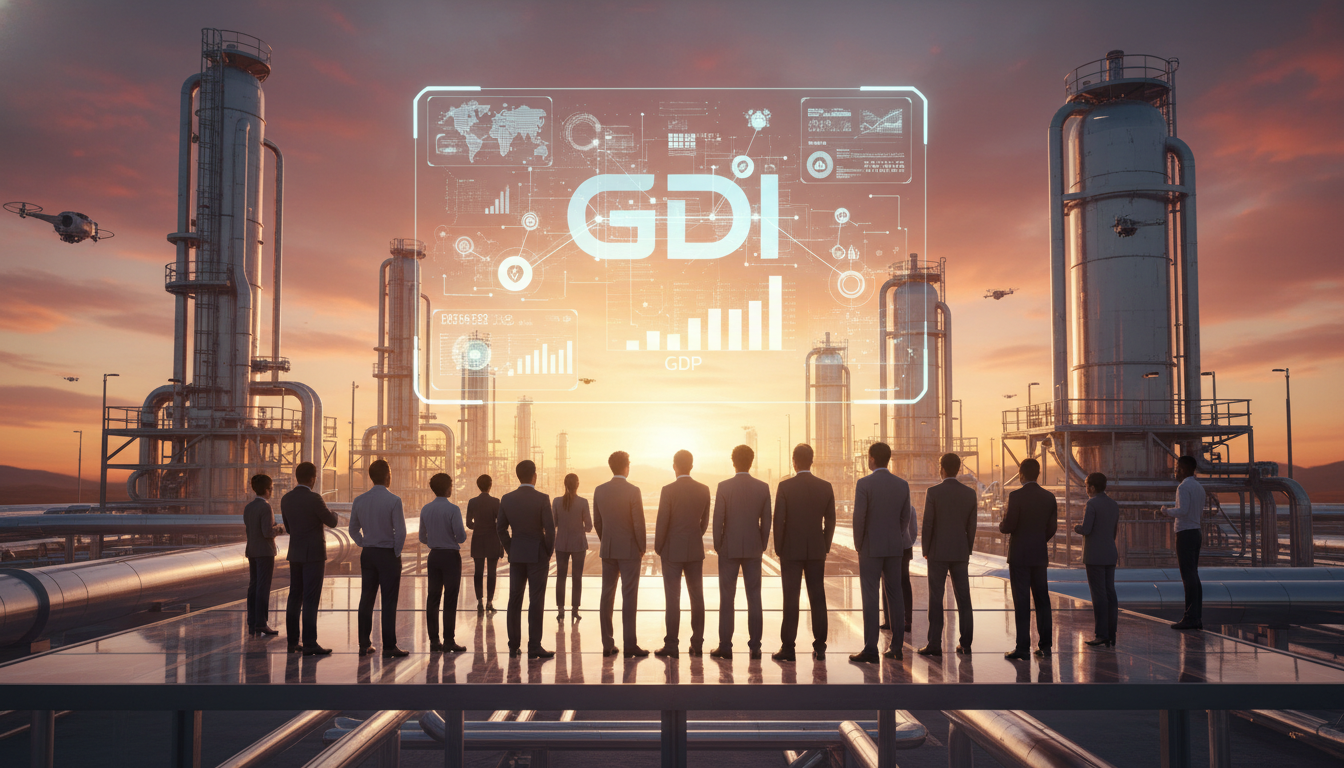
AI Era Investors: GDI Trumps GDP in the Energy Equation
In a global economy increasingly defined by digital dominance, traditional economic metrics are proving insufficient for discerning true national power and future investment opportunities. For astute investors in the oil and gas sector, a new benchmark is emerging: Gross Domestic Intelligence (GDI). This innovative indicator moves beyond conventional Gross Domestic Product (GDP) to quantify a nation’s foundational access to artificial intelligence resources. Understanding GDI is no longer a peripheral concern but a strategic imperative, directly influencing long-term energy demand, critical infrastructure development, and the shifting geopolitical landscape that underpins the global energy market.
The Rise of Gross Domestic Intelligence: A New Investment Lens for Energy
The concept of Gross Domestic Intelligence represents a profound shift in how financial powerhouses, including leading investment banks, are beginning to assess national competitiveness. This isn’t just about technological advancement; it’s about the very capacity to generate and leverage AI, which will become a cornerstone of national influence and, by extension, profoundly impact the industries that power our world. At its core, GDI measures a nation’s comprehensive access to the fundamental building blocks of artificial intelligence. This primarily encompasses advanced AI compute infrastructure, featuring the latest generation of Graphical Processing Units (GPUs) like Nvidia’s H100 equivalents, sophisticated networking hardware, and the sprawling, energy-intensive data centers necessary to house and power these systems. It’s an ecosystem assessment, not merely a count of chips, acknowledging that the ability to operate and scale AI capabilities demands immense, reliable energy inputs.
Global GDI Disparities and Their Energy Footprint
Recent analysis, drawing on updated data from Q4 2025, solidifies a significant global imbalance in AI computational power. The United States continues to hold an overwhelming lead, commanding approximately 75% of the world’s share. This dominance is underscored by American companies, particularly giants like Google, with their extensive proprietary TPUs and substantial allocations of Nvidia GPUs, which stand out as unparalleled leaders in computational might. In contrast, China trails significantly, holding roughly 10%, followed by the European Union, Norway, and Japan. This persistent and widening gap in GDI has direct implications for energy investors. Where AI compute resources are concentrated, an exponential surge in electricity demand is inevitable. This translates into increased demand for natural gas, a primary fuel for power generation, and potentially for crude oil derivatives in regions reliant on liquid fuels for grid stability. The sustained US lead in GDI signals a sustained domestic energy demand trajectory that warrants close monitoring from a strategic investment perspective.
Navigating Volatility: GDI, Geopolitics, and Investor Sentiment
The long-term implications of GDI are playing out against a backdrop of ongoing market volatility, keeping investors on edge. As of today, Brent Crude trades at $95.57 per barrel, reflecting a notable increase of +5.74% within the day’s range of $92.77 to $97.81. Similarly, WTI Crude stands at $87.45, up +5.88% from a daily range of $85.45 to $89.60. This recent upward swing follows a significant retreat, where Brent crude prices slid from $112.78 on March 30th to $90.38 by April 17th, marking a nearly 20% decline. Such sharp fluctuations inevitably lead to investor uncertainty. We’ve observed our readers keenly asking “is WTI going up or down?” and seeking clarity on “what do you predict the price of oil per barrel will be by end of 2026?” While short-term price movements are influenced by immediate supply-demand dynamics and geopolitical headlines, GDI offers a crucial overlay for long-term forecasting. The strategic importance of AI compute power directly ties into geopolitical stability and the security of energy supply chains. Nations with high GDI will seek to secure robust and resilient energy resources, potentially influencing global trade flows and investment decisions in key producing regions, regardless of short-term market noise.
Forward Outlook: Upcoming Events and the GDI Energy Nexus
Looking ahead, the interplay between GDI’s long-term energy demands and upcoming market events will be critical for investors. The OPEC+ Joint Ministerial Monitoring Committee (JMMC) Meeting on April 20th and the full OPEC+ Ministerial Meeting on April 25th are pivotal. Decisions from these gatherings regarding production quotas could significantly impact global crude supply stability. Any move towards increased cuts, for instance, could tighten markets further, pushing prices upward and increasing operational costs for energy-intensive AI infrastructure. Conversely, maintaining or increasing output could provide a more stable supply, beneficial for nations striving to expand their GDI. Beyond OPEC+, weekly data from the EIA, with its Petroleum Status Report on April 22nd and April 29th, will offer vital insights into US crude inventories, refining activity, and production trends. The Baker Hughes Rig Count reports on April 24th and May 1st will provide a real-time pulse on drilling activity. These domestic supply indicators are particularly relevant given the US’s leading GDI position; sustained domestic energy production is essential to fuel the rapidly expanding computational infrastructure required for AI. Investors should monitor these events closely, not just for their immediate price impact, but for their implications on the long-term energy security required to power the global AI revolution.


