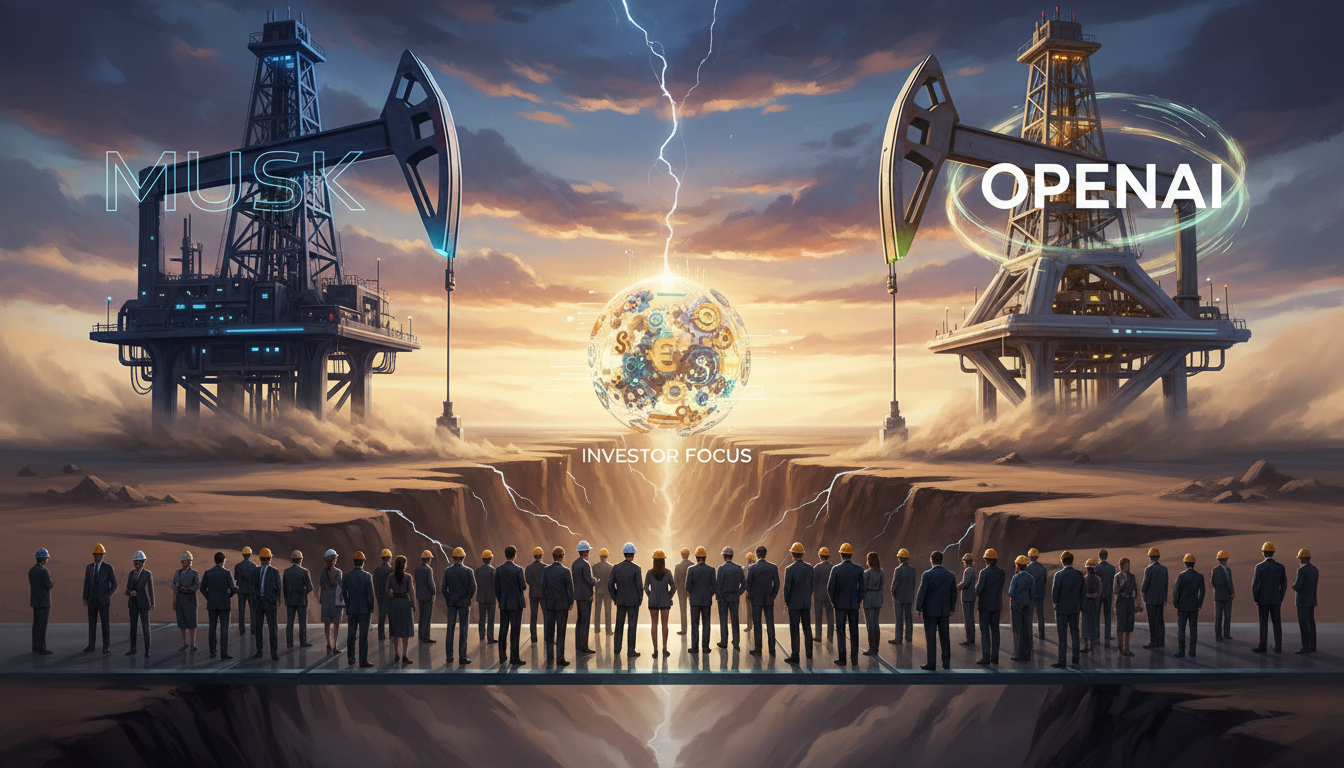
The high-stakes world of advanced artificial intelligence development recently offered a stark illustration of strategic divergence and leadership clashes, as an OpenAI executive recounted a fiery exchange with co-founder Elon Musk. This testimony, delivered before a federal jury, pulls back the curtain on the intense ideological battles that shape the future of tech giants and, by extension, investment landscapes.
Joshua Achiam, serving as OpenAI’s chief futurist, detailed a “pretty tense exchange” during a civil trial involving Musk and OpenAI CEO Sam Altman. The incident culminated in Musk allegedly branding Achiam a “jackass,” a moment that encapsulates the deep philosophical rifts at the heart of AI innovation and corporate governance.
Strategic Departures and the Battle for Talent
The contentious encounter unfolded during a company-wide meeting in February 2018, gathering approximately 50 to 60 employees. This crucial assembly preceded Musk’s eventual departure from the AI startup he helped establish. Achiam, then a research scientist, testified that Musk outlined his primary reason for leaving: an impending conflict of interest arising from Tesla, Musk’s electric vehicle behemoth, directly competing with OpenAI for the world’s most sought-after AI engineering talent.
For investors, this “talent war” is a critical metric. The ability to attract and retain elite technologists is a core driver of innovation and competitive advantage in the rapidly evolving AI sector. Musk’s foresight into this impending talent crunch underscores the immense value placed on human capital in high-tech ventures, where the scarcity of specialized expertise can significantly influence a company’s trajectory and long-term valuation. This dynamic is not unlike the fierce competition for specialized geologists or engineers in niche energy sectors, where human ingenuity translates directly into operational efficiency and exploratory success.
Divergent Visions: Rapid Ascent vs. Responsible Development
Beyond talent acquisition concerns, Achiam highlighted a more profound strategic disagreement. Musk, according to Achiam, expressed “a general lack of confidence in OpenAI’s overall path.” It became evident that Musk was intent on pursuing Artificial General Intelligence (AGI) on his own terms, at an accelerated pace. His rationale was rooted in a deep-seated apprehension that if another entity achieved AGI first, they might mismanage its immense power, leading to potentially catastrophic outcomes. This fear fueled a desire to “race towards AGI,” building it with unprecedented speed.
Achiam and a cohort of his colleagues, however, viewed such a rapid and unbridled sprint towards AGI as a “fairly unsafe proposition.” They articulated concerns that Musk’s proposed acceleration seemed “reckless.” The specter of a “science fiction super intelligence bootstrapping event”—a scenario where an AI system could exponentially enhance itself overnight, gaining capabilities to “crack encryption and take over the world”—loomed large in their considerations. For these scientists, the line between theoretical speculation and imminent danger was dangerously blurred.
This fundamental divergence in strategy presents a classic investment dilemma: how do companies balance aggressive innovation for market leadership against the imperative for responsible and ethical development? Investors assessing AI firms must weigh the potential for groundbreaking returns against significant, even existential, risks. A management team’s approach to these ethical guardrails can profoundly influence stakeholder trust, regulatory scrutiny, and ultimately, a company’s sustainable growth trajectory.
Leadership Style and the Cost of Dissent
When questioned about Musk’s intent behind the “jackass” remark—specifically, whether it was an attempt to push him beyond his “comfort zone,” as Musk had suggested in earlier testimony—Achiam emphatically disagreed. He believed the comment stemmed directly from Musk’s frustration at being “challenged,” not from a pedagogical motive. This insight offers a glimpse into the high-pressure environment of top-tier tech leadership and the personality dynamics that can profoundly impact corporate decision-making.
In any investment context, understanding the leadership’s temperament and its approach to internal dissent is crucial. A culture that stifles challenge or punishes honest feedback can lead to echo chambers, blind spots, and ultimately, poor strategic choices. Conversely, an environment that encourages robust debate, even if contentious, often fosters resilience and more thoroughly vetted strategies, enhancing long-term value for investors.
The Emblem of Principled Opposition
The aftermath of the heated meeting reinforced the gravity of Achiam’s stance. Colleagues privately conveyed their gratitude for his willingness to confront the tech titan. The sentiment culminated in a public acknowledgment at the subsequent company all-hands meeting, where Achiam was presented with a unique award. The trophy, a golden figurine depicting a “jackass,” bore a memorable inscription: “Never stop being a jackass for safety.”
This commemorative gesture speaks volumes about the internal culture OpenAI was cultivating—one that, at least among a significant segment of its employee base, valued principled opposition and a commitment to ethical considerations above the immediate dictates of a powerful co-founder. For astute investors, corporate culture is not merely a soft metric; it is a tangible asset that influences employee retention, innovation velocity, and a company’s ability to navigate complex ethical landscapes. A strong, principled culture can be a powerful differentiator, signaling a robust foundation for sustainable growth and a proactive approach to potential societal impacts, which are increasingly under the microscope of ESG-conscious funds. Understanding these internal dynamics is key to unlocking a true understanding of an entity’s investment potential beyond headline figures.
The episode highlights that even at the pinnacle of technological innovation, human factors—leadership styles, strategic disagreements, and cultural values—remain potent forces shaping market outcomes and investor perceptions. These are the underlying currents that financial journalists scrutinize, seeking to provide a comprehensive view of value creation and risk mitigation in the volatile, yet profoundly promising, world of advanced AI.


