

Current Climate brings you the latest news about the business of sustainability every Monday. Sign up to get it in your inbox.
The Trump administration’s elimination of tax credits for electric vehicle purchases had the predicted effect in the final quarter of 2025, triggering a 36% drop for the segment after a spike in the third-quarter as Americans raced to grab the $7,500 incentive before it vanished. As a result, full-year EV sales dropped 2% to 1.275 million from a record 1.3 million in 2024, according to Cox Automotive.
The outlook for battery-powered vehicles in the U.S. this year isn’t much better, with London-based forecaster Benchmark Minerals Intelligence anticipating a further 29% drop. But that weakness isn’t the story worldwide. In fact, global EV sales could jump nearly 16% this year to 23.9 million units, with China growing about 20% and Europe rising by 14%.
Against the domestic downturn, General Motors and Ford have announced huge shifts in their strategy and are taking big writedowns as a result: Ford booked a $19.5 billion charge last year and cancelled its electric F-150 Lightning pickup. GM has so far said it’s taking charges of at least $7.6 billion to scale back its battery and EV production plans, a big reversal from steady investments in recent years.
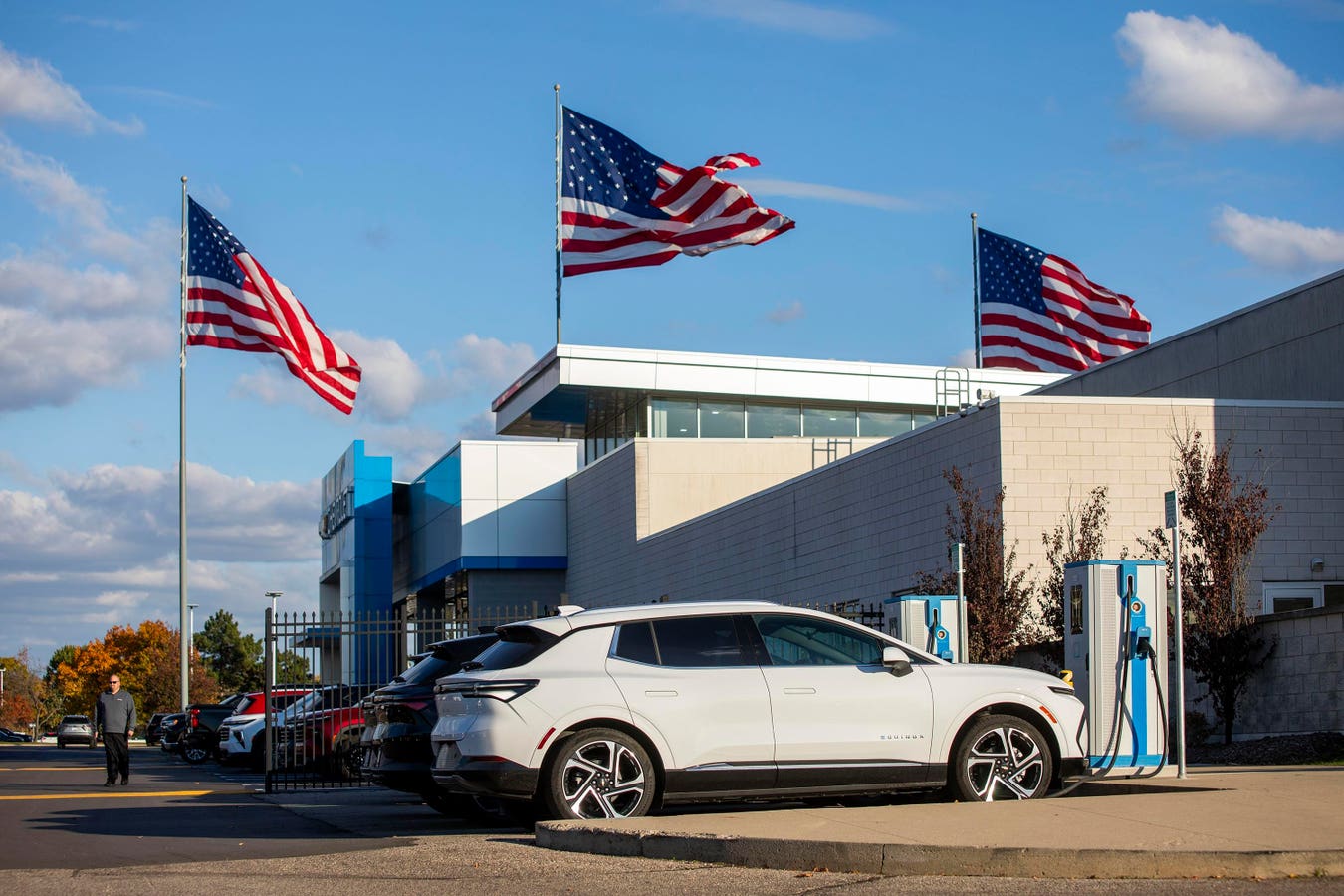
GM’s shift is particularly surprising since it quietly became the second-biggest EV seller in the U.S. last year, delivering nearly 170,000 models through its Chevrolet, Cadillac and GMC brands, a company record and 48% annual increase. Only Tesla, which posted a 7% U.S. drop in 2025, sold more. And with that brand growing increasingly toxic in California, the top U.S. EV buyer, because of CEO Elon Musk’s strident political and social views, there’s certainly an opportunity for GM, with affordable models like its Equinox EV and revamped Bolt hatchback, to grab more market share.
The $27 billion of cuts by Ford and GM, pivoting to increased sales of big, gasoline-powered SUVs and pickups, perhaps make short-term economic sense, but looks short-sighted and out of step with the direction the world is heading. China is already the leading maker and buyer of EVs – consumer sales there were 10 times those in the U.S. – and it’s finding more opportunities in both developing and advanced markets eager for its affordable products. Even Canada, which up to now has followed the U.S. lead on keeping Chinese EVs out with 100% tariffs, is changing that policy. It plans to import up to 49,000 models in exchange for lower tariffs on its agricultural exports, drawing Trump administration criticism.
Rather than cutting back so sharply on their EV operations, both Ford and GM would be wise to focus on affordable, mass-market models that promise high volume, building on the success of the Mustang Mach-E and GM’s electric Equinox – and look beyond the U.S. Both companies are loaded with smart engineers, many of whom helped build up Tesla, and have made big gains in battery R&D and production. Despite the company’s cutbacks, GM CEO Mary Barra said EVs remain the future, choppy conditions in the U.S. aside
“Once we have more affordable EVs…I think people will pick EVs,” she told reporters last week. “We’re going to be pragmatic about it.”
One could argue that with its Equinox EV, priced from $33,600, and Bolt, starting at $29,000, models far below an average new vehicle price of nearly $50,000, GM has met Barra’s affordability requirement. Her “pragmatic” may to have more to do with ensuring the company doesn’t anger an administration that simply hates electric cars.
The Big Read
Brightline Hires Ex-Eurostar Chief As Vegas Bullet Train Costs Climb
Brightline, the private passenger railway created by billionaire investor Wes Edens, has tapped Nicolas Petrovic, a past head of the high-speed Eurostar line, as its new CEO, taking the wheel from Mike Reininger, who will now focus on getting the company’s Las Vegas-to-Southern California bullet train built.
Petrovic, who most recently led Etihad Rail Mobility, the high-speed system in the United Arab Emirates, will focus on building up Brightline’s Florida service and ridership, which operates between Orlando and Miami. Reininger is shifting to managing director of Brightline West, tasked with getting the $21 billion, 218-mile bullet train built and running by 2029.
“The insights Nicolas brings from around the globe will strengthen our operating company as it continues to grow and expand, while Mike concentrates his focus once again on implementing an unprecedented infrastructure development,” Edens said in a statement. The company also named Mauricio Anderson as its new CFO.
Becoming a 21st-century U.S. rail baron has been a goal of Eden’s, a Fortress Investment Group cofounder and co-owner of sports teams, including the NBA’s Milwaukee Bucks and European soccer teams like the Premier League’s Aston Villa. But bringing modern 200 MPH+ rail travel to the United States is taking longer and costing more than he’d initially anticipated. Ridership on Brightline’s Florida trains, which operate well below 150 miles per hour, is growing, up 13% through November 2025 to 2.8 million people, but its aspirations are much higher. Likewise, revenue on the line was $193.4 million through November, up 14% from a year earlier. Growth should continue in 2026 with the addition of new rail cars from Siemens, another of Petrovic’s former employers, and a potential expansion of the line to Tampa in the coming years.
Read more here
Hot Topic
Star Tribune via Getty Images
Christophe Beck, CEO of Ecolab, on solving the data center water problem
Along with power needs, the other issue with data centers is the growing consumption of water, a finite resource, for cooling. How does this get solved?
Stepping back for a second, water is at the heart of AI and it’s at the heart of a lot of other things. It’s at the heart of life. It’s at the heart of growth. It’s at the heart of our future. It’s been true for millions of years. All the water we have is on the planet. There’s nothing else that’s coming from outer space.
Humans have always found a way to make it work, and I think that’s going to be the path forward. The key issue we have is that humans have been using, for way too long, water in linear ways. You take it, you use it, you dump it, and you hope for the best.
That’s not the way nature does it. As we know it, it’s a circular system that goes to the cloud, it rains, comes back, and all that, which is more complicated. But that’s the only way to be moving from finite to infinite, because when you’re circular, you don’t have any issues.
When we think about AI, I think about three dimensions and [Ecolab] tries to address all three. You need water to produce power. It’s the number one place where water is going in the U.S. Second is to cool the data centers, and third is to produce the chips. When I think about those three dimensions, you say, well, water is at the core of what’s happening here. At the same time, AI is growing exponentially, love it or hate it. It was 27% of the market last year for power usage – up 10 times from 2023. So AI was growing 10 times within 12 to 24 months. We’re kind of trying to catch a tiger by the tail.
So for Ecolab, you’re working with companies to create closed systems that use the same amount of water over and over again?
Yes. The way we look at it is, how do we use water in a circular way? That’s what we do for power generation, like in a nuclear power plant. You try to reuse water as often as you can. In a data center, it used to be air-cooled, like an AC in a big room, cooling computers. It’s moved a little bit in the last two years toward liquid cooling.
The way we solve this isn’t to use no water. It’s ultimately to use and reuse water in a closed loop.
Ecolab provides a range of services for industrial companies. Are data centers now the fastest-growing part of your business?
No doubt. And it became the fastest-growing in the last three years, with the whole OpenAI kickoff game that we’ve all experienced. Three years ago, for us, data centers were computer centers that banks had, that cities had, that universities had. And for us, being the largest water and cooling company in the world, we were looking at those locations as air conditioning projects. That was normal times – pretty flat, pretty boring. Then suddenly, everything changed when AI really, really took off with the arrival of OpenAI.
So we’ve reorganized into these three new dimensions: cooling, power generation, and AI chip production, because those are three different technologies.
It’s helping us as a company to grow because our solutions are circular solutions: reuse water as much as you can. It helps you ultimately to operate in places that have very limited amounts of water and limited amounts of power, as well.
What Else We’re Reading
At least 22GW of renewables thwarted or in limbo under Trump’s “blockade” (Canary Media)
Is anything left of the American Climate Corps? (Grist)
Data from multiple international agencies show ‘unprecedented run of global heat’ (Inside Climate News)
In green California, very little plastic is being recycled (Los Angeles Times)
House passes bill codifying Trump’s executive order that gets rid of water-saving showerhead regulations (Associated Press)
Economists’ climate models can predict catastrophic or modest damage, but not which of these futures is coming (The Atlantic)
