Big Oil Faces Steep Profit Decline: A Post-Pandemic Low for Energy Giants
The world’s preeminent oil and gas companies are navigating their most challenging financial landscape since the global health crisis, as a significant downturn in crude prices compresses profit margins and erodes investor confidence. This year marks a third consecutive period of declining earnings for the sector’s behemoths, a sharp reversal from the record-setting profits witnessed in 2022 following the geopolitical upheaval in Eastern Europe. Collectively, the adjusted net income for five of the largest integrated energy companies – ExxonMobil, Shell, TotalEnergies, Chevron, and BP – is projected to have plummeted by approximately $90 billion from 2022 to 2024, signaling a profound shift in market dynamics for shareholders.
Market Headwinds Intensify Pressure on Energy Majors
Recent weeks have seen an acceleration of adverse market conditions weighing heavily on the industry. An increase in global supply from OPEC producers, coupled with escalating international trade tensions, has dampened overall market sentiment. Brent crude, the international benchmark, briefly dipped below $60 a barrel this month, underscoring the bearish outlook. Financial analysts are now forecasting that crude prices in the second half of 2025 could average more than 20% lower than last year’s average of $81 a barrel, presenting a formidable challenge to profitability and investment strategies across the sector. Investors must carefully assess how these macroeconomic pressures will impact future earnings and shareholder returns.
Shareholders Demand Fiscal Discipline Amidst Volatility
Against this backdrop of softening crude prices and an uncertain geopolitical climate, investors are scrutinizing the financial resilience of these major energy players. A key concern for shareholders revolves around which companies possess the stringent cost discipline and robust balance sheet strength necessary to sustain the elevated dividends and share buyback programs that have become commonplace in recent years. As one analyst from RBC Capital Markets observed, “The core questions emerging from investors center on identifying who will initiate spending cuts first. Given the profoundly uncertain environment, capital allocators are actively seeking assurances regarding financial stability and commitment to shareholder value.” This highlights a critical period for management teams to demonstrate their strategic acumen.
Eni’s Strategic Response Offers a Potential Industry Blueprint
Preliminary first-quarter results from Italian energy major Eni, released last week, provided an early glimpse into how companies might adapt to these challenging conditions. Eni committed to reducing its capital expenditure by at least $500 million this year and forecasted its cash flow to be $2 billion, or 15%, lower than anticipated at an oil price of $65 a barrel. Crucially, the company reaffirmed its commitment to maintaining shareholder distributions, signaling a strategic prioritization of investor returns despite the operational headwinds. Analysts at HSBC lauded Eni’s approach as a “template to follow” for its global peers, though they cautioned that not all companies possess the requisite balance sheet strength to execute such a strategy effectively without impacting long-term growth prospects.
Industry-Wide Capital Expenditure Adjustments Underway
Beyond individual company strategies, a broader trend of scaling back investments is becoming evident across the entire oil and gas sector in response to the sustained price slump. According to a recent report from energy consultancy Wood Mackenzie, global upstream development spending is now expected to decrease year-on-year for the first time since 2020. This reduction in capital allocation to exploration and production projects signifies a defensive posture adopted by many industry participants, prioritizing cash preservation and short-term profitability over aggressive growth. Investors should monitor these capital expenditure trends closely, as they will influence future supply dynamics and long-term asset valuations.
Upcoming Earnings Season: Focus Shifts to Forward Guidance
The forthcoming earnings season will provide further critical insights into the financial health and strategic direction of the supermajors. BP is scheduled to report its results on Tuesday, followed by TotalEnergies on Wednesday, with Shell, ExxonMobil, and Chevron rounding out the week on Friday. While analysts generally anticipate a weak first quarter from these companies, the most significant declines in oil prices occurred after the reporting period concluded. Consequently, investor attention will primarily center on the forward guidance offered by management teams, particularly their outlook on capital allocation, production targets, and shareholder return policies in the prevailing lower price environment.
Shell Demonstrates Resilience with Proactive Shareholder Commitments
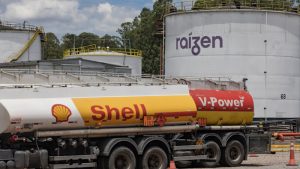
Among the European majors, Shell appears to be particularly well-positioned to weather the current downturn, having proactively outlined its strategy for sustained shareholder returns. In March, Chief Executive Wael Sawan pledged to return half of Shell’s cash flow to investors. Significantly, he also affirmed the company’s ability to continue its share buyback program even if crude prices fall to $50 a barrel and committed to maintaining its dividend at an oil price as low as $40 a barrel. Such explicit commitments provide a strong signal of financial robustness and confidence in the company’s operational efficiency, potentially reassuring investors seeking stability in a volatile market.
Navigating the Volatility: A Critical Period for Investor Value
In conclusion, the oil and gas sector faces a challenging period marked by significant profit compression, reminiscent of the immediate post-pandemic era. The confluence of falling crude prices, increased supply, and geopolitical uncertainties demands strategic agility and robust financial discipline from energy giants. As the earnings season unfolds, investors will be keenly observing which companies demonstrate the clearest path to maintaining shareholder value through prudent capital management, cost control, and unwavering commitments to distributions. Those supermajors that can effectively navigate this environment while protecting their balance sheets and rewarding shareholders will likely emerge as preferred long-term investments in the evolving energy landscape.