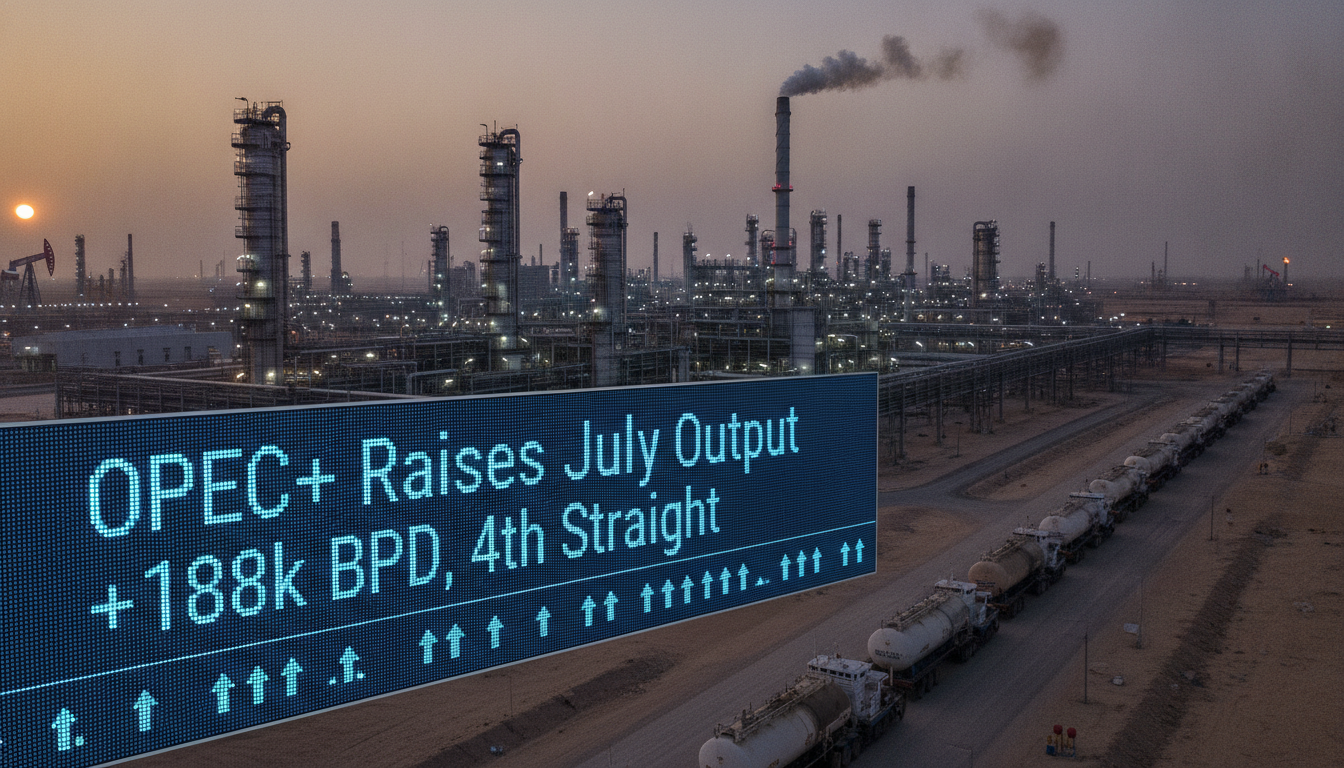
OPEC+ Signals Continued Supply Push Amid Geopolitical Volatility
In a significant move watched closely by global energy markets, the influential OPEC+ alliance has again committed to a calibrated increase in its oil production targets. The cartel, comprising the Organization of the Petroleum Exporting Countries and its key non-OPEC partners, including Russia, finalized an agreement on Sunday to lift output quotas by 188,000 barrels per day (bpd) commencing in July. This decision marks the fourth consecutive month of target increases, underscoring a steady, albeit cautious, approach to supply management even as geopolitical tensions in the Middle East continue to cast a long shadow over global crude flows.
The latest adjustment aligns with the increment seen in June, following a slight recalibration from the 206,000 bpd monthly boosts implemented in April and May. This earlier adjustment came after the United Arab Emirates opted to exit the broader OPEC+ framework, necessitating a recalculation of the collective quotas. The ongoing US-Iran conflict, a persistent source of instability, continues to exert pressure on exports from several critical member nations, exacerbating disruptions to the intricate web of global energy supplies.
The Strait of Hormuz Bottleneck: A Persistent Supply Challenge
A critical factor influencing market dynamics and investor sentiment remains the precarious situation surrounding the Strait of Hormuz. This vital maritime choke point, through which a significant portion of the world’s seaborne oil transits, faces continuous disruption due to the escalating conflict. Market observers have characterized the current environment as potentially the most severe oil supply crisis ever witnessed, with major crude producers in the Persian Gulf, notably Saudi Arabia, struggling to fully satisfy customer demand since late February.
Despite the alliance’s intention to incrementally increase output, the tangible impact of these decisions is often curtailed by these external pressures. Since April, the seven core OPEC+ members participating in this specific unwinding process have collectively elevated their production quotas by nearly 600,000 bpd. This forms part of a broader strategy to gradually phase out the substantial 1.65 million bpd voluntary production cuts initially agreed upon in 2023. However, the reality on the ground shows actual crude production lagging significantly behind these ambitious target levels.
Production Realities Versus Stated Targets
Discrepancies between targeted and actual output highlight the challenges confronting the alliance. According to OPEC’s own data, the group’s total production in April averaged 33.19 million bpd, representing a sharp decline from the 42.77 million bpd recorded in February. This pronounced drop directly reflects the severe export disruptions impacting key Gulf producers, underscoring the vulnerability of supply chains to regional instability.
Industry analysts are quick to point out the practical limitations of these output increases. Jorge Leon, an energy analyst with Rystad and a former OPEC official, succinctly articulated the market’s skepticism, stating, “An OPEC+ production increase means very little while the Strait of Hormuz remains closed.” He further cautioned investors about the potential for rapid market shifts: “When the Strait of Hormuz reopens, the market could move very quickly from fear of shortage to fear of surplus.” This underscores a critical duality for investors: an immediate supply crunch countered by the prospect of future oversupply should geopolitical risks abate.
Market Response and Oil Price Dynamics
In the immediate aftermath of the OPEC+ announcement and amid perceptions of an easing in US-Iran conflict escalation, oil prices experienced a notable dip. Crude benchmarks settled around $93 a barrel on Friday, a retreat from levels that previously neared $72 a barrel before the conflict’s onset. This fluctuation reflects the market’s hypersensitivity to geopolitical developments and its constant recalibration of risk premiums. Investors are weighing the impact of potential supply shortfalls against any signals of de-escalation that could pave the way for increased export volumes.
The sustained volatility underscores the importance of a nuanced understanding of market drivers, where supply fundamentals, geopolitical events, and speculative sentiment intertwine to dictate price trajectories. For investors, monitoring the intricate dance between production targets, actual output, and geopolitical developments remains paramount for navigating these turbulent waters.
The Gradual Unwinding of Cuts Nears Completion
The seven nations actively participating in the Sunday meeting – Saudi Arabia, Iraq, Kuwait, Algeria, Kazakhstan, Russia, and Oman – are pressing ahead with their strategy to systematically reverse the 1.65 million bpd voluntary production cuts established in 2023. Calculations indicate that following the July increase, approximately 567,000 bpd of the original cut still needs to be reinstated into the market. This figure accounts for the UAE’s earlier departure from the group’s coordinated effort.
Should OPEC+ maintain its current trajectory of monthly increases around 188,000 bpd through August and September, the market could witness the full unwinding of these remaining cuts by the close of the third quarter. This brings the group closer to a full restoration of pre-cut production levels, potentially setting the stage for different supply-demand dynamics as 2026 progresses. Investors should closely track this timeline, as the completion of this unwinding phase will mark a significant milestone in OPEC+’s post-pandemic supply management strategy.
Strategic Outlook for Energy Investors
The latest OPEC+ decision, while reinforcing a commitment to supply stability, also highlights the inherent complexities and risks in the contemporary oil market. Geopolitical instability, particularly in the critical Strait of Hormuz, continues to overshadow production targets, creating a persistent divergence between announced increases and actual crude availability. For astute energy investors, this situation presents a dynamic landscape demanding careful analysis.
The potential for a swift pivot from perceived scarcity to surplus, as articulated by market experts, underscores the need for agile investment strategies. While current prices reflect ongoing supply constraints and geopolitical risk premiums, the complete unwinding of the 2023 cuts by September could shift the supply-demand balance. Investors should meticulously monitor geopolitical developments, actual production figures, and the broader global economic outlook to effectively position portfolios in an energy market defined by both persistent challenges and evolving opportunities.


