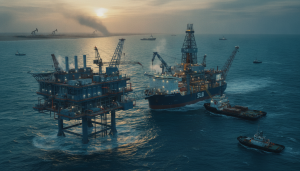
In a significant move poised to influence investment decisions across the energy sector, Shell has achieved a groundbreaking milestone by securing MiQ methane emissions certification for its entire Gulf of Mexico production portfolio. This landmark certification, covering all ten of the supermajor’s offshore assets in the region, awards them the organization’s highest Grade A methane performance rating. For investors tracking the evolving landscape of environmental, social, and governance (ESG) factors, this development signals a critical step in operational transparency and de-risking future energy portfolios.
Elevating Standards: First-Ever Offshore Crude Certification
The certification, rigorously conducted through an independent third-party audit against MiQ’s stringent methane emissions standard, marks a pivotal moment for the industry. Notably, this is the first instance where MiQ has extended its verification to offshore crude oil production assets. Historically, MiQ’s focus has predominantly been on natural gas operations. Expanding its scope to crude oil underscores the growing imperative for comprehensive methane accountability across all hydrocarbon streams.
Achieving a Grade A rating from MiQ signifies not only a remarkably low methane intensity within Shell’s GoM operations but also highlights robust monitoring and mitigation programs designed to proactively detect and reduce emissions. For institutional and retail investors alike, this independent validation offers a layer of confidence in Shell’s operational integrity and its commitment to reducing its environmental footprint.
Operational Excellence Meets Environmental Stewardship
Shell’s achievement in the Gulf of Mexico is particularly compelling given its concurrent operational performance. The company reports a substantial 40% reduction in methane emissions from its Gulf of America operations since 2016. What makes this figure truly stand out is that it has been achieved while simultaneously increasing production by 40% over the same period. This demonstrates a rare and highly sought-after combination of growth and environmental progress, challenging the long-held industry assumption that increased production necessarily leads to higher emissions.
As one of the basin’s largest offshore operators, Shell’s portfolio has previously been noted for its exceptionally low greenhouse gas intensity compared to global oil production averages. This latest certification further solidifies that reputation, offering tangible evidence of disciplined execution and operational excellence in challenging deepwater environments. Investors are increasingly prioritizing companies that can deliver both profitability and demonstrable sustainability, making such metrics crucial for long-term value creation.
The Growing Imperative of Methane Transparency for Investors
The move by Shell and the expanding influence of organizations like MiQ reflect a broader industry trend towards greater methane emissions transparency. As regulatory frameworks tighten globally and investor scrutiny intensifies, credible emissions data is becoming a non-negotiable component of market access and financial viability. MiQ’s CEO, Georges Tijbosch, emphasized this point, stating that Shell’s certification serves as a blueprint for how operators can future-proof their operations in an environment where verified emissions data is essential for both compliance and market competitiveness.
For financial stakeholders, understanding a company’s methane performance transcends mere environmental compliance; it directly impacts financial risk and opportunity. Poor methane management can lead to significant regulatory fines, reputational damage, and even restricted access to capital markets increasingly favoring ESG-compliant investments. Conversely, robust performance, independently verified, can enhance shareholder value, attract sustainable investment flows, and secure a competitive edge in a rapidly evolving energy landscape.
MiQ’s Expanding Reach and Future Outlook
MiQ, a not-for-profit organization dedicated to methane emissions certification, is rapidly establishing itself as a key arbiter of environmental performance in the energy sector. The organization currently certifies over 30% of U.S. natural gas production and more than 7% of the global gas supply. Its expansion into offshore crude oil certification, spearheaded by Shell’s GoM assets, signals a significant broadening of its influence and scope.
This expanding reach implies that methane verification will become an increasingly standard expectation across all facets of oil and gas production. Investors should anticipate a future where detailed, independently verified methane intensity data becomes a routine component of company disclosures, directly influencing valuation models and investment decisions. Companies demonstrating proactive engagement with such certification standards, like Shell, are positioning themselves favorably for the coming decade, showcasing a proactive approach to environmental responsibility that aligns with long-term financial resilience and enhanced shareholder confidence.