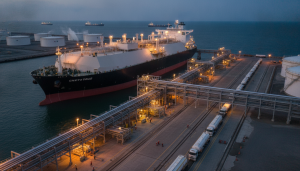
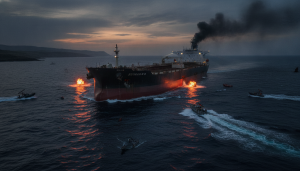
The global oil market is grappling with a profound shift in its fundamental calculus, as the recent conflict in the Persian Gulf redefines the operational reality of the Strait of Hormuz. Investors must prepare for a future where hydrocarbon exports through this critical maritime chokepoint may never fully revert to pre-war volumes, creating persistent supply uncertainties and influencing long-term energy strategies.
The cessation of hostilities on February 28, initiated by the U.S. and Israel, saw Iran effectively close the sea lane, triggering the largest oil supply disruption in history. This move demonstrated Tehran’s significant leverage, which it now appears intent on consolidating through any eventual peace settlement. The consensus among regional leaders, as articulated by former senior energy and national security advisor Amos Hochstein, is stark: Iran will maintain de facto control over the Strait of Hormuz for the foreseeable future, irrespective of formal agreements. “Everybody in the region believes that,” Hochstein affirmed.
A New Paradigm for Hormuz Traffic
This evolving geopolitical landscape casts a long shadow over the future of oil tanker movements. Helima Croft, head of global commodity strategy at RBC Capital Markets, warns that any resolution granting Iran operational influence over the Strait will invariably lead to “appreciably lower flows” through the waterway. The prospect of Western commercial ships navigating Hormuz under the Revolutionary Guard’s coordination, with the inherent risk of violating U.S. sanctions, is a deterrent that could permanently alter shipping patterns.
Richard Meade, editor-in-chief of Lloyd’s List, a venerable shipping industry publication, offered a sobering projection: post-conflict traffic might stabilize at just 60% to 70% of pre-war volumes. This reduction would not necessarily trigger a global recession, but rather establish a more “insidious” outcome – a permanently bifurcated strait. Access would become a function of political alignment, not the principle of freedom of navigation, with China-affiliated vessels potentially enjoying unhindered passage while Western counterparts negotiate bilateral agreements with Iran.
Such a scenario introduces an unprecedented layer of complexity for global energy supply chains and investor confidence, demanding a re-evaluation of risk premiums and long-term asset allocation in the Middle East.
Lessons from the Red Sea Disruption
The protracted crisis in the Red Sea provides a crucial, albeit distinct, precedent for understanding how geopolitical instability can cause enduring disruption at maritime chokepoints. Beginning in November 2023, Houthi militants, aligned with Iran, launched a series of attacks on commercial shipping in response to the Gaza conflict. The initial hijacking of a cargo ship on November 19, 2023, was followed by two years of missile and drone assaults.
The impact was immediate and severe. Daily traffic through the Bab el-Mandeb Strait, linking the Red Sea to the Gulf of Aden, plummeted by over 50%, from 75 vessels on November 19, 2023, to just 31 by January 30, 2024. Significantly, even after Houthi attacks ceased at the end of last year, traffic has yet to return to its previous levels. This demonstrates that once established, security concerns can have a lasting chilling effect on maritime trade, extending far beyond the active period of conflict.
Tomer Raanan, a maritime risk analyst at Lloyd’s List, underscores a key takeaway: “You don’t need a massive navy in order to create major disruption in a maritime chokepoint.” This principle is profoundly relevant to the Strait of Hormuz, highlighting how asymmetric threats can disproportionately impact global energy flows. Jack Kennedy, head of Middle East country risk at S&P Global Market Intelligence, notes the uncertainty surrounding the duration of Hormuz’s traffic collapse. Shipowners will meticulously weigh the security assurances of any U.S.-Iran deal, if one materializes, against the lingering threat of renewed hostilities, especially if a permanent resolution to Iran’s nuclear and ballistic missile programs remains elusive. The risk of vessels being trapped for months in the event of renewed conflict is a formidable consideration.
Hormuz: An Irreplaceable Artery
While the Red Sea offers valuable insights, the Strait of Hormuz presents unique challenges due to its strategic indispensability. Unlike the Red Sea, which ships can bypass by rerouting around the Cape of Good Hope, Hormuz is a true chokepoint without any viable alternatives for many types of cargo. This fundamental difference means shippers may be compelled to adapt to the new conditions in Hormuz, rather than simply avoiding it.
The Strait’s criticality to global energy markets cannot be overstated. Before the recent conflict, approximately 20% of the world’s oil and liquefied natural gas (LNG) supplies transited through Hormuz. Furthermore, its importance extends beyond crude oil, encompassing LNG, fertilizers, and a myriad of other commodities crucial for international trade and economic stability. While Saudi Arabia and the United Arab Emirates have pipeline infrastructure capable of diverting millions of barrels of oil daily to Red Sea and Gulf of Oman terminals, these alternatives, though helpful, cannot fully compensate for the vast volumes and diverse products traditionally shipped through Hormuz. As Raanan points out, “We’re not just talking oil that needs to come out of Hormuz.”
Adapting to a Post-Conflict Energy Landscape
In response to these enduring vulnerabilities, Middle East exporters are actively pursuing diversification strategies. The UAE, for instance, is accelerating the construction of a second pipeline designed to bypass Hormuz, with an anticipated operational date of 2027. This proactive approach reflects a broader recognition of the long-term geopolitical risks associated with relying on a single, vulnerable chokepoint.
U.S. Energy Secretary Chris Wright articulates a vision where Hormuz’s strategic importance to global energy markets diminishes in the post-war era, as Gulf nations invest in more resilient export infrastructure. Wright suggests that Iran’s current blockade is “a card you can play once,” implying that the world will adapt by creating “other routes for energy to get out of the Persian Gulf.” This shift will lead to “a decreasing importance from the Strait of Hormuz, but not a decreasing importance of those nations’ energy production and energy supply.”
For energy investors, this evolving scenario necessitates a keen eye on infrastructure development, geopolitical risk assessments, and the long-term trajectory of global energy trade routes. While the immediate crisis may subside, the underlying structural changes and the persistent threat of maritime disruption will continue to shape investment decisions and strategic planning within the oil and gas sector for years to come.