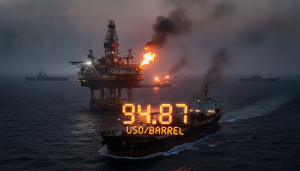
Global crude benchmarks experienced significant downward pressure as optimistic signals emerged regarding a potential agreement between the United States and Iran to facilitate the reopening of the crucial Strait of Hormuz. Investors digested statements from senior U.S. officials, leading to a notable decline in oil prices, though substantial hurdles remain on the path to a comprehensive resolution.
Oil Prices Recede on Diplomatic Hopes
The market reacted swiftly to the diplomatic overtures, with Brent crude futures shedding as much as 6.4%, trading down to $96.90 a barrel. West Texas Intermediate (WTI) also followed suit, hovering near the $91 per barrel mark. This price correction underscores the acute sensitivity of global energy markets to geopolitical stability, particularly concerning the Persian Gulf’s strategic waterways.
U.S. Secretary of State Marco Rubio adopted a cautiously optimistic tone, emphasizing Washington’s commitment to exploring all diplomatic avenues. While senior U.S. officials indicated that a final endorsement of any accord could still be days away, the prospect of eased tensions was enough to trigger a sell-off in a market already grappling with supply anxieties. Over the past weekend, President Donald Trump affirmed that negotiations were progressing in an “orderly and constructive manner,” though he also stressed that the U.S. would not rush into a deal, maintaining that Washington’s blockade of the Strait would persist until a formal agreement was finalized. His sentiment was echoed on Monday through social media, reiterating that discussions were “proceeding nicely!”
Persistent Obstacles: Nuclear Program and Frozen Assets
Despite the positive rhetoric from Washington, significant divergences continue to cloud the prospects of a swift and enduring resolution. Key contentious issues, particularly the future of Iran’s nuclear program and the unfreezing of its assets, represent formidable obstacles. Reports from Iran’s Tasnim news agency suggested that the draft agreement faces the risk of collapse due to alleged U.S. obstruction on certain critical clauses, specifically the demand for the release of Iranian assets. Esmail Baghaei, Iran’s Foreign Ministry Spokesman, tempered expectations on Monday, telling reporters that while consensus had been achieved on numerous topics, claiming the imminent signing of an agreement would be premature. This divergence highlights the deep mistrust and complex web of demands that characterize U.S.-Iran relations, keeping investors on edge regarding the true durability of any potential deal.
The Hormuz Crucible: Global Energy’s Lifeline Under Siege
The current global energy landscape has been profoundly disrupted since February, when a conflict ignited by U.S. and Israeli actions against Iran rapidly escalated across the Persian Gulf. This regional instability led to the curtailment of millions of barrels of daily crude supplies, pushing global commodity prices higher and exacerbating inflationary pressures. The Strait of Hormuz, a choke point connecting the Persian Gulf’s vast energy reserves to international markets, has been subjected to an unprecedented dual blockade by both Tehran and Washington, severely restricting vital maritime traffic.
In peacetime, the Strait of Hormuz typically facilitates the transit of approximately one-fifth of the world’s total oil and liquefied natural gas (LNG) supplies. The prospect of its full reopening would offer immense relief to energy-dependent economies across Asia, including major importers such as China, Japan, and South Korea, which have been heavily impacted by the supply crunch and increased shipping costs. Current transits through the strait have been reduced to a mere fraction of pre-war volumes, though some vessels have successfully navigated the challenging environment. Notably, ship-tracking data confirms the passage of a supertanker carrying Iraqi crude destined for China, successfully crossing the U.S. blockade, alongside indications of three LNG tankers also having exited the zone.
Market Psychology: Relief vs. Resolution
Market analysts are scrutinizing the implications of these diplomatic developments. Charu Chanana, Chief Investment Strategist at Saxo Markets in Singapore, articulated the prevailing sentiment: “The two sides may be closer on a ceasefire and Strait of Hormuz reopening framework, but still far apart on the harder issues,” citing lingering disagreements over sanctions and Iran’s nuclear aspirations. Chanana concluded that “Oil has priced in relief, but not a durable resolution.” This perspective suggests that while immediate fears of further escalation might have eased, the fundamental, long-term supply challenges remain unaddressed, implying potential volatility for crude prices in the coming weeks. Trading activity in Brent futures was notably subdued on Monday, influenced by public holidays in both the U.S. and the UK. The U.S. Memorial Day holiday traditionally marks the commencement of the summer travel season, a period historically associated with increased demand for gasoline, diesel, and jet fuel, adding another layer of complexity to current market dynamics.
Navigating the Interim: Ceasefire and Shipping Fees
A potential interim agreement offers a glimpse into a phased de-escalation. The Washington Post reported, citing a senior administration official, that the U.S. and Iran have developed a memorandum proposing a 60-day ceasefire extension. Under this tentative framework, the Strait of Hormuz would undergo de-mining and be reopened to traffic during this extended ceasefire period, allowing for further negotiations toward a permanent deal. However, even this interim step presents points of contention. Iran’s foreign ministry spokesman clarified that the Islamic Republic seeks to levy a “shipping fee” for services and environmental protection within the Strait, rather than a “toll.” This distinction is critical, as the Trump administration has previously declared any form of toll system unacceptable. Iran’s Islamic Revolutionary Guard Corps Navy (IRGCN) claimed on Sunday, via Tasnim, that 33 vessels, including oil tankers and container ships, had already transited the strait after obtaining IRGCN permission, underscoring Iran’s assertion of control over the waterway.
Domestic Pressures and Broader Geopolitical Instability
Domestically, President Trump faces mounting political pressure to de-escalate the conflict, particularly with the November midterm elections looming, which will determine control of the U.S. Congress. The prolonged geopolitical strife has directly impacted American consumers, contributing to a surge in fuel costs, with average U.S. gasoline prices reaching their highest levels since 2022. This economic strain adds urgency to the White House’s diplomatic efforts. Beyond the Persian Gulf, the broader geopolitical landscape continues to present risks to global energy supplies. The ongoing conflict between Russia and Ukraine saw both nations targeting each other’s energy infrastructure. Ukrainian forces reportedly struck Russia’s Sheskharis oil terminal, the largest on its Black Sea coast, along with a storage facility and a major petrochemicals plant. Concurrently, Ukraine’s state energy company, Naftogaz, accused Russia of targeting oil and gas facilities in eastern Ukraine, demonstrating that energy supply vulnerabilities persist across multiple fronts, demanding constant vigilance from energy investors.