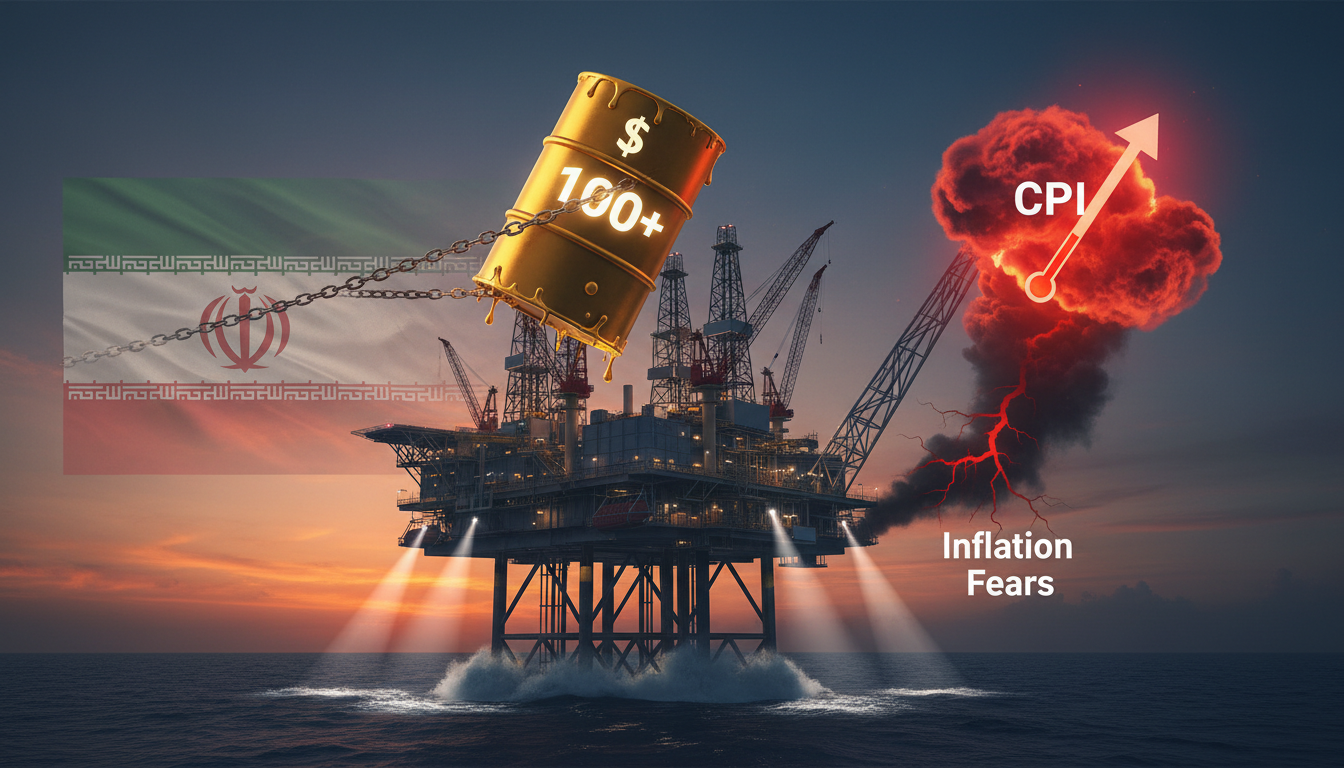
Global crude benchmarks surged past the significant $100 per barrel threshold on Tuesday, driven by escalating geopolitical tensions between the United States and Iran. This price rally reflects increasing market anxiety over the stalled diplomatic efforts, which appear to have diminished hopes for a rapid resolution to the ongoing conflict impacting the Middle East. Furthermore, a critical U.S. inflation report underscored the profound economic ripple effect stemming directly from the regional instability and its impact on energy costs.
At 15:50 ET (19:50 GMT), the July expiry contract for Brent crude, the international benchmark, registered a robust 3.4% increase, settling at $107.72 per barrel. Concurrently, West Texas Intermediate (WTI) crude for June delivery advanced by an impressive 4.3%, pushing its price to $102.29 per barrel. These upward movements signal a market grappling with persistent supply concerns and the specter of heightened regional instability.
Diplomatic Gridlock Fuels Market Uncertainty
Investor sentiment remains profoundly shaped by fears that the protracted conflict, now stretching beyond two months, could critically constrict global crude supplies. These anxieties intensified following reports that President Trump decisively rejected Tehran’s most recent counter-proposal for a peace agreement, labeling it as “totally unacceptable” and a “piece of garbage.” Such rhetoric suggests a hardening stance, indicating that the fragile ceasefire between the warring parties has reached its most precarious point since the conflict began.
Tehran, for its part, mounted a defense of its position earlier in the week, asserting that its diplomatic overture was centered on achieving a cessation of hostilities, demanding the lifting of the existing U.S. naval blockade, and ensuring the unhindered resumption of shipping operations through the strategically vital Strait of Hormuz. Iran’s demands also included claims for war reparations, the complete removal of international sanctions, and formal recognition of its sovereignty over the crucial waterway. These counter-demands highlight the deep chasm that separates the two sides, making any immediate breakthrough seem increasingly improbable.
Compounding these concerns, a late Monday report from CNN indicated that President Trump is reportedly giving serious consideration to the possibility of reinstating significant combat operations against Iran should peace negotiations continue to falter. This development has reignited severe apprehension within the energy sector regarding the future security of maritime transit through the Strait of Hormuz. This critical chokepoint is indispensable for global energy flows, facilitating the passage of approximately one-fifth of the world’s total crude oil and refined fuel supplies. Any disruption here would have catastrophic implications for energy markets worldwide.
Amin Nasser, the Chief Executive of Saudi Aramco, the world’s largest oil producer, offered a stark warning this week. He cautioned that even if the Strait were to become fully operational again without delay, the global oil supply chain could still require several months to normalize. His comments underscore the immense logistical and economic challenges inherent in resolving such a complex geopolitical bottleneck. Earlier hopes of a diplomatic breakthrough, which had briefly led to a temporary retreat in oil prices last week, have since largely dissipated amidst the current impasse, leaving investors to once again price in elevated risk premiums. In a show of support for maritime security, the United Kingdom announced on Tuesday its commitment to deploy drones, advanced jet aircraft, and a warship as part of any future defensive mission aimed at safeguarding secure shipping lanes through the strait.
President Trump Foresees an Oil ‘Gusher’ Amidst Tensions
Addressing the escalating tensions with Iran, President Trump maintained a firm posture on Tuesday, stating, “We don’t have to rush anything.” Speaking to radio talk show host Sid Rosenberg, the President emphasized the efficacy of current economic pressure, noting, “We have a blockade which allows them no money.” He reiterated a core strategic objective: “It’s a very simple thing: we cannot let them have a nuclear weapon — because they’d use it.” These statements reinforce the U.S. administration’s unwavering stance on nuclear non-proliferation as a central pillar of its Iran policy.
Later, as he prepared to depart for a three-day trip to China, President Trump addressed reporters, asserting that the U.S. would “only” be “making a good deal” regarding Iran. When pressed on his “redline” for potentially ending the ceasefire, the President remained elusive, simply stating, “we’re going to see.” Despite the immediate market reaction to rising geopolitical risk, Trump offered an optimistic long-term outlook on energy supply. “One way or the other, it’s going to work out very well. It’s going to work out very well. I think you’re going to have so much oil, you’re going to have a gusher of oil like you’ve never had before. So when oil goes up a little bit, I thought it would go up much more,” he predicted.
Reflecting on past market expectations, the President further elaborated, “If you go back three, four months ago, we were contemplating, we assumed oil would go much higher. Yesterday, it was at $99. And if you think about it, I would have taken that all day long, because it’s very simple: Iran cannot have a nuclear weapon. They will not have a nuclear weapon.” His comments suggest a belief that the current oil price levels, while elevated, are still manageable within the broader strategic context, especially when weighed against the imperative of preventing nuclear proliferation.
During his upcoming discussions in Beijing, President Trump indicated that Iran would be a key topic with Chinese President Xi Jinping. He characterized China as having been “relatively good” concerning the ongoing conflict. He noted, “You look at the blockade, no problems. They get a lot of their oil from that area, we’ve had no problem.” Highlighting his personal rapport, he added, “And he’s been a friend of mine. He’s been somebody that we get along with… this is going to be a very exciting trip. A lot of good things are going to happen.” China’s role is particularly crucial given its status as Iran’s largest oil purchaser, which grants Beijing significant diplomatic leverage with Tehran, making its stance on the conflict and any future resolutions highly influential for global energy markets.