Geopolitical Tensions Force Stealth LNG Exports Through Strait of Hormuz, Reshaping Investor Risk
The global liquefied natural gas (LNG) market faces unprecedented challenges as the Abu Dhabi National Oil Co. (ADNOC) employs clandestine shipping tactics to maintain a critical, albeit limited, flow of exports through the volatile Strait of Hormuz. This strategic pivot underscores a new era of heightened operational risk and supply chain uncertainty that investors in the oil and gas sector must closely monitor.
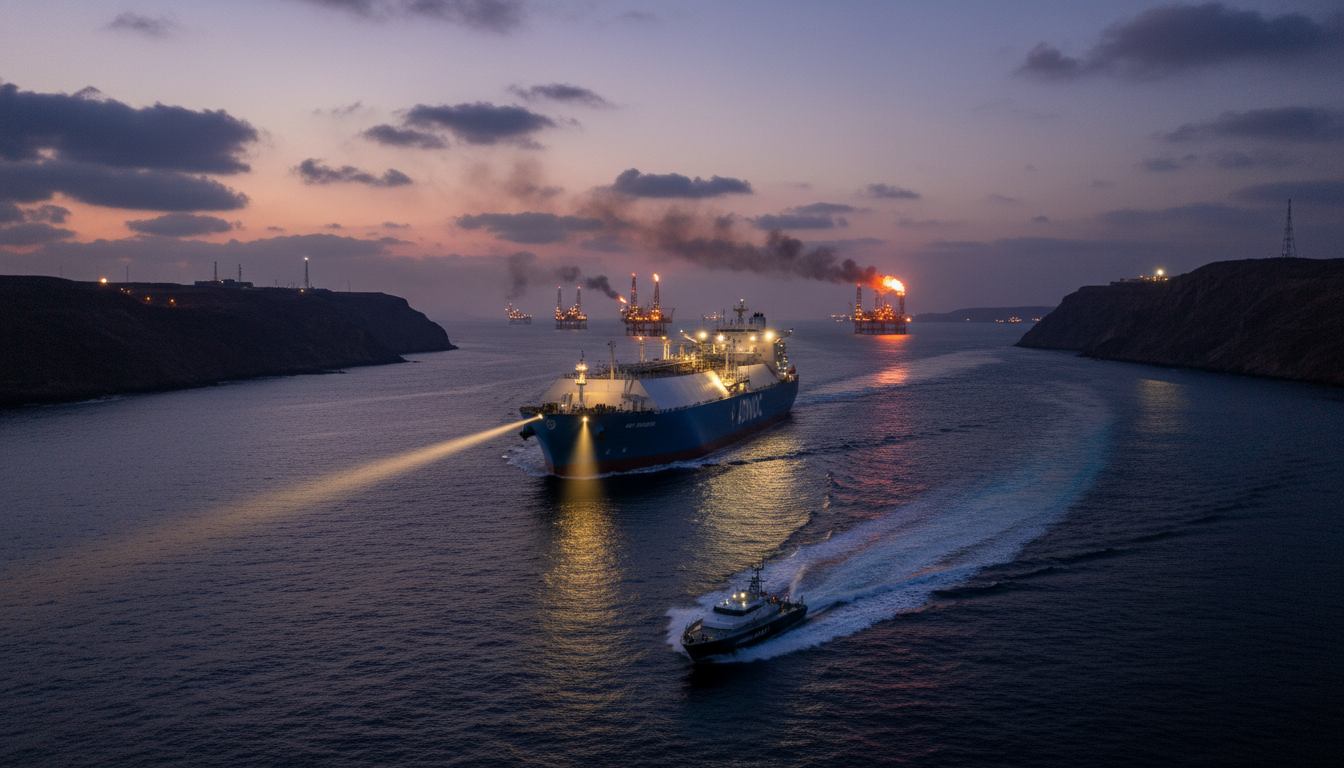
In a clear departure from standard maritime practices, ADNOC has resorted to disabling tanker tracking signals, effectively making its vessels “go dark” to navigate the conflict-ridden waterway. Recent analysis of vessel-tracking data, corroborated by insights from industry insiders, reveals that at least two loaded LNG tankers departing ADNOC’s Das Island facility ceased broadcasting their locations after entering the Strait. Further satellite imagery confirms ongoing docking activities at the terminal, even as no corresponding AIS (Automatic Identification System) signals are publicly transmitted from nearby vessels. This deliberate concealment extends to inbound traffic as well, with three empty ADNOC LNG carriers also ceasing signal transmission upon reaching the eastern entrance of the Strait, indicating a calculated strategy to load new cargoes under the radar.
Strait of Hormuz: A Critical Bottleneck Under Siege
The Strait of Hormuz, a choke point that typically facilitates approximately one-fifth of the world’s total LNG supply, remains severely impacted by the ongoing geopolitical tensions between the United States and Iran. A de facto blockade by both sides, coupled with persistent security threats, has rendered the waterway virtually impassable for conventional shipping. Earlier this week, the escalating dangers were starkly highlighted by Iranian drone attacks on an ADNOC-linked oil tanker operating near Oman, a stark reminder of the kinetic risks involved.
While ADNOC has maintained a discreet silence on these operational adjustments, the data speaks volumes about the extraordinary measures producers are undertaking. The current conflict, now entering its third month without a clear resolution for unimpeded maritime transit, has forced producers to embrace riskier strategies to keep energy supplies moving. This approach has, to some extent, enabled ADNOC to sustain minimal LNG production from its export facilities, providing a vital, though limited, lifeline to global energy markets.
Contrasting Strategies: ADNOC’s Stealth vs. Qatar’s Shutdown
ADNOC’s proactive, albeit covert, stance sharply contrasts with the approach taken by its prominent neighbor, Qatar. Following the US and Israeli strikes on Iran in late February, Qatar entirely halted its LNG shipments through the Strait of Hormuz. In March, attacks attributed to Iran forced the closure of Qatar’s massive Ras Laffan LNG export facility, leading to the declaration of force majeure on its scheduled deliveries to customers worldwide. This stark difference in response highlights the diverging risk appetites and operational constraints faced by major LNG exporters in the region, directly impacting global supply stability and pricing dynamics.
The decision by ADNOC to operate without transmitting AIS signals represents a significant departure from industry norms. LNG shipowners and operators are notoriously risk-averse, a characteristic reinforced by past incidents, such as the widespread avoidance of the Red Sea by nearly all LNG carriers since Houthi rebel attacks intensified in 2023. This unprecedented shift toward “dark shipping” in a contested zone signals an elevated risk premium for all stakeholders, from vessel insurers to commodity traders.
Unveiling Covert Movements: Tanker Data Insights
Specific examples underscore the depth of these operational changes. The ADNOC-owned tanker *Mraweh* was recently observed loaded with cargo near northern Indonesia, with Japan listed as its next destination, after an absence of over two weeks from public vessel-tracking systems. This vessel had previously been sighted empty on April 19, idling near the eastern entrance of the Strait of Hormuz, before its signal disappeared. Similarly, the *Mubaraz*, which loaded cargo from Das Island in early March, ceased transmitting its location in late March, only to reappear nearly a month later as it transited the southern tip of India. These individual vessel movements confirm a pattern of intentional signal disruption to facilitate passage through the Strait.
For investors, these developments underscore the inherent geopolitical risks embedded in energy infrastructure and supply chains. While ADNOC’s ability to maintain even a trickle of exports offers a glimmer of resilience, the overarching picture remains one of deep disruption. Since late February, only two loaded ADNOC-linked LNG tankers have been identified exiting the Persian Gulf, a stark reduction from the pre-conflict average of approximately three shipments per day. This substantial curtailment in supply from a region vital to global energy security suggests continued volatility in LNG prices and a heightened focus on the diversification and resilience of global energy portfolios.
The long-term implications for LNG investment include potential increases in shipping insurance premiums, re-evaluation of transit routes, and a sustained geopolitical risk premium on Middle Eastern energy assets. As the conflict persists, the ability of producers to adapt and navigate such unprecedented challenges will be a defining factor for market stability and investor confidence in the volatile global energy landscape.


