U.S. Natural Gas Storage Soars: Investor Insights from Latest EIA Report
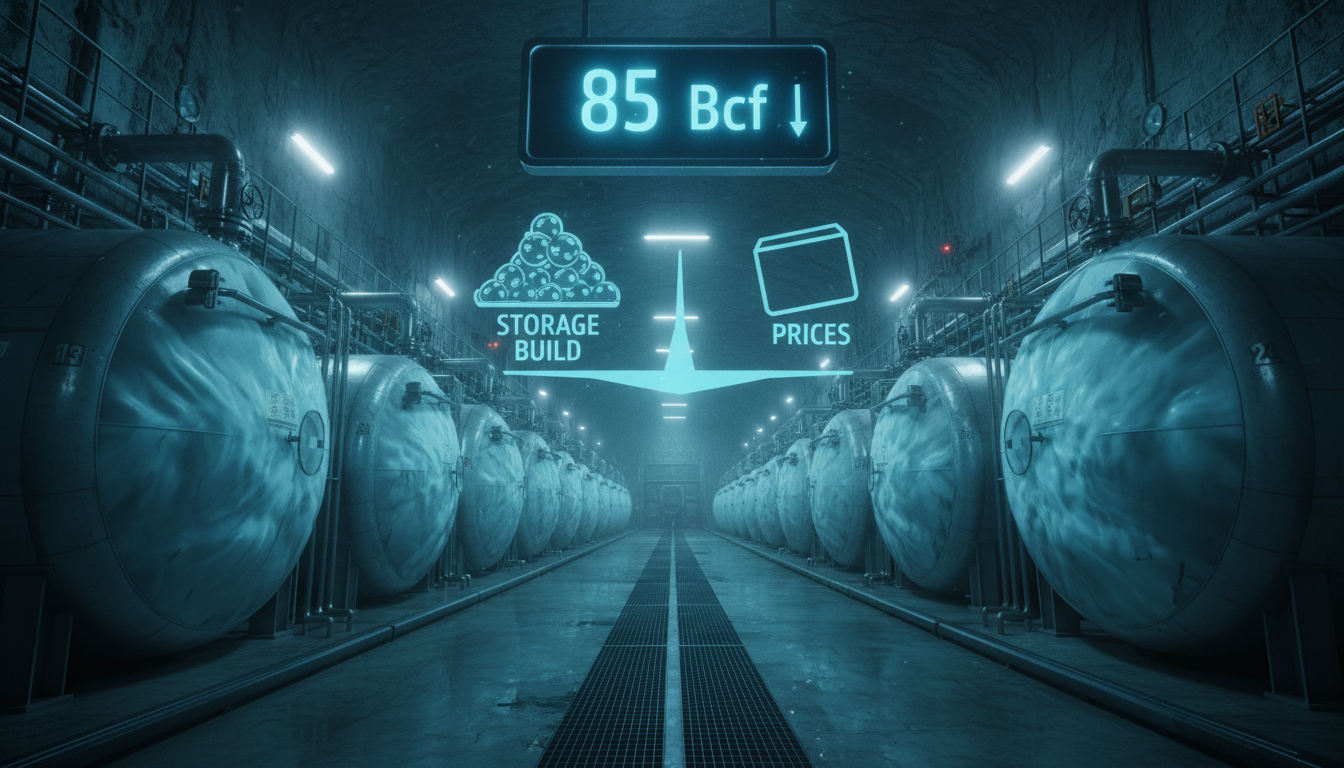
The latest update from the U.S. Energy Information Administration (EIA) reveals a robust increase in domestic natural gas stockpiles, marking a significant development for energy investors monitoring market fundamentals. As of May 8, 2026, working gas in storage surged by a net 85 billion cubic feet (Bcf) during the most recent reporting week, a clear indicator of evolving supply-demand dynamics within the U.S. natural gas landscape. This substantial build pushes total inventories to 2,290 Bcf, positioning the market with ample supply as the shoulder season progresses.
This week’s inventory injection is a critical data point for analysts and portfolio managers, confirming a healthy buffer in the nation’s gas supply. The 2,290 Bcf now held in underground storage stands notably higher than levels observed in prior periods. Specifically, current reserves are 51 Bcf, or approximately 2.3%, above the 2,239 Bcf recorded at this exact time last year, May 8, 2025. Furthermore, the market’s position looks even more robust when viewed against the five-year average for this period (2021-2025), with current storage exceeding the 2,150 Bcf average by a substantial 140 Bcf, representing a 6.5% surplus. Despite these significant increases, total working gas levels remain comfortably within the established five-year historical range, alleviating immediate concerns about extreme oversupply but signaling potential downward pressure on future pricing.
Regional Storage Dynamics: A Closer Look at the Bcf Build
The 85 Bcf national increase was distributed across all major storage regions, reflecting widespread injections as warmer weather typically softens heating demand and gas flows toward storage ahead of peak summer cooling. Understanding these regional movements is crucial for investors, as localized supply imbalances can create arbitrage opportunities or impact regional spot prices.
East Region Navigates Steady Injections
The East region saw its working gas inventory climb by 27 Bcf, moving from 361 Bcf to 388 Bcf week-over-week. Compared to a year ago, when the East held 391 Bcf, current levels are down marginally by 0.8%. However, looking at the five-year average of 386 Bcf, the region is slightly ahead by 0.5%, indicating a relatively balanced storage trajectory compared to historical norms. Investors in this densely populated and industrial region will watch closely for any shifts in demand as the summer approaches.
Midwest Maintains Parity
In the Midwest, storage facilities added 24 Bcf, bringing the total to 476 Bcf from 452 Bcf the previous week. This region shows remarkable consistency, with current storage precisely matching the 476 Bcf reported on May 8, 2025. When measured against the five-year average of 480 Bcf, the Midwest currently sits 0.8% lower, suggesting that while the region is keeping pace with last year, it’s slightly behind its longer-term average build pattern. The stability here could indicate predictable regional demand and supply patterns.
Mountain and Pacific Regions Demonstrate Strong Growth
The Mountain region recorded a modest but significant 3 Bcf increase, lifting its total to 206 Bcf from 203 Bcf. This region continues to outperform historical benchmarks significantly. Current inventories are a robust 12.0% higher than the 184 Bcf stored at this time last year and an impressive 44.1% above the five-year average of 143 Bcf. This substantial surplus could reflect increased local production or shifts in pipeline flows. Similarly, the Pacific region added 4 Bcf, reaching 279 Bcf from 275 Bcf. This region also demonstrates considerable strength against historical figures, boasting an 18.2% increase over last year’s 236 Bcf and a substantial 36.1% lead over the five-year average of 205 Bcf. These elevated levels in the Western U.S. highlight a potential shift in regional supply dynamics or reduced demand relative to available storage capacity.
South Central: A Critical Hub Showing Mixed Signals
The crucial South Central region, encompassing a vast network of storage and production, saw a 27 Bcf injection, raising its total from 914 Bcf to 941 Bcf. This region is a complex mix of salt cavern and non-salt storage. On a year-over-year basis, the South Central’s 941 Bcf is marginally lower by 1.1% compared to the 951 Bcf from May 8, 2025. However, it is slightly above the five-year average of 935 Bcf by 0.6%. A closer examination reveals a divergence within the South Central. Salt cavern facilities, known for their rapid injection and withdrawal capabilities, increased by 12 Bcf to 285 Bcf. This is a 6.9% decrease from last year’s 306 Bcf, but a slight 0.4% increase over the five-year average of 284 Bcf. Non-salt storage, which typically offers larger, slower-moving capacity, added 15 Bcf, bringing its total to 656 Bcf. This represents a 1.7% increase from last year’s 645 Bcf and is also 0.8% above the five-year average of 651 Bcf. The relative decline in salt storage year-over-year could be a point of interest for traders reliant on quick-response capacity.
Investor Outlook and Market Implications for Natural Gas
The significant national storage build of 85 Bcf, pushing total inventories above both last year’s levels and the five-year average, presents a nuanced picture for natural gas investors. While it signals a well-supplied market entering the warmer months, potentially capping upside price movements, the fact that total working gas remains within the five-year historical range suggests the market is not yet in a state of extreme surplus. Continued strong injections, particularly if demand remains subdued, could pressure front-month futures contracts. Conversely, an unexpected heat wave or robust industrial demand could quickly draw down these inventories, especially in key demand centers. Investors should monitor regional weather forecasts, pipeline utilization rates, and liquefied natural gas (LNG) export activity as key drivers that could rapidly alter the supply-demand balance and price trajectory in the coming weeks and months. The consistent builds across all regions indicate a market actively preparing for future demand, underscoring the importance of these weekly EIA reports in formulating informed trading and investment strategies in the dynamic natural gas sector.