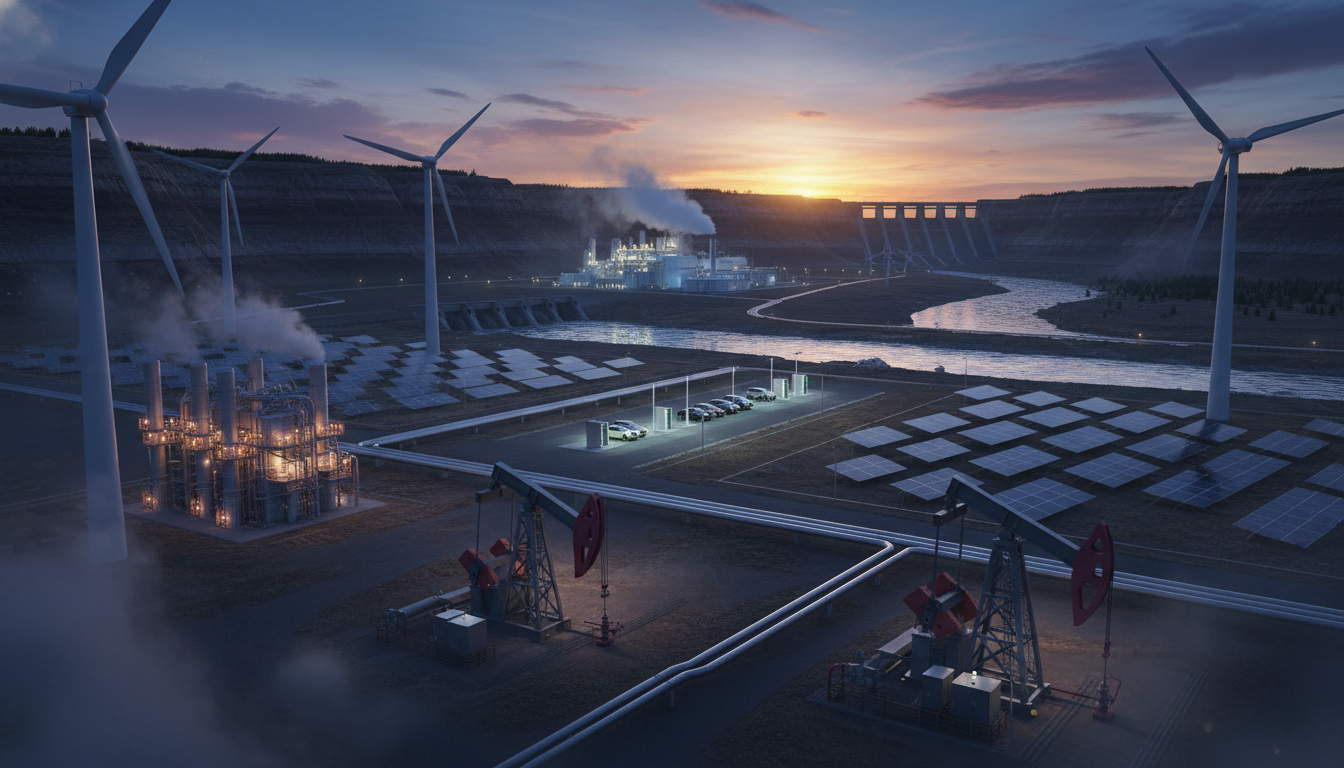
Canada’s oil and gas sector presents a unique investment narrative, distinctly divergent from the rapid-cycle, short-term production often seen south of the border. Rather than a focus on immediate velocity and quick scaling in response to market fluctuations, the Canadian energy landscape champions immense scale, enduring asset life, and unparalleled resource depth. This fundamental difference is most profoundly illustrated across its principal basins.
The Western Canadian Sedimentary Basin: A Foundation of Longevity
At the heart of Canada’s energy system lies the Western Canadian Sedimentary Basin (WCSB), a colossal hydrocarbon province stretching across northeastern British Columbia, Alberta, Saskatchewan, and Manitoba. Recognized as one of the world’s largest, the WCSB’s structure is inherently layered, accommodating a rich tapestry of conventional, oil sands, and unconventional resources all within a single, integrated system. This multi-faceted composition defines both Canada’s competitive advantage and its inherent developmental considerations for investors.
Oil Sands: Anchoring Long-Term Value and Stability
The oil sands, predominantly located in northern Alberta, stand as the most compelling example of Canada’s distinct energy approach. Representing one of the globe’s largest proven oil reserves, these assets are not designed for swift production responses. Instead, they demand substantial upfront capital investment, extensive development timelines, and the deployment of vast infrastructure. However, once operational, they deliver remarkably stable, long-life production, often likened more to a mining operation than traditional upstream oil extraction.
This characteristic makes the oil sands fundamentally different from the nimble, fast-response Permian Basin, which excels at rapidly adjusting output and generating quick returns. While the Gulf of Mexico’s deepwater projects share some parallels in their capital intensity and long duration, the oil sands offer a unique value proposition centered less on exploration risk and more on robust execution, diligent cost management, and long-term price assumptions. For investors prioritizing sustained output and predictable cash flows over rapid growth cycles, the oil sands represent a strategic “marathon” play, offering decades of consistent production once capital is effectively deployed, without the steep decline rates typical of many conventional wells.
The Montney: Canada’s Unconventional Powerhouse with Global Reach
Further west, the Montney formation has emerged as Canada’s preeminent unconventional play. Spanning British Columbia and Alberta, it ranks among North America’s largest gas and liquids-rich formations. The Montney offers a compelling hybrid model, blending characteristics of both shale and conventional resource development. It delivers significant scale coupled with growing operational flexibility, continually enhanced by advancements in drilling and completion technologies.
While often compared to U.S. basins like the Marcellus Shale or even parts of the Permian, the Montney possesses its own distinct profile. It rivals the Marcellus in its impressive depth and resource scale, yet boasts a more favorable liquids exposure. It shares some operational agility with the Permian, though operating within a different infrastructure and capital velocity environment. Crucially, the Montney’s investment profile is undergoing a transformative shift. Historically constrained by pipeline capacity and limited access to global markets, new LNG export infrastructure developing on Canada’s west coast is repositioning the Montney from a regionally discounted gas play to a vital global gas supplier, directly linking its output to lucrative international markets, particularly in Asia. This strategic reorientation significantly enhances its attractiveness for long-term investors.
Duvernay and Deep Basin: Unlocking Further Potential
Moving southeast, the Duvernay formation represents another significant unconventional opportunity. This oil and liquids-rich play frequently draws comparisons to the Eagle Ford Shale in the U.S. It has successfully attracted substantial investment, though its development has proceeded at a more measured pace, largely due to higher operational costs and the need for ongoing infrastructure build-out. Despite these considerations, the Duvernay stands as one of Canada’s most promising remaining frontiers for unconventional oil growth.
Meanwhile, the Deep Basin has consistently served as a reliable, albeit less publicized, source of gas and liquids production. This region delivers steady output, underpinned by multiple stacked pay zones and decades of accumulated operational expertise. The Deep Basin serves as Canada’s equivalent of mature U.S. basins that continue to generate value through incremental enhancements and optimization rather than pursuing high-growth, breakthrough development. For investors seeking stable, predictable cash flow from proven reserves, the Deep Basin offers a compelling, lower-risk proposition.
Navigating the Canadian Energy Investment Framework
These diverse basins collectively underscore the fundamental structural differences between the Canadian and U.S. energy sectors. The U.S. model thrives on private mineral ownership, rapid capital deployment, and short-cycle production timelines, enabling quick market responses. Conversely, Canada’s system, characterized by Crown (government) mineral ownership, seasonal drilling cycles, and a more regulated development process, inherently favors longer planning horizons, larger-scale projects, and more integrated, coordinated infrastructure development.
This divergence directly influences capital flows. In the United States, investment often gravitates towards speed and flexibility, rewarding rapid deployment and short-term returns. In Canada, capital typically aligns with projects offering significant scale and extended duration, reflecting the underlying asset characteristics and regulatory environment. Neither approach is inherently superior, but they yield vastly different operational and financial outcomes for investors.
Strategic Outlook for Investors: Stability in Volatile Markets
Canada’s basins are not engineered for immediate market responsiveness; rather, their design ensures a reliable, long-term supply of energy. This characteristic translates into lower volatility but also a less immediate impact during periods of market disruption. However, this inherent stability is rapidly appreciating in value within an increasingly fragmented and uncertain global energy market. The capacity to deliver consistent, long-duration production has become a critical strategic asset.
Canadian basins, particularly the oil sands and the Montney, are ideally positioned to fulfill this crucial role. Nonetheless, investors must acknowledge ongoing constraints, including pipeline capacity, regulatory timelines, and persistent market access challenges, which continue to influence the pace of resource development. Unlike the U.S., where infrastructure expansion can often proceed with greater agility, Canada’s system necessitates consensus and alignment among multiple stakeholders. While this can slow progress, it also fosters more structured, deliberate, and sustainable growth, mitigating some risks associated with rapid, uncoordinated expansion. This enduring tension between immense resource potential and the realities of execution has consistently defined Canada’s energy journey and remains a key consideration for savvy investors today.