US Oil Production: A Paradox Amidst Global Supply Turmoil
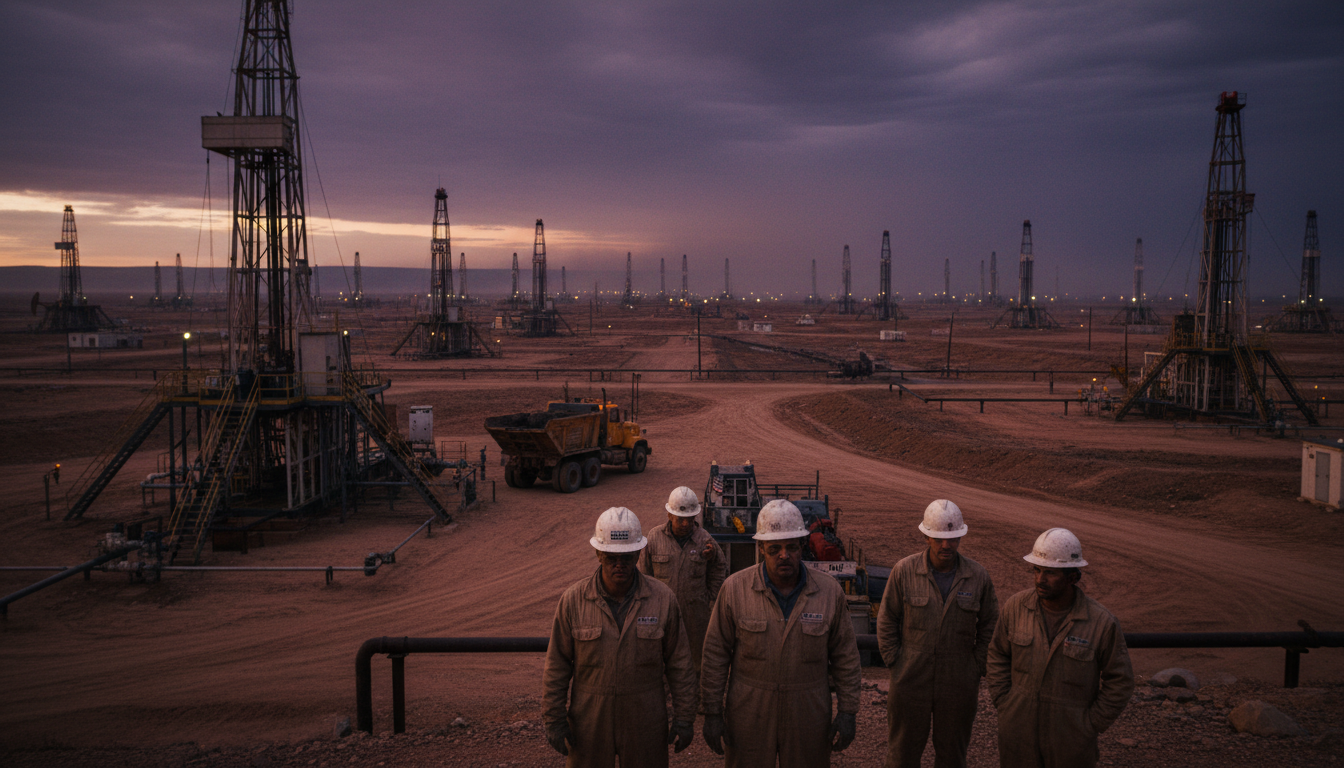
Despite fervent calls from Washington to significantly boost domestic crude output, America’s leading oil and gas producers are exercising remarkable restraint, even as global energy markets face unprecedented volatility. Since January 2025, when President Trump began his term, the industry has heard a clear mandate to “Drill, baby, drill!” Yet, the anticipated surge in production to alleviate international shortages remains largely elusive, a critical factor for investors monitoring the energy landscape.
The geopolitical chessboard, particularly the escalating conflict between the U.S. and Israel against Iran and other Middle Eastern powers, has plunged several nations into severe energy deficits. The dramatic closure of the Strait of Hormuz, a vital maritime artery connecting the Persian Gulf with the Gulf of Oman, following the U.S.-Israeli attack on Iran in February, has choked off a substantial portion of the world’s oil flow. Historically, this strait facilitates the passage of approximately 20 percent of global oil supplies. In the last two months, however, only a mere fraction has managed to traverse these critical waters, sending shockwaves through international markets and driving crude prices ever higher.
America’s Capacity vs. Global Demand Deficit
The United States stands as the planet’s preeminent crude oil producer, having reached an impressive five billion barrels annually in 2025, equating to over 13 million barrels per day (bpd). When accounting for other liquid fuels like ethanol and liquefied petroleum gases, U.S. total oil production expands to a staggering 21.2 million bpd. This figure, according to the International Energy Agency (IEA), is double the output of major producers like Russia or Saudi Arabia, underscoring America’s significant raw potential. Yet, this formidable capacity is not translating into a rapid solution for the current global energy crisis.
Western oil companies have recently reported soaring profits, a direct consequence of elevated crude prices and an increasing reliance from governments seeking to mitigate the ongoing supply crunch. Despite these lucrative conditions, a notable reluctance persists among these producers to channel their substantial revenues into aggressive new drilling campaigns. Investor focus remains keenly on capital discipline, and companies are wary of historical boom-and-bust cycles that have often penalized excessive spending.
Capital Discipline Trumping Expansion
The decision to temper production growth is deeply rooted in financial prudence and market uncertainty. Data from energy analytics firm Baker Hughes reveals a telling trend: by late April, the number of active drilling rigs in the United States had actually decreased compared to when the Middle East conflict first flared. Furthermore, projections from the U.S. Department of Energy (DoE) suggest that while domestic production has indeed seen significant increases in recent years, a potential decline could materialize in 2026, signaling a potential peak in the current cycle.
U.S. oil and gas firms have adopted a more conservative operational stance, primarily driven by the extreme price volatility of fossil fuels and significant ambiguities surrounding future demand patterns. Developing new wells and bringing them online for extraction is a process spanning many months. During this lengthy gestation period, the geopolitical landscape and, consequently, global oil prices, can undergo dramatic shifts. Furthermore, many companies have already laid out their detailed capital expenditure plans, and any abrupt deviation could jeopardize their meticulously projected profits and shareholder returns.
Dan Pickering, Chief Investment Officer at Houston’s Pickering Energy Partners, succinctly captured this sentiment, posing the critical question, “Do you want to be the dumb guy that sees oil at $100, raises your budget 25 percent and then watches oil plummet?” The resounding consensus among most oil executives appears to be a firm no, prioritizing sustained profitability over speculative expansion.
Major Players and Modest Projections
Even industry giants like Exxon Mobil and Chevron have signaled their intent to adhere to their pre-conflict drilling schedules, eschewing substantial increases despite reporting enhanced profits over the past two months. Exxon’s Chief Financial Officer, Neil Hansen, indicated that the company is “producing the maximum amount that we can” from its core assets in West Texas and New Mexico. This measured approach extends to broader strategic considerations, with Exxon also exercising caution regarding capital deployment given the elevated risks to its assets in the Persian Gulf region.
This restraint is not confined to the supermajors. A revealing survey conducted by the Federal Reserve Bank of Dallas in April, canvassing oil and gas executives, indicated widespread expectations for U.S. oil production to remain flat or increase by less than 250,000 bpd this year – roughly a 2 percent rise – directly attributable to the conflict in Iran. To put this into perspective for investors, such an increase would replace less than 3 percent of the estimated 10 million barrels of oil lost daily due to the Strait of Hormuz closure.
Kaes Van’t Hof, CEO of Diamondback Energy, starkly illustrated the inadequacy of this potential increase at an April Columbia University energy conference, stating it was “like putting a garden hose into an Olympic-size swimming pool that’s been emptied” when measured against the global supply deficit.
The Refining Bottleneck and Crude Quality Mismatch
Beyond the issues of capital discipline and production capacity, a fundamental challenge lies in the specific characteristics of U.S. crude oil. The United States predominantly extracts a very light crude. However, a significant portion of its domestic refining infrastructure is designed to process heavier crude grades, which it traditionally imports from sources such as Venezuela. This creates a quality mismatch, limiting the ability of U.S. refineries to absorb rapidly increased volumes of domestically produced light oil.
Scott Modell, CEO of Rapidan Energy, elaborated on this constraint, explaining, “Shale fields are already operating near their maximum capacity. And the crude oil coming from the Permian Basin is of insufficient quality for many U.S. refineries.” This refining bottleneck further compounds the difficulty in deploying American output to address the severe shortage of Persian Gulf heavy crude.
Investor Outlook: Navigating Persistent Supply Headwinds
In conclusion, several intertwined challenges are preventing U.S. oil firms from rapidly scaling up production to effectively bridge the gap left by the constrained Persian Gulf crude supplies. These include the allure of high but inherently volatile oil prices, the practical limitations of existing shale fields, a crucial mismatch in domestic refining capacity, and the pervasive uncertainty surrounding long-term oil price trajectories and demand. Despite significant political encouragement for a massive boost in domestic production, the anticipated increase in U.S. output is highly unlikely to meaningfully compensate for the global deficit. For investors, this scenario suggests continued tight markets, elevated energy prices, and persistent supply headwinds, leaving many nations worldwide grappling with severe energy shortages in the foreseeable future.