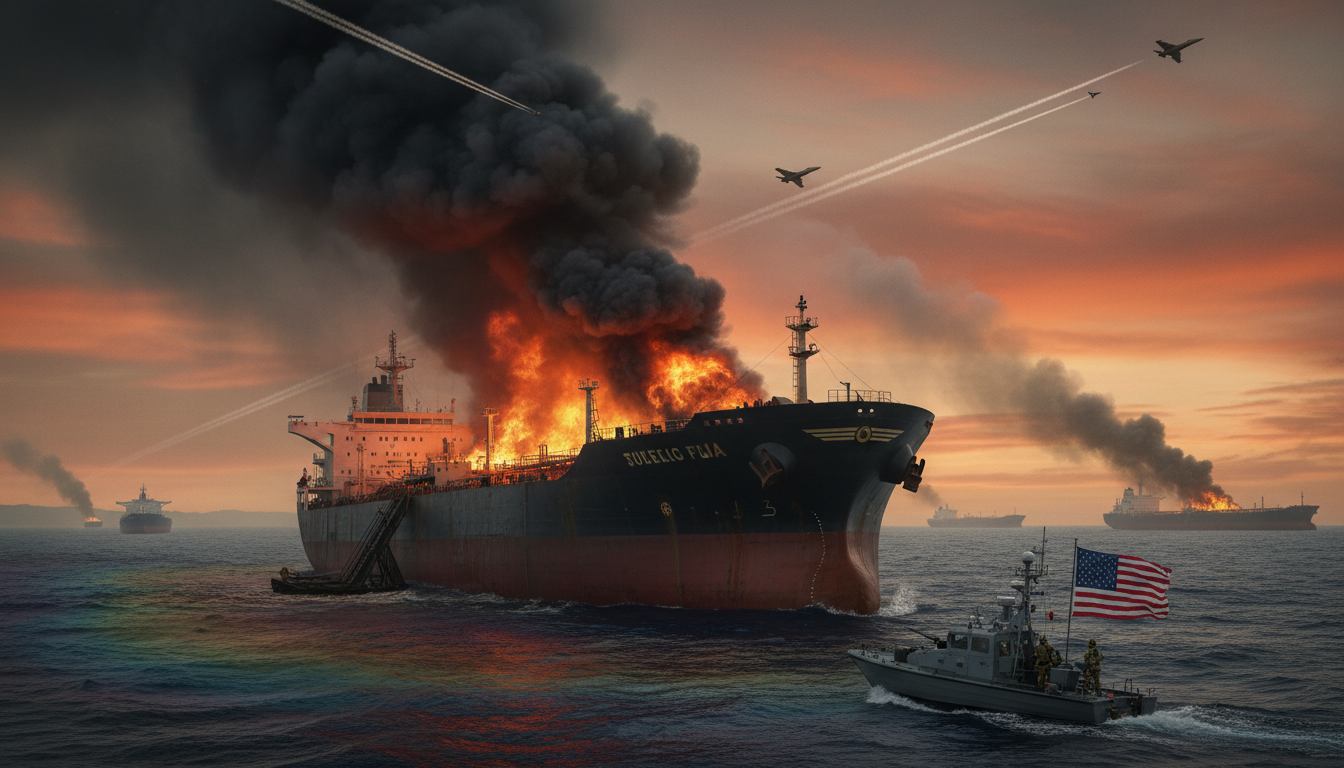
The geopolitical landscape across the Middle East just ratcheted up another notch, sending ripples of uncertainty through global energy markets. U.S. forces executed a precision strike on Friday against two unladen oil tankers flying Iranian flags in the Gulf of Oman, halting their entry into an Iranian port. This latest military action intensifies an already volatile situation, further undermining a fragile ceasefire between Washington and Tehran and prompting significant concern among oil and gas investors worldwide.
According to U.S. Central Command (CENTCOM), a U.S. fighter jet successfully disabled both vessels by deploying precision munitions directly into their smokestacks. This assertive move serves as a stark enforcement of the U.S. naval blockade targeting Iranian ports, a critical countermeasure enacted after Iran effectively closed the Strait of Hormuz following initial U.S. and Israeli strikes on February 28, 2026, an operation dubbed “Epic Fury.” A recently released video from CENTCOM captured a flight deck crew member signaling an F-35 jet on an aircraft carrier, providing a visual testament to the ongoing military maneuvers in the region.
Escalation in the Strait of Hormuz and Global Supply Fears
This incident follows a direct exchange of fire between U.S. and Iranian forces in the strategically vital Strait of Hormuz on Thursday, mere hours before the tanker strikes. Both nations accused the other of initiating hostilities in the waterway, which typically facilitates approximately 20% of the world’s total oil trade. The Strait has rapidly transformed into a focal point of military and economic confrontation since the conflict’s commencement on February 28. President Donald Trump, while asserting that the temporary truce remains intact, downplayed the Thursday clashes as “just a love tap” in an interview, later reinforcing on social media that Iran faces further military consequences if it fails to agree to a nuclear deal.
The persistent disruption of tanker traffic, particularly through and around the Strait of Hormuz, has directly triggered a severe global energy supply shock. This immediate market reaction manifests as surging international oil prices, alongside a cascade of broader economic repercussions. Energy investors are closely monitoring these developments, recognizing the profound impact on supply chains, operating costs, and global demand forecasts.
Navigating the Diplomatic Maze Amidst Military Action
Paradoxically, these renewed hostilities unfolded even as Iran reportedly reviewed a U.S. proposal designed to de-escalate the conflict and pave the way for renewed nuclear negotiations. Secretary of State Marco Rubio, speaking from Rome after meeting with Pope Leo XIV, indicated on Friday morning that he anticipates Iran’s response to the diplomatic overture later in the day. Rubio expressed a degree of cautious optimism, stating, “We’ll see what the response entails. The hope is it’s something that can put us into a serious process in negotiation.”
This juxtaposition of aggressive military enforcement with ongoing diplomatic efforts creates an exceptionally complex and unpredictable environment for global energy markets. Investors must reconcile the administration’s stated commitment to a ceasefire with its increasingly assertive military posture in the Gulf region. The market’s interpretation of these mixed signals will continue to drive significant volatility in crude benchmarks like Brent and WTI.
Investment Implications: Volatility is the New Constant
For investors focused on oil and gas, the current geopolitical climate necessitates an agile and well-informed strategy. The immediate consequence of the ongoing naval blockade and the threat to shipping lanes is an acute fear premium built into crude prices. This premium reflects both actual supply disruptions, as Iranian oil is kept off global markets, and the heightened risk of broader regional conflict that could jeopardize output from other major producers in the Gulf.
Companies operating in the shipping and logistics sectors, particularly those with exposure to the Middle East, face elevated insurance costs and operational risks. Upstream exploration and production firms, while potentially benefiting from higher oil prices, must also factor in the increased geopolitical risk associated with future investments in the region. Furthermore, the “cascade of other effects” includes potential inflationary pressures as energy costs ripple through manufacturing, transportation, and consumer goods, potentially impacting central bank policies and global economic growth projections.
Traders are closely watching diplomatic breakthroughs or further military escalations, both of which could trigger sharp market movements. The market’s perception of the sustainability of the U.S. naval blockade and Iran’s capacity to disrupt vital shipping routes remains a primary driver of sentiment. Energy portfolio managers should consider diversifying holdings, hedging against price swings, and closely scrutinizing the balance between global oil demand growth and the very real threat of constrained supply from this critical hydrocarbon-rich region.
The coming days will be crucial as the world awaits Iran’s diplomatic response and monitors any further military actions. The interplay between military might and diplomatic overtures in the Gulf of Oman and the Strait of Hormuz continues to shape the trajectory of global oil prices and the broader outlook for the energy sector. Investors should prepare for sustained volatility and the imperative of diligent analysis in this rapidly evolving market.