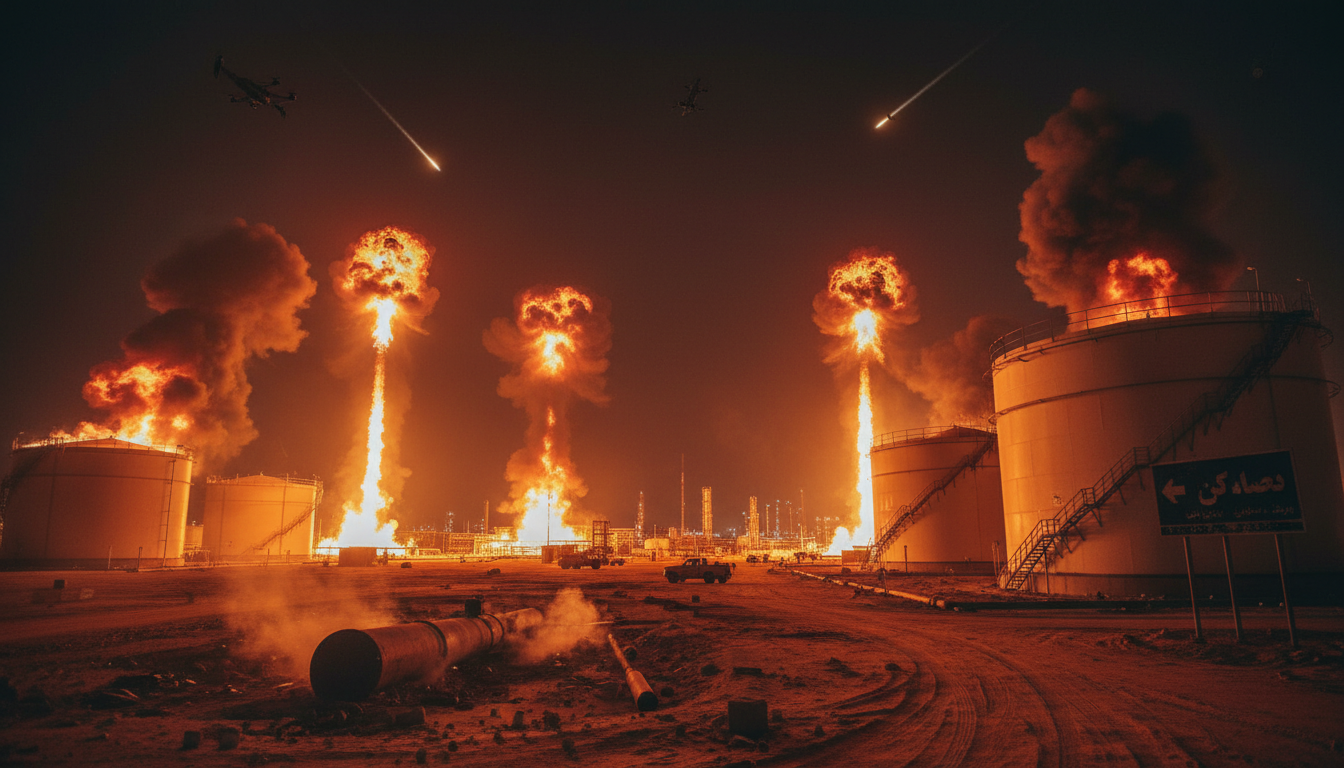
The global oil market experienced a sharp jolt this week as geopolitical tensions in the Middle East flared anew, directly impacting energy infrastructure and reigniting fears over crude supply stability. Following a brief period of relative calm, the United Arab Emirates faced a renewed barrage of attacks on Monday, marking the first such incident in nearly a month and signaling a dangerous escalation in the broader regional conflict involving the U.S. and the Islamic Republic of Iran.
This latest surge in hostilities shattered an uneasy truce that had largely held since an informal ceasefire between Tehran and the U.S.-Israel alliance was established around April 8. The UAE swiftly confirmed that its air defenses intercepted multiple cruise missiles, which were identified as originating from Iran and targeted various strategic locations across the nation. This development sent immediate ripples through commodities trading floors, with Brent crude futures surging significantly.
Direct Hits on Energy Infrastructure
The most alarming reports for energy investors centered on the port city of Fujairah, a critical global bunkering hub and a key point for crude oil storage and transshipment. Sources close to the matter confirmed that an oil terminal, with a partial ownership stake held by commodities giant Vitol Group, suffered an attack. Concurrently, Fujairah’s official media office reported a substantial fire erupting in an industrial oil zone, directly attributing the incident to an Iranian drone strike. The attacks, tragically, also resulted in three individuals sustaining injuries, underscoring the tangible human cost alongside the economic disruption.
For market participants, Fujairah’s strategic importance cannot be overstated. It provides an alternative route for oil exports, bypassing the congested and often perilous Strait of Hormuz. Any threat to its operational capacity or security immediately introduces a significant risk premium into crude prices, reflecting heightened concerns about potential supply interruptions from one of the world’s most vital energy arteries.
Market Reaction: Brent Crude Surges
The immediate market response to these renewed aggressions was stark and unequivocal. Brent crude, the international benchmark for oil prices, saw a substantial jump, climbing by almost 6% to trade at approximately $114 per barrel. This sharp increase vividly illustrates how sensitive global oil prices remain to geopolitical instability in the Middle East, a region that accounts for a significant portion of the world’s hydrocarbon output.
Investors are keenly aware that any disruption, perceived or real, to Middle Eastern oil flows can quickly translate into higher energy costs globally. The premium attached to crude prices now reflects not only fundamental supply-demand dynamics but also an elevated geopolitical risk component, directly influenced by the volatility emanating from the Persian Gulf. This rapid price movement serves as a potent reminder of the fragility of global supply chains and the profound impact regional conflicts can have on international energy markets.
A Fragile Truce and Broader Conflict
The recent attacks underscore the precarious nature of the current de-escalation efforts. The wider conflict ignited in late February, commencing with U.S. and Israeli strikes against targets in Iran. Tehran swiftly retaliated with a massive display of force, unleashing thousands of missiles and drones against Israel and several Gulf Arab states, including the UAE. This initial phase of the conflict resulted in thousands of fatalities, predominantly in Iran and Lebanon, where Israel has been engaged in a separate, yet interconnected, struggle against Iran-backed Hezbollah militants.
Throughout this period, the United Arab Emirates emerged as a primary target, experiencing more direct attacks than any other nation. The UAE’s Foreign Ministry characterized the latest strikes as a “dangerous escalation,” unequivocally stating that the nation “will not tolerate any threat to its security and sovereignty under any circumstances.” This robust declaration signals the UAE’s firm stance and its reservation of the “full and legitimate right to respond to these unprovoked attacks,” raising the specter of further retaliatory actions and a deeper regional entanglement.
Strait of Hormuz and U.S. Involvement
Compounding the regional volatility, the attacks on the UAE transpired just hours after an ADNOC-owned tanker reportedly came under drone fire from Iranian forces near the strategically critical Strait of Hormuz. This incident, while not resulting in significant damage according to initial reports, directly targeted a state-owned vessel from a major crude producer at the choke point through which a substantial percentage of the world’s seaborne oil supply transits daily.
These events also coincided with a new U.S. initiative aimed at facilitating the safe passage of commercial vessels stranded in the Persian Gulf via the Strait. President Donald Trump described this effort as “humanitarian,” with the U.S. military confirming that two U.S.-flagged merchant ships had successfully navigated the waterway as part of this operation. However, Iran promptly issued a stern warning, cautioning that it would engage U.S. forces if they ventured too close to Hormuz and explicitly instructing commercial ships to seek permission before traversing the vital maritime corridor. This direct confrontation of maritime authority in the Strait of Hormuz adds another layer of complexity and risk to global oil shipping.
Investor Outlook: Navigating Persistent Geopolitical Risk
For investors focused on the oil and gas sector, these recent developments serve as a critical reminder of the persistent and significant geopolitical risks inherent in the global energy landscape. The Middle East, despite its immense hydrocarbon wealth, remains a flashpoint for international tensions, capable of rapidly influencing crude oil prices and the profitability of energy investments.
Portfolio managers and analysts must factor in not only traditional supply-demand fundamentals but also the unpredictable nature of regional conflicts, the security of critical energy infrastructure, and the potential for disruptions in key shipping lanes like the Strait of Hormuz. The ongoing volatility necessitates a cautious yet agile approach to oil and gas investments, emphasizing diversification, robust risk management strategies, and a keen eye on evolving geopolitical narratives. As long as these tensions simmer, the global energy markets will continue to price in a substantial risk premium, keeping crude oil prices elevated and highlighting the intrinsic link between regional stability and global energy security.