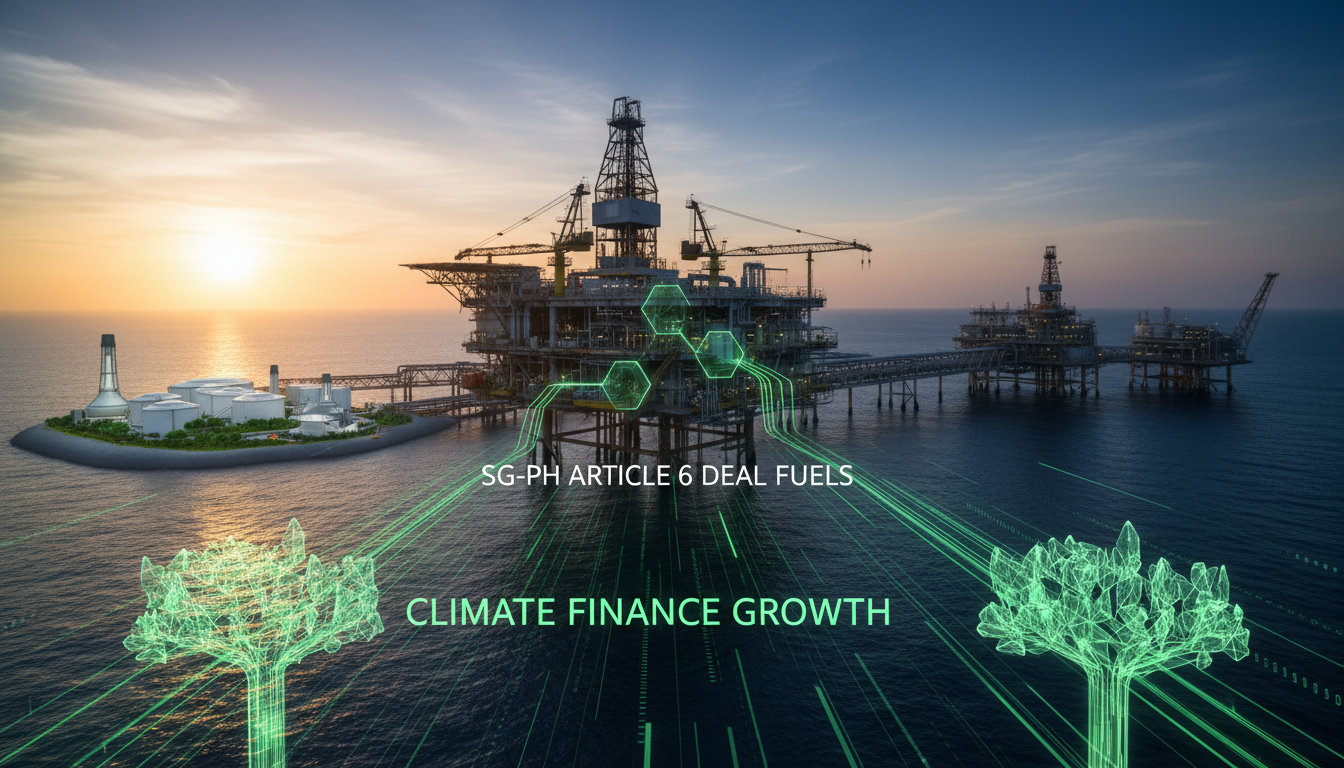
In a significant development for Southeast Asia’s burgeoning carbon markets, the Philippines and Singapore have formalized a groundbreaking Implementation Agreement under Article 6 of the Paris Agreement. Signed during ASEAN Climate Week in Manila, this accord establishes a legally binding framework for generating and transferring high-integrity carbon credits, signaling a clear path for climate finance to flow into the Philippines and offering new avenues for investors focused on energy transition and decarbonization.
For the Philippines, this represents its inaugural Article 6 Implementation Agreement, immediately elevating its position within the global system for cross-border carbon credit transactions. This move is crucial for a nation highly vulnerable to climate impacts, demonstrating a proactive stance in leveraging market mechanisms to fund vital mitigation efforts.
Singapore, a regional leader in carbon services and green finance, further solidifies its strategic network of Article 6 partnerships. This agreement bolsters its commitment to utilize international carbon credits as a core component of its national climate strategy, simultaneously cultivating demand for verified, high-quality offsets across the Asian market. The collaboration underscores a shared vision for robust, transparent carbon markets that support economic development while driving emissions reductions.
Establishing a Robust Legal Framework for Article 6 Credits
The core of this agreement lies in its creation of a legally binding structure for carbon credit generation and transfer from mitigation projects based in the Philippines. For investors and project developers, this certainty is paramount. Projects developed under this framework must strictly adhere to the rigorous requirements of Article 6 of the Paris Agreement, encompassing detailed authorization, transparent accounting, and verifiable credit transfer protocols.
While specific details regarding authorization processes and eligible carbon crediting methodologies are slated for future publication, the mere existence of this framework provides much-needed clarity. Market participants understand that the credibility of carbon credits hinges on trust, meticulous accounting, and explicit host-country approval. Ambiguities surrounding these elements can severely compromise credit quality, leading to concerns over double counting and the genuine climate impact of projects. This bilateral agreement effectively de-risks potential investments by offering a structured, government-backed pathway to market for compliant credits.
Developers now possess a clearer route to bring their climate-positive projects to fruition, knowing that their generated credits will operate within an internationally recognized and legally sound system. Concurrently, corporate buyers, particularly those in the energy sector seeking credible offsets for their Scope 1, 2, or 3 emissions, gain access to a more formalized mechanism for sourcing carbon credits directly linked to national climate priorities in a high-growth region.
Unlocking Climate Finance and Sustainable Development in the Philippines
A primary objective of this collaboration is to channel significant climate finance towards mitigation projects within the Philippines, thereby unlocking additional potential for emissions reduction. These investments are projected to yield substantial co-benefits, extending beyond environmental gains to include critical areas like job creation, enhanced energy security, a reduction in environmental pollution, and tangible improvements for local communities.
Singapore’s Minister for Sustainability and the Environment and Minister-in-charge of Trade Relations, Grace Fu, emphasized the profound implications, stating, “This Agreement will deepen collaboration between our two countries, channel climate finance towards impactful projects in the Philippines and unlock new opportunities in carbon markets for businesses and local communities. Together, ASEAN can lead the way in building a low-carbon future that delivers tangible benefits across the region.” Her remarks highlight the deal’s embedding within a broader ASEAN agenda, where robust carbon markets can play a pivotal role in mobilizing capital for critical transition projects that might otherwise struggle for funding, particularly in the face of escalating climate risks and burgeoning energy demand.
The Philippines’ Department of Environment and Natural Resources Secretary, Juan Miguel T. Cuna, echoed this sentiment, framing the agreement as a dual climate and development imperative. He affirmed, “For the Philippines, entering into this Implementation Agreement under Article 6.2 is a strategic decision – one grounded in our national priorities, our development aspirations, and our commitment to global climate action.” His statement underscores the careful consideration given to aligning carbon market participation with national economic and social objectives, a crucial factor for long-term project success and investor confidence.
Strategic Implications for ASEAN’s Carbon Market Evolution
For C-suite executives and institutional investors tracking the evolution of global decarbonization efforts, this agreement offers a clear signal: Article 6 cooperation is rapidly transitioning from conceptual discussions to concrete execution. Governments across the region are actively constructing the legal and policy infrastructure necessary to support tradable carbon credits, facilitate climate finance flows, and enable ambitious corporate climate strategies.
However, the ultimate success and value of this agreement will hinge on its diligent implementation. Market confidence will be directly proportional to the quality of the methodologies employed, the robustness of project authorization processes, and the unwavering transparency of emissions accounting. These elements are non-negotiable for investors seeking to deploy capital into carbon projects with genuine environmental integrity and long-term financial viability.
What Energy Sector Leaders Should Monitor
This bilateral accord creates significant new opportunities for a diverse range of stakeholders: project developers focusing on renewable energy, nature-based solutions, or industrial decarbonization; carbon market intermediaries providing advisory and trading services; and corporate buyers, including those within the broader oil and gas industry, seeking government-authorized, high-integrity credits to meet their decarbonization targets or diversify their asset portfolios.
Concurrently, the agreement elevates the standard for due diligence. Investors and buyers must meticulously assess project quality, verify host-country approval, scrutinize sustainable development claims, and ensure the long-term climate integrity of any credits procured. This increased scrutiny, while demanding, ultimately strengthens the market by filtering out lower-quality assets and promoting genuine climate impact.
For the Philippines, the deal provides a vital conduit to attract private capital into mitigation initiatives that directly align with its national development priorities. For Singapore, it enhances access to a diversified pool of regional carbon credits and reinforces its strategic role as a pivotal carbon services hub in Asia. Across the entire ASEAN bloc, this agreement contributes significant momentum to the formation of a more structured and interconnected carbon market architecture. If implemented with the highest standards of integrity and transparency, this framework holds the potential to effectively bridge regional capital with urgent climate action in one of the world’s most economically dynamic yet climate-exposed regions.


