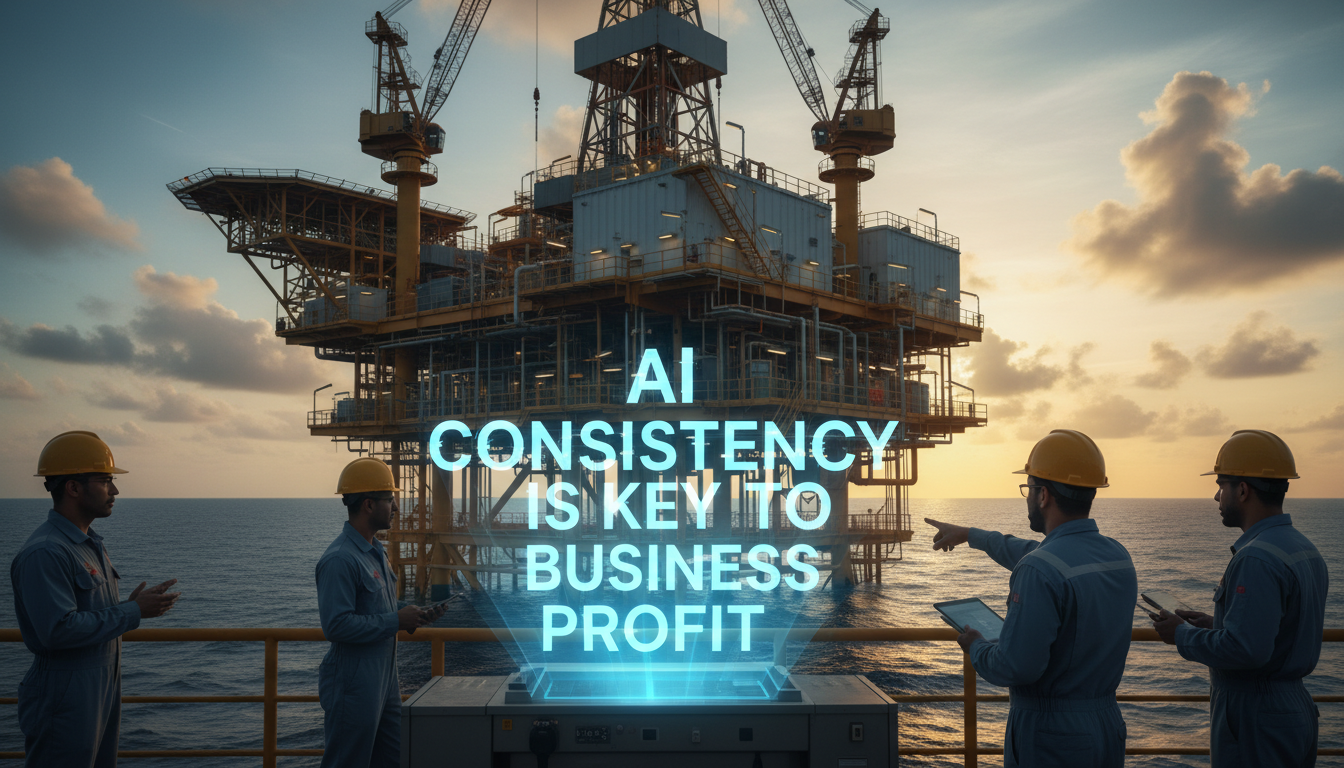
The burgeoning integration of artificial intelligence across industries, including the capital-intensive oil and gas sector, faces a pivotal challenge that investors must heed: AI’s inherent variability. Billionaire entrepreneur and technology advocate Mark Cuban recently illuminated this critical issue, observing that a fundamental hurdle for both enterprise-level and consumer AI tools is their inability to consistently deliver the same answer to an identical query. This lack of deterministic output, he argues, could have profound implications for businesses banking on AI for critical operations and strategic decision-making.
Cuban’s commentary on social media highlighted a core distinction between conventional software and generative AI. Traditional enterprise applications are typically engineered around deterministic rules; provide the same input, and you invariably receive the same output. This predictability forms the bedrock of many mission-critical systems, where consistency is paramount. However, contemporary generative AI models, such as OpenAI’s GPT-5.5, Anthropic’s Opus 4.7, and Google’s Gemini 3.1, operate on a probabilistic framework. They generate responses by weighing a range of likely options, rather than adhering to a single, fixed computational path. This fundamental design means that identical questions can yield diverse answers, introducing an element of unpredictability that is starkly different from established business software paradigms.
Navigating AI’s Probabilistic Nature in Energy Investments
For investors scrutinizing the oil and gas landscape, understanding AI’s probabilistic nature is not merely a technical curiosity; it’s a critical factor influencing operational efficiency, risk management, and ultimately, shareholder value. Imagine AI being deployed for reservoir modeling, predicting equipment failures on offshore platforms, or optimizing drilling trajectories. If the same input data leads to varying predictions, the reliability of these insights for multi-million-dollar decisions comes into question. In an industry where precision can mean the difference between significant profit and substantial loss, the “consistency problem” takes on heightened importance.
The energy sector relies heavily on data-driven insights for everything from seismic interpretation and exploration planning to refining processes and commodity trading. While AI offers transformative potential to accelerate these processes and uncover new efficiencies, its variability introduces a layer of complexity. For instance, an AI tool used for predictive maintenance on a crucial pipeline might, on two separate occasions with identical sensor data, suggest slightly different maintenance schedules or prioritize different components. While human experts could reconcile these, the inherent inconsistency adds time and uncertainty, potentially eroding the promised efficiency gains.
The Trade-off: Creativity Versus Consistency in O&G Applications
While some argue that AI’s variability is a feature, not a bug—allowing for more creative or nuanced responses in open-ended scenarios—the oil and gas industry often demands concrete, repeatable outcomes. For tasks requiring innovative problem-solving in exploration or novel approaches to carbon capture, a range of valid answers might indeed be beneficial. However, when it comes to regulatory compliance, safety protocols, precise financial forecasting, or real-time operational control of complex machinery, strict consistency is often non-negotiable. The consequences of AI “hallucinations” or divergent outputs in these contexts could range from costly errors to significant safety hazards or environmental incidents.
This dynamic presents a crucial challenge for energy companies adopting AI. They must carefully delineate where probabilistic AI can add value through creative problem-solving versus where deterministic reliability is absolutely essential. Investors should be keen to understand how energy companies are addressing this trade-off in their AI deployment strategies, particularly regarding governance, validation processes, and human oversight.
Elevating Human Judgment and Domain Knowledge in Energy
Cuban’s observations underscore an increasingly vital role for human judgment and specialized domain knowledge. He contends that the ability to critically evaluate and challenge AI-generated output is becoming indispensable. In the intricate world of oil and gas, this translates into an intensified demand for experienced geologists, engineers, data scientists, and market analysts who possess a deep understanding of energy physics, geology, economics, and regulatory frameworks. These human experts are uniquely positioned to interpret ambiguous AI outputs, validate reliable predictions, and identify potential inconsistencies or errors that automated systems might miss.
Consider the task of evaluating a new drilling prospect. An AI might analyze vast datasets of seismic imagery, well logs, and historical production data to generate a probability of success. However, an experienced petroleum geologist with decades of field knowledge might spot nuances in the geological formation or local conditions that an AI model, even an advanced one, failed to fully account for. This human intervention ensures that the AI serves as an augmentative tool, enhancing analytical capabilities, rather than a sole decision-maker. For investors, this suggests that the “talent wars” for highly skilled domain experts in the energy sector will only intensify, as their role in leveraging AI effectively becomes more pronounced.
Strategic AI Adoption: Learning Everything vs. Learning Nothing
Cuban further expanded on the dichotomy of AI users, categorizing them into two groups: those who deploy AI to avoid learning, and those who leverage it to learn everything. This distinction offers a powerful lens through which to evaluate energy companies’ digital transformation efforts. Companies that treat AI as a “black box” solution, relying on its outputs without critical engagement or continuous learning by their human workforce, risk becoming complacent and making costly errors. This passive approach could lead to strategic missteps in everything from capital allocation for new projects to optimizing operational logistics in complex supply chains.
Conversely, energy firms that empower their teams to use AI as a tool for accelerated learning—to deepen their understanding of reservoir dynamics, optimize extraction processes, predict market shifts with greater accuracy, or innovate new sustainable energy solutions—stand to gain a significant competitive edge. These organizations foster a culture where AI augments human intellect, pushing the boundaries of what’s possible and driving genuine innovation. For long-term investors in the energy space, identifying companies that are strategically integrating AI to enhance human capabilities, rather than simply replacing them, will be crucial for discerning future market leaders.
In conclusion, while artificial intelligence undeniably offers revolutionary potential for driving efficiency, innovation, and profitability across the oil and gas value chain, its probabilistic nature and consistency challenges, as highlighted by Mark Cuban, demand thoughtful consideration. Investors should prioritize companies that demonstrate a nuanced understanding of AI’s strengths and limitations, invest heavily in domain expertise, and implement robust validation processes. The future success in energy AI will not solely depend on the sophistication of the algorithms, but on the strategic deployment and critical oversight provided by human intelligence.


