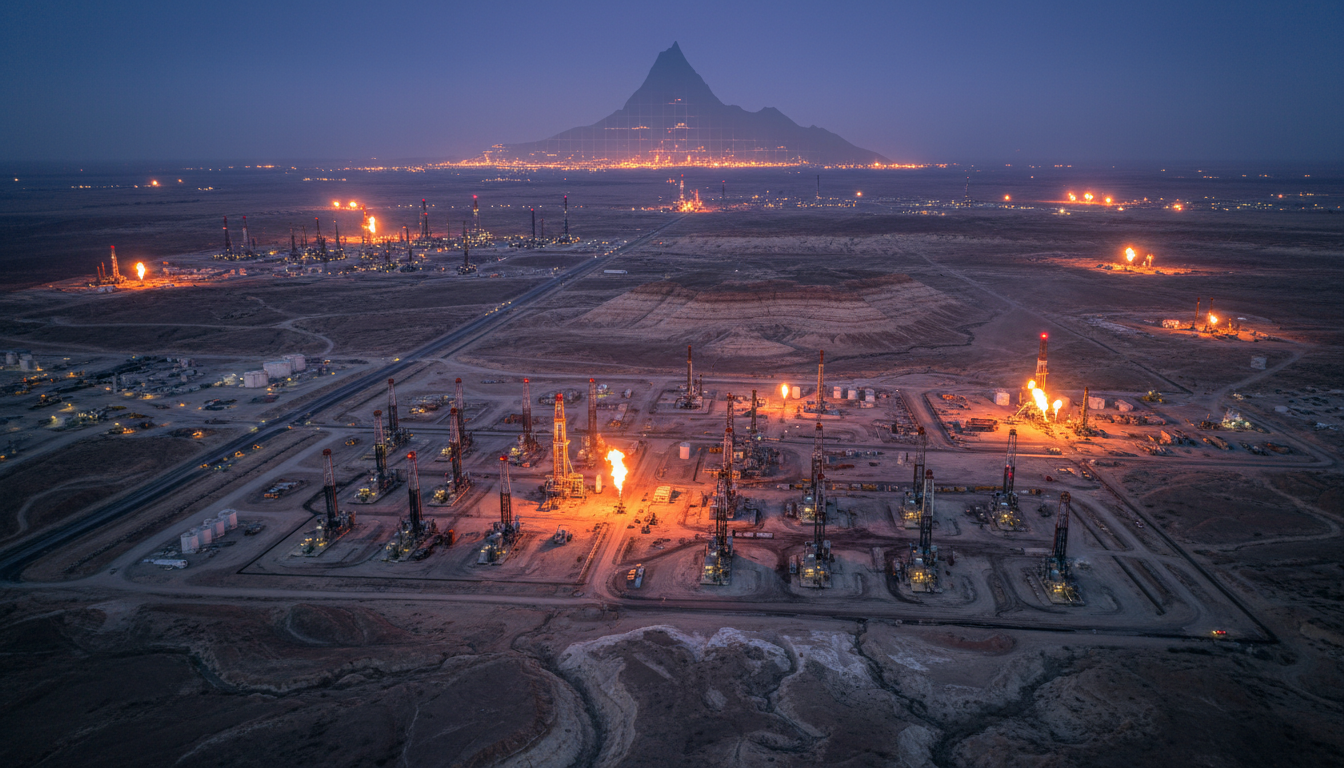
The Evolving Face of Peak Oil: Hubbert’s Enduring Relevance in the Shale Industrial Age
The venerable Hubbert Peak Theory, once considered a simple prophecy for oil’s demise, is experiencing a profound reinterpretation within the modern energy landscape. Far from being debunked, its fundamental principles are proving remarkably resilient, stress-tested by the unprecedented scale, sophisticated capital deployment, and advanced technology of the shale revolution. The advent of unconventional extraction did not dismantle Hubbert’s core geological tenets; rather, it illuminated what his original model implicitly assumed but never had to fully confront: that geology alone ceases to be the sole determinant of production trajectories once industrial-scale extraction takes hold.
Hubbert’s Legacy and the Conventional Model
M. King Hubbert’s initial framework was elegant in its simplicity: oil production from a finite resource base would naturally ascend, reach a maximum point, and subsequently decline as reservoirs depleted. This mathematical precision held true for conventional oil fields, which were developed gradually and individually. Famously, the United States’ crude oil production peaked around 1970, almost precisely as Hubbert predicted, cementing his theory’s mythical status. This historical accuracy subsequently made the rapid, often counter-cyclical growth of shale appear almost heretical to the established understanding of peak oil.
Yet, the shale revolution did not defy the underlying physics of Hubbert’s work. Individual shale wells undeniably follow steep, irreversible decline curves. Basins still exploit their most productive rock first. Recovery factors remain constrained by thermodynamic limits. What fundamentally changed was not the process of depletion itself, but the sophisticated industrial system engineered around it.
Shale’s Paradigm Shift: From Exploration to Manufacturing
Shale extraction fundamentally transformed the industry’s operational philosophy, replacing traditional exploration logic with a manufacturing mindset. Wells became standardized, short-cycle, repeatable units. Capital allocation, once a multi-year commitment, shifted to near real-time decisions. Technological advancements emerged less from groundbreaking discoveries and more from continuous iteration: optimizing lateral lengths, enhancing stage density, maximizing proppant loading, and refining pad designs. Production became a modular process. Decline was no longer a slow, inevitable outcome; it was aggressively harvested and continuously replenished through new drilling.
This critical shift matters immensely for oil and gas investors because Hubbert’s original framework implicitly assumed that new production capacity would lag behind demand and price signals by years, even decades. Shale compressed that lag into mere months, introducing an “elastic flow” of supply. Production could surge decisively when prices strengthened and equally quickly stall when capital retreated. To an outside observer, the classic bell curve of production seemed to vanish.
The Permian Basin: A Modern Case Study
Nowhere is this dynamic more evident than in the Permian Basin, arguably the most impactful oil province of the contemporary era. The Permian has experienced multiple production peaks and subsequent recoveries over the last decade, a phenomenon classical Hubbert logic would deem impossible. However, at the individual well level, decline remains brutal. And at the basin level, the observable progression from high-quality core inventory to more marginal acreage is both measurable and undeniable. Operational realities such as parent-child well interference, rising gas-oil ratios, and flattening productivity gains are not theoretical constructs; they are tangible challenges impacting investor returns.
What the Permian clearly demonstrates is that peak oil no longer presents itself as a singular, unmistakable volumetric crest. Instead, it manifests as a peak in the rate of change – a “peak growth” phenomenon. Growth rates decelerate before overall volumes actually decline. The capital required to sustain production rises significantly before output begins its downward trend. Plateaus persist for longer durations because operators are deliberately managing them to maximize economic life. Hubbert foresaw peak production; shale unveils peak growth.
Economic Inventory: The New Scarcity Metric
The critical variable in this new paradigm is no longer abstract, geological reserves, but readily accessible “economic inventory.” Shale basins do not simply run out of oil; they run out of drilling locations that can clear the prevailing capital thresholds under existing cost structures, regulatory burdens, and shareholder expectations. When prime Tier One drilling locations become scarce, operators do not immediately pivot to less economic Tier Three acreage. They consciously slow down. This strategic choice alone invalidates a purely geological view of peak oil while simultaneously reaffirming its fundamental essence: finite resources face economic limits.
Globally, shale has fragmented the concept of a single, synchronized peak. Conventional provinces continue to behave as Hubbert would predict, showing steady decline without continuous reinvestment. Key Middle Eastern producers have masked inherent depletion through politically managed plateaus, substituting geopolitical discipline for geological inevitability. Shale regions, however, introduced a third distinct regime: a highly responsive, decline-intensive, and fundamentally capital-dependent supply source.
The outcome is not a clean, global bell curve, but a more complex, frayed plateau. Legacy fields are in decline. New barrels entering the market are typically shorter-lived and demand higher capital intensity. Net global supply stability now depends less on new discoveries and more on sustained, disciplined reinvestment. This is precisely why the often-cited claim that demand will peak before supply offers an incomplete picture. While demand might flatten, the inherent quality and accessibility of new supply barrels continue to erode. Depletion and decline are relentless, independent of consumption forecasts.
Capital Markets Reshape the Supply Narrative
The capital markets have perhaps most thoroughly rewritten the practical application of Hubbert’s theory. In his era, capital chased barrels. In the modern shale industrial age, the barrels are now chasing capital. Publicly traded operators have institutionalized financial restraint through return-focused mandates, making growth an optional objective, not an inherent assumption. Private operators strategically fill volatility gaps, but even private capital now demands quicker paybacks and clearer exit strategies. External pressures from ESG mandates, increasing regulatory friction, persistent labor constraints, and service-sector inflation further restrict the industry’s ability to respond rapidly to upside price signals.
This fundamental inversion of capital dynamics carries profound implications for energy investors. Oil production no longer peaks solely because hydrocarbons are geologically unavailable. It peaks because the marginal barrel fails to meet the required return on capital at scale. While this represents a different trigger, the ultimate outcome remains strikingly similar. The resulting peak is flatter, more prolonged, and quieter, but paradoxically also more durable.
Ironically, this very capital discipline often extends the lifespan of shale basins. Slower, more deliberate development preserves valuable inventory, mitigates interference damage between wells, and spreads the inevitable depletion over significantly longer timeframes. However, this discipline also solidifies plateaus. Once aggressive growth is no longer incentivized or rewarded, the structural mechanisms necessary to restart it at prior rates simply do not exist. The system becomes self-stabilizing, and eventually, self-declining.
A Modern Hubbert Interpretation for Oil & Gas Investors
A contemporary restatement of Hubbert’s theory, therefore, is neither apocalyptic nor dismissive. Oil production peaks when a complex interplay of geology, capital discipline, technological limits, labor availability, and social license collectively converge to constrain the economic viability of the marginal barrel. The shale revolution profoundly altered the relative weighting of these variables, but it did not eliminate any of them from the equation.
This current moment holds significant weight for those investing in the energy sector. The explosive growth phase of the shale revolution, characterized by a tolerance for high capital expenditure, is undeniably over. What follows is the shale industrial age: an era defined by optimization over expansion, endurance over new discovery, and free cash flow generation over sheer volume. Production levels may remain robust for an extended period, but the expectation of aggressive growth in output will not.
Hubbert himself could not have foreseen this nuanced production profile because the industrial system capable of producing it did not yet exist. Yet, the underlying outcome remains recognizably his: decline repackaged as careful management, and scarcity deferred rather than eliminated. The peak that now announces itself is not with a dramatic crash, but with a prolonged, almost stubborn reluctance to grow further. For today’s astute investor, this subtle, capital-constrained plateau may prove to be the most accurate and enduring version of peak oil yet.