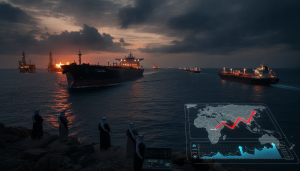
The global energy landscape finds itself in an escalating state of tension as the critical Strait of Hormuz continues to experience severe disruption, fundamentally recalibrating market expectations for crude oil prices. Leading financial analysts are underscoring a persistent upward bias for Brent crude, driven by an acute physical scarcity rather than a surge in global demand. Investors are keenly watching developments, with geopolitical considerations now dictating much of the immediate market direction for vital commodities.
Strait of Hormuz Stranglehold Drives Brent Upward
Market intelligence from Zaye Capital Markets confirms a robust performance for Brent crude, directly attributing its strength to the market’s accurate assessment of ongoing supply vulnerabilities emanating from the Strait of Hormuz. Vessel movement through this indispensable maritime conduit remains significantly curtailed, a situation exacerbated by a painfully slow pace of diplomatic resolution.
Naeem Aslam, CIO at Zaye Capital Markets, articulated a firm bullish outlook, emphasizing that the current ascent in oil prices stems from a genuine physical scarcity and restricted barrel availability, rather than any significant uptick in global demand. He highlighted that political resistance to reopening proposals suggests that substantial oil flows will not resume in the near term, solidifying the supply-side pressures.
For investors, this implies a recalibration of priorities. While macroeconomic indicators like U.S. Consumer Confidence releases hold traditional importance, their immediate impact on oil markets is now secondary. Even if consumer confidence surpasses expectations, it may provide additional impetus to the ongoing rally. Conversely, a weaker print is unlikely to trigger a substantial sell-off as long as the Strait of Hormuz remains constrained. Traders are advised to look past short-term demand fluctuations and maintain positions anticipating higher prices, as the risk premium will continue to dominate market dynamics, ensuring volatility with a distinct upward trajectory until unimpeded tanker movement is restored.
International Community Pleads for Open Passageway
The gravity of the situation extends far beyond financial trading desks, prompting urgent calls from international bodies. On April 27, the UN Secretary-General Antonio Guterres, addressing the United Nations Security Council, unequivocally asserted the imperative to uphold navigational rights and freedoms through the Strait of Hormuz, referencing Security Council Resolution 2817.
Guterres made an impassioned plea to all involved parties to “Open the Strait. Let ships pass. No tolls. No discrimination. Let trade resume. Let the global economy breathe.” He stressed that these foundational principles must be respected fully and without delay. His remarks underscored a commitment to peaceful settlement, urging restraint, dialogue, and confidence-building measures in alignment with Articles 33 and 34 of Chapter VI of the UN Charter. The UN continues to offer its good offices and support through its Special Representatives and Envoys to facilitate dispute resolution among national and regional partners.
The Secretary-General’s comments served as a stark reminder of the Strait of Hormuz’s unparalleled strategic importance. This critical maritime chokepoint handles approximately one-fifth of the world’s total oil trade, an equivalent share of global liquefied natural gas (LNG), and nearly one-third of all internationally traded fertilizers. The assurance of safe and unimpeded passage through this waterway is not merely an economic concern but a profound humanitarian imperative. The immediate economic reverberations of the closure are already evident, with Guterres noting that “everyone is paying the price” for this disruption.
Broadening Supply Shock and Long-Term Market Shifts
The repercussions of the effective closure of the Strait of Hormuz are proving to be far-reaching, triggering a profound and extensive supply shock that now impacts a multitude of sectors, extending well beyond the immediate energy sphere to agriculture and industrial inputs. Ole S. Hansen, Head of Commodity Strategy at Saxo Bank, noted that while initial containment of crude price impacts was observed through demand destruction and inventory drawdowns, the underlying stress is increasingly evident across refined products, fertilizers, and various industrial raw materials.
Hansen cautioned that even if a reopening of the Strait were to materialize, the path to normalization would be arduous and protracted. Significant logistical and operational hurdles are anticipated to keep commodity markets tight for many months to come, suggesting a persistent environment of elevated prices and limited availability. Furthermore, this crisis is serving as a powerful catalyst for structural transformations within the global economy. A renewed focus on clean energy initiatives is gaining momentum, alongside a critical reassessment of global supply chain resilience strategies.
For discerning investors and market participants, the essential insight lies in recognizing the broad and enduring nature of this disruption’s influence. Its effects will undeniably extend far beyond the initial shock experienced by the global oil markets, reshaping investment considerations across a diversified portfolio of commodities and energy-related assets. The geopolitical risks in key transit choke points have never been more palpable, necessitating a careful re-evaluation of long-term investment strategies.
As the international community grapples with this critical geopolitical flashpoint, market participants must remain vigilant. The interplay of restricted supply, diplomatic stalemates, and the essential nature of the Strait of Hormuz’s trade flows promises continued volatility and upward pressure on a broad spectrum of commodities, making informed analysis crucial for navigating the evolving energy landscape.