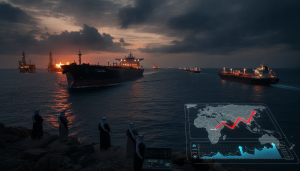
Geopolitical Tensions Drive Crude Higher as Iran Seeks Interim Deal Amidst Stalemate
The global oil markets are once again grappling with heightened geopolitical risk emanating from the Middle East, as Iranian Foreign Minister Abbas Araghchi embarked on crucial diplomatic engagements in Russia, seeking to coordinate strategy amidst an escalating eight-week military confrontation with the United States and Israel. This high-stakes diplomatic flurry comes as Tehran signals a potential willingness to pursue an interim agreement with Washington, a development closely watched by energy investors.
Araghchi’s visit to Moscow, which included a planned meeting with President Vladimir Putin, underscores Iran’s urgent need to align its diplomatic efforts with key allies after the recent US-Israeli military actions significantly disrupted bilateral communication channels. The core of Iran’s latest proposal, according to reports, centers on de-escalation: Tehran would agree to reopen the vital Strait of Hormuz in exchange for Washington lifting its naval blockade on Iranian ports. This strategic waterway, critical for global oil shipments, has been largely impassable, contributing to market jitters.
Iranian state media reported that Araghchi intends to convey this proposal to Pakistan, acting as the primary mediator with the U.S. Tehran’s demands extend beyond merely lifting the naval blockade; they include establishing a new legal framework governing the Strait of Hormuz and an unequivocal guarantee against future military intervention. Significantly, Iran indicated its readiness to defer negotiations concerning its long-standing nuclear program to a later stage, prioritizing the immediate cessation of the conflict and the restoration of its maritime trade access.
However, the prospect of such an interim deal faces considerable hurdles. The U.S. has yet to officially comment on Iran’s specific proposal, though President Donald Trump did acknowledge a “new plan” from Iran. A White House spokesperson, in a statement to Bloomberg, reiterated Washington’s firm stance: “the United States holds the cards and will only make a deal that puts the American people first, never allowing Iran to have a nuclear weapon.” This suggests a strong commitment to resolving the nuclear issue concurrently with any broader agreement, diverging from Iran’s proposed phased approach.
Many Middle East analysts have advocated for a rapid reopening of the Strait of Hormuz to alleviate global fuel price pressures and temper the broader economic impact, deferring complex issues like Iran’s nuclear ambitions. Some European and Persian Gulf Arab leaders estimate that comprehensive negotiations on the nuclear program alone could extend for at least six months. Yet, President Trump has consistently indicated that Iran’s atomic development must be integral to any resolution, maintaining that the current blockade remains an effective tool to pressure Tehran into making concessions by stifling its critical oil exports.
Crude Oil Markets React to Geopolitical Impasse
The persistent diplomatic stalemate and the ongoing disruptions within the Middle East immediately translated into market volatility, pushing crude oil prices higher. Brent crude, the international benchmark, surged by 2.1 percent, reaching $107.52 a barrel by 11:05 a.m. in Dubai. This upward trajectory reflects investor concern over the continued constrained flow through the Strait of Hormuz, a conduit for roughly a fifth of the world’s seaborne crude.
Market analysts at Goldman Sachs Group Inc. have responded to the evolving situation by upgrading their fourth-quarter forecast for Brent crude. The investment bank now projects Brent to average $90 a barrel, a significant increase from their previous estimate of $80 per barrel. This revision stems from a recalibration of their timeline for the “normalization” of crude exports from the Persian Gulf, which they now anticipate by the end of June, pushing back their earlier expectation of mid-May. The delay signals a deeper embedding of geopolitical risk into supply forecasts, impacting investment decisions across the energy sector.
Complexities Mount as Diplomacy Falters
The intricate dance of international diplomacy faces severe headwinds. “We must ensure the rights of the Iranian people after 40 days of resistance and secure the country’s interests,” Araghchi stated, as reported by the state-run Islamic Republic News Agency. His comments highlight the domestic pressures influencing Iran’s negotiating position, emphasizing the need to demonstrate a tangible return for their prolonged standoff.
Araghchi also indicated a “high degree of alignment” between Iran and Oman regarding the future management of the Strait of Hormuz. Iran has historically proposed implementing a toll system for traffic through the strait, with revenues shared collaboratively with Oman, which shares the strategic waterway. Such a mechanism could provide a framework for future governance, but only if broader geopolitical tensions subside.
Efforts to restart in-person peace talks suffered a significant setback when President Trump canceled a trip to Pakistan by his key envoys, Steve Witkoff and Jared Kushner. This decision followed Araghchi’s clear signal that he would not engage with American negotiators while in Pakistan, and Iran’s government reiterated its refusal to hold further discussions under the shadow of U.S. military threats. The absence of direct dialogue further complicates the path to resolution, maintaining a climate of uncertainty for global energy markets.
Adding to the regional instability, recent Israeli strikes in southern Lebanon reportedly resulted in 14 fatalities, including two children, according to Lebanese state media. While President Trump announced an extension of the ceasefire between Lebanon and Israel—which has a protracted conflict with Iran-backed Hezbollah—until around mid-May, both sides continue to exchange accusations of truce violations. These ongoing regional skirmishes underscore the fragility of the Middle East’s geopolitical landscape, making any resolution concerning Iranian oil exports a complex and multifaceted challenge for global energy investors.