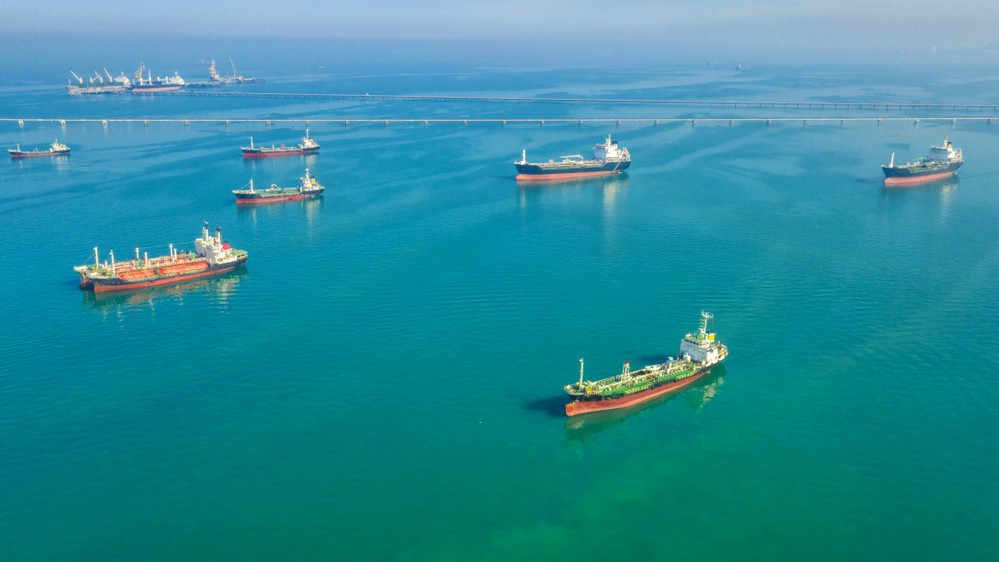
The global energy landscape is currently navigating a period of heightened volatility and profound uncertainty, driven primarily by the escalating crisis in the Strait of Hormuz. This vital chokepoint, through which a significant portion of the world’s seaborne crude oil passes, is experiencing unprecedented disruption. Recent intelligence indicates a near-total paralysis of maritime traffic, with reports of only a single bulk carrier managing to exit the strait and a complete absence of vessels attempting entry. This alarming development, stemming from direct Iranian actions, signals a critical escalation in regional tensions, compelling oil and gas investors to re-evaluate supply stability and future crude oil price trajectories.
Geopolitical Flashpoint: The Hormuz Standoff Intensifies
The immediate catalyst for this severe gridlock was Iran’s assertive move to fire upon three vessels transiting the Strait late Wednesday. Tehran has framed these actions as a direct response to perceived breaches of a fragile ceasefire agreement previously established with the United States and Israel. Crucially, Iran has singled out ongoing Israeli military operations in southern Lebanon as a primary violation, emphasizing that this region must be explicitly included within the scope of any cessation of hostilities. This intricate diplomatic backdrop, punctuated by recent direct talks between Israel and Lebanon, highlights the complex web of regional rivalries that directly impacts energy transit security.
Further exacerbating the crisis, Iranian forces have compounded the shipping risks by seizing two container ships. This move closely followed the United States’ own seizure of two Iranian vessels earlier in the week, creating a tit-for-tat dynamic that significantly elevates commercial shipping risks. Concurrently, the U.S. has implemented a blockade targeting traffic to and from Iranian ports within the Persian Gulf. While this aims to curtail Iranian maritime activity, its effectiveness remains partial; our proprietary intelligence, for instance, has tracked as many as 34 tankers with sanctioned or Iranian affiliations continuing to move in and out of the waterway. This demonstrates the persistent challenges in enforcing complete maritime interdiction in such a complex operational environment, even as the broader ceasefire agreement on direct missile strikes between the principal warring parties appears to hold.
Market Reaction and Price Trajectory Amidst Mounting Risk
The gravity of the Hormuz situation is clearly reflected in current market pricing. As of today, Brent crude trades at $104.52, showing a marginal increase of 0.11% within a day range of $103.27 to $105.15. WTI crude, the U.S. benchmark, stands at $99.68, experiencing a slight decline of 0.25% after trading between $98.42 and $100.74. Gasoline prices are also feeling the pressure, currently at $3.44 per gallon, up 0.29% within a range of $3.41 to $3.45. This current pricing reflects a significant risk premium building into the market, a trend observable over the past fortnight, with Brent having climbed over 8% from $95.92 on April 9th to reach $103.9 by April 28th, prior to today’s slight movement. The sustained disruption at Hormuz, now approaching the end of its second month, fundamentally shifts perception regarding the reliability of Middle Eastern energy routes, prompting the IEA to warn of a potential permanent re-architecture of global energy flows.
Investor Concerns: Navigating Supply Volatility and Future Flows
Our proprietary reader intent data reveals a heightened focus among investors on understanding the implications of this crisis. Many are keenly asking for a base-case Brent price forecast for the next quarter, and what specific factors could push prices above $120. The current Hormuz standoff provides a potent answer to the latter. A prolonged or escalating disruption would severely constrict global supply, driving prices higher as alternative routes are sought and strategic reserves are drawn down. Investors are also noting that broader US-Iran negotiations remain stalled, with Iran insisting that a full ceasefire depends on the US lifting its blockade of Iranian ports – a critical point highlighted in recent queries that directly feeds into the complexity of de-escalation. The persistent challenges in enforcing complete maritime interdiction, despite the US blockade, further complicate the outlook, making any definitive long-term price forecast contingent on unpredictable geopolitical developments rather than pure supply-demand fundamentals.
The long-term implications extend beyond immediate price spikes. The reliability of Middle Eastern energy routes is now fundamentally questioned, pushing investors to consider the viability of alternative supply corridors, increased investment in non-OPEC production, and accelerated energy transition efforts. While questions about EV adoption’s impact on long-term oil demand projections remain relevant, the immediate concern is unequivocally on short-to-medium term supply security. This crisis underscores the need for robust portfolio diversification and a keen eye on geopolitical catalysts, as the stability of a single chokepoint can rapidly redraw the investment landscape.
Forward Outlook: Key Events and the Path Ahead
With the Strait of Hormuz crisis unfolding, upcoming data releases and reports will be scrutinized even more closely by investors seeking clarity and direction. Tomorrow, April 29th, the EIA Weekly Petroleum Status Report will offer crucial insights into U.S. crude oil and product inventories, providing an early indication of how global supply disruptions might be impacting the world’s largest consumer. This will be followed closely by the Baker Hughes Rig Count on May 1st, a key metric for understanding potential responses from U.S. producers to higher prices.
Looking further ahead, the EIA Short-Term Energy Outlook on May 2nd will be a critical release, as the agency will undoubtedly revise its price and supply forecasts in light of the Hormuz situation. The subsequent API Weekly Crude Inventory (May 5th) and another EIA Weekly Petroleum Status Report (May 6th) will continue to monitor inventory shifts. Perhaps most significantly, the IEA Oil Market Report on May 12th will offer a comprehensive global perspective on supply-demand balances and the potential long-term architectural shifts in energy flows that Fatih Birol has alluded to. These events, combined with any diplomatic or military developments in the Strait, will provide vital intelligence for investors navigating this period of unprecedented supply risk.


