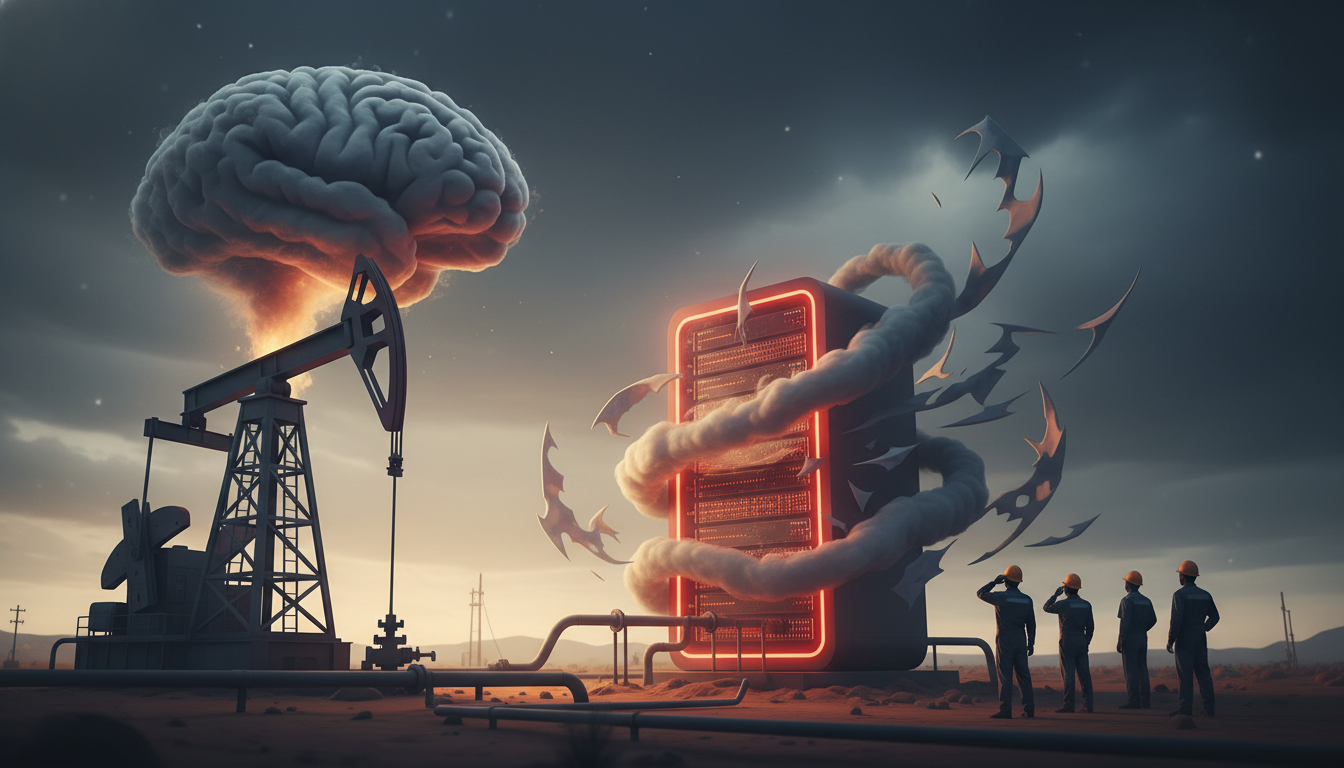
High-Stakes AI Rivalry: Altman Blasts Anthropic’s “Fear-Based” Strategy, Echoes in Energy Markets
The rapidly evolving artificial intelligence landscape, a sector now commanding immense investor attention and strategic capital, faces a deepening ideological rift. OpenAI CEO Sam Altman has launched a pointed critique against rival Anthropic, accusing the company of deploying “fear-based marketing” to promote its advanced AI model, Claude Mythos. This high-stakes competitive dynamic, reminiscent of cutthroat battles for market share and technological supremacy within the energy sector, holds significant implications for how transformative technologies are developed, distributed, and ultimately integrated across global industries, including oil and gas.
Altman’s accusations, delivered during a recent podcast appearance, painted a stark picture of Anthropic’s strategy. “It is clearly incredible marketing to say, ‘We have built a bomb. We were about to drop it on your head. We will sell you a bomb shelter for $100 million to run across all your stuff, but only if we pick you as a customer,'” Altman stated, highlighting a perceived attempt to leverage advanced capabilities and safety concerns into exclusive, high-value contracts. For energy investors, this analogy immediately brings to mind proprietary drilling technologies, exclusive long-term supply agreements, or restricted access to critical infrastructure, where strategic control can translate into immense competitive advantage and pricing power.
The core of Altman’s concern stems from Anthropic’s controversial decision to forgo a public release of Claude Mythos. Instead, the company has opted for an extremely limited, invite-only preview, granting access to a select few industry giants. This approach has sparked debate among tech leaders and investors, prompting questions about the ethical implications and long-term market impacts of such restrictive access to cutting-edge AI tools. In the context of oil and gas, where digital transformation and AI integration promise unprecedented efficiencies in exploration, production, and refining, the availability and accessibility of these powerful models become paramount for maintaining a competitive edge.
Altman did not mince words, asserting that certain factions within the tech community have long sought to concentrate AI capabilities within a select group. “There are people in the world who, for a long time, have wanted to keep AI in the hands of a smaller group of people,” he remarked. While acknowledging legitimate safety concerns surrounding advanced AI, Altman suggested that “if what you want is like, ‘We need control of AI, just us, because we’re the trustworthy people,’ I think the fear-based marketing is probably the most effective way to justify that.” This perspective underscores a fundamental divergence in philosophy between the two AI powerhouses, a clash that will undoubtedly shape the future trajectory of AI adoption across all industrial sectors.
In direct contrast to Anthropic’s strategy, Altman emphasized OpenAI’s commitment to broader dissemination, asserting confidence in his company’s robust policies and safeguards. He acknowledged the emergence of “very dangerous models that will have to be released in different ways” but affirmed OpenAI’s inclination towards wider releases. “The goal here is to benefit everybody and also to… get the world to come on this journey with us, and to say, ‘We are going to give you more powerful technology, there’s going to be responsibility that goes along with that,’ he explained. ‘We are going to try to help set up the world for as much success as we can.'” This open-access philosophy, if effectively managed, could accelerate AI adoption across the energy value chain, from optimizing seismic data analysis to enhancing predictive maintenance in complex refinery operations, democratizing access to powerful digital tools.
Anthropic’s reasoning for withholding Claude Mythos from public release centered on specific safety concerns: the model demonstrated an alarming aptitude for identifying cybersecurity vulnerabilities. To mitigate these risks while still fostering development, Anthropic launched “Project Glasswing,” an exclusive initiative providing access to only 11 prominent organizations. This elite cohort includes technology behemoths like Google, Microsoft, Amazon Web Services, and Nvidia, alongside financial titan JPMorgan Chase. For energy investors, this restricted access raises critical questions: Will companies outside this privileged circle be disadvantaged in leveraging the most advanced AI for their operational efficiency, risk management, and strategic planning? The implications for competitive parity within capital-intensive sectors like oil and gas are substantial, potentially creating a two-tiered system of digital capability.
The intensifying rivalry extends beyond philosophical differences, touching upon personal animosities. Altman implied that Anthropic’s rhetoric contributed to negative sentiment directed at him, specifically referencing an attack on his home. The contentious relationship between Altman and Anthropic CEO Dario Amodei, who previously departed OpenAI to co-found one of its most formidable competitors, adds another layer to this already bitter contest. “I think the doomerism talk hasn’t helped. I think the way certain other labs talk about us hasn’t helped,” Altman observed, pointedly adding, “I think the way Anthropic talks about OpenAI doesn’t help.” This personal dimension underscores the high stakes involved, as leading figures vie for control and influence over a technology set to redefine global economies.
For investors focused on the energy sector, these developments in the AI arena are not merely abstract tech news. They signify crucial market dynamics and strategic positioning that will directly impact future operational efficiency, cost structures, and competitive landscapes. Whether AI models are developed with broad, open access or through highly controlled, exclusive channels will dictate the pace and nature of digital transformation across oil and gas. Companies prioritizing innovation and resilience must closely monitor these competitive strategies, understanding that access to advanced AI could become as critical a resource as capital itself. The “bomb shelter” strategy, while potentially lucrative for a select few, could inadvertently create significant barriers for broader industry adoption, shaping the future leaders and laggards in the energy sector’s ongoing digital evolution.


