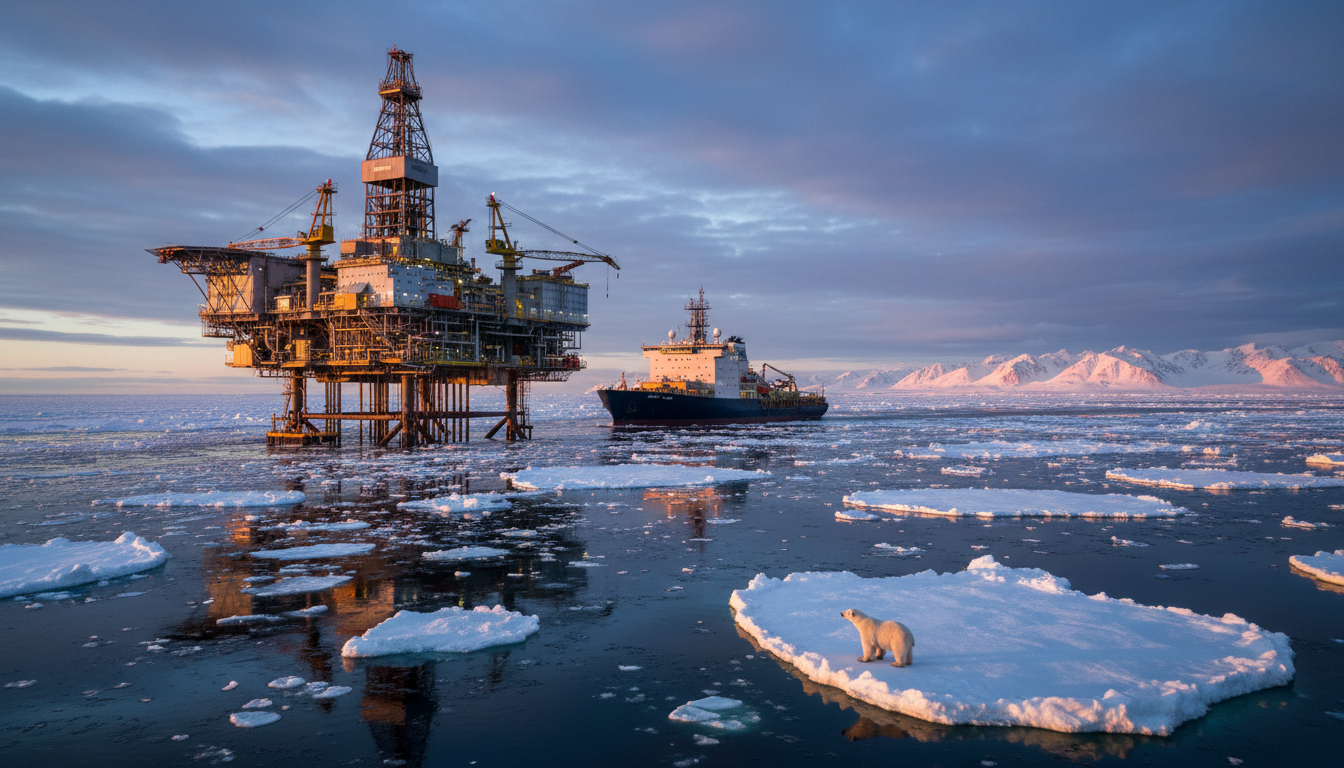
Greenland, long a whispered possibility in the annals of oil and gas exploration, is rapidly solidifying its position as a tangible, albeit highly complex, frontier investment. As the global energy landscape grapples with persistent supply disruptions and shifting geopolitical allegiances, the strategic imperative for diversified and stable hydrocarbon sources has never been clearer. This vast Arctic territory, with its formidable remoteness and inherent challenges, is moving from the realm of speculative interest to a serious, long-term consideration for energy investors seeking to capitalize on the next generation of mega-projects.
The Geological Prize: Unpacking Greenland’s Vast Potential
Beneath Greenland’s expansive ice sheets lies a geological promise that resonates deeply with the capital-intensive world of energy exploration. Extensive assessments of the Jameson Land Basin in East Greenland alone indicate a prospective resource endowment exceeding 13 billion barrels of oil. This places it firmly among the most significant undeveloped basins globally, a scale that warrants the colossal investments required for Arctic development. Beyond Jameson Land, the broader East Greenland Rift system has been identified as a major hydrocarbon province, boasting striking geological similarities to established producing regions across the North Atlantic. For savvy investors, this geological analogy offers a critical layer of de-risking, suggesting the presence of proven play types within a largely unproven territory. The sheer volumetric potential provides the foundational economic rationale for undertaking projects of this magnitude, offsetting the inherent logistical and environmental complexities.
Macro Tailwinds and Geopolitical Imperatives Driving Arctic Interest
The renewed focus on Greenland is not merely a cyclical phenomenon but rather the result of a powerful convergence of macro-economic and geopolitical forces. Firstly, escalating global supply uncertainty is compelling international energy companies and sovereign entities to expand their horizons beyond conventional producing regions. The relentless pursuit of energy security demands a global search for new reserves in diverse locales, mitigating over-reliance on any single, potentially volatile, area. This drive is clearly reflected in recent market movements: as of today, Brent Crude trades at $104.52 per barrel, showing a marginal daily increase but representing a robust 8.3% climb over the past two weeks, from $95.92 on April 9th to $103.9 on April 28th. This persistent upward pressure on prices underscores the market’s underlying tightness and the critical need for new, stable supply sources. Meanwhile, WTI Crude stands at $99.68, reflecting similar dynamics, albeit with a slight daily dip. The significant run-up in crude prices provides a powerful incentive to explore and develop high-cost frontier resources.
Secondly, technological advancements and evolving climate patterns are collectively improving Arctic accessibility. Extended operational windows and enhanced capabilities for navigating extreme conditions are making exploration and potential development more technically feasible and economically viable than ever before, significantly reducing historical logistical hurdles. Finally, geopolitics plays an increasingly critical role, elevating the strategic value of resources located within stable, Western-aligned jurisdictions. Greenland, as an autonomous territory within the Kingdom of Denmark, offers this crucial element of political stability—a stark contrast to many other resource-rich regions plagued by volatility and sovereign risk. This potent combination of factors makes the Arctic, and Greenland specifically, an increasingly attractive, albeit long-term, proposition for strategic energy investors.
Navigating Investor Concerns: Risk, Reward, and Future Catalysts
Our proprietary reader intent data reveals a clear focus on understanding market volatility and long-term demand fundamentals, which are directly pertinent to frontier investments like Greenland. Investors are actively asking: “What would push Brent below $80? What would push it above $120?” These questions highlight the high-stakes nature of such projects; while Greenland’s potential is vast, its development hinges on a sustained high-price environment to justify the immense capital expenditure and long lead times. The geopolitical context further adds complexity, with ongoing situations like the Israel-Lebanon ceasefire extensions and stalled US-Iran negotiations contributing to the very uncertainty that drives Brent’s price fluctuations and underscores the need for diverse supply. Moreover, the question regarding “the impact of EV adoption on long-term oil demand projections” signals investor apprehension about peak oil demand, which is a critical consideration for projects that may not come online for decades. Developing Greenland’s resources demands a conviction that global oil demand will remain robust enough for a sufficient period to deliver returns on these multi-billion-dollar investments. The interplay between immense geological potential, the strategic imperative for energy security, and these significant market and demand uncertainties defines the unique risk-reward profile of Greenland oil.
Key Dates and Data Points: Monitoring the Arctic Horizon
While direct Greenland-specific exploration catalysts may be years away, the broader energy market’s pulse provides crucial signals for investors evaluating frontier plays. Investors keen on understanding the long-term viability and pricing environment for projects like Greenland will be closely watching upcoming market data releases. The EIA Weekly Petroleum Status Report, published consistently each Wednesday (e.g., April 29th and May 6th), offers immediate insights into U.S. crude inventories, refinery activity, and demand, impacting short-term price dynamics. More critically for long-term strategic planning, the EIA Short-Term Energy Outlook on May 2nd and the IEA Oil Market Report on May 12th will provide comprehensive global supply, demand, and inventory forecasts. These reports are instrumental in shaping the “base-case Brent price forecast for next quarter” that our readers are actively seeking, a forecast that directly underpins the economic models for high-cost, long-horizon projects. Monitoring these industry benchmarks allows investors to gauge the robustness of the global energy appetite and assess the sustained economic viability required to unlock the challenging, yet potentially transformative, resources of Greenland. Every data point, from weekly rig counts to monthly global outlooks, contributes to the intricate mosaic that informs investment decisions in this high-stakes Arctic frontier.