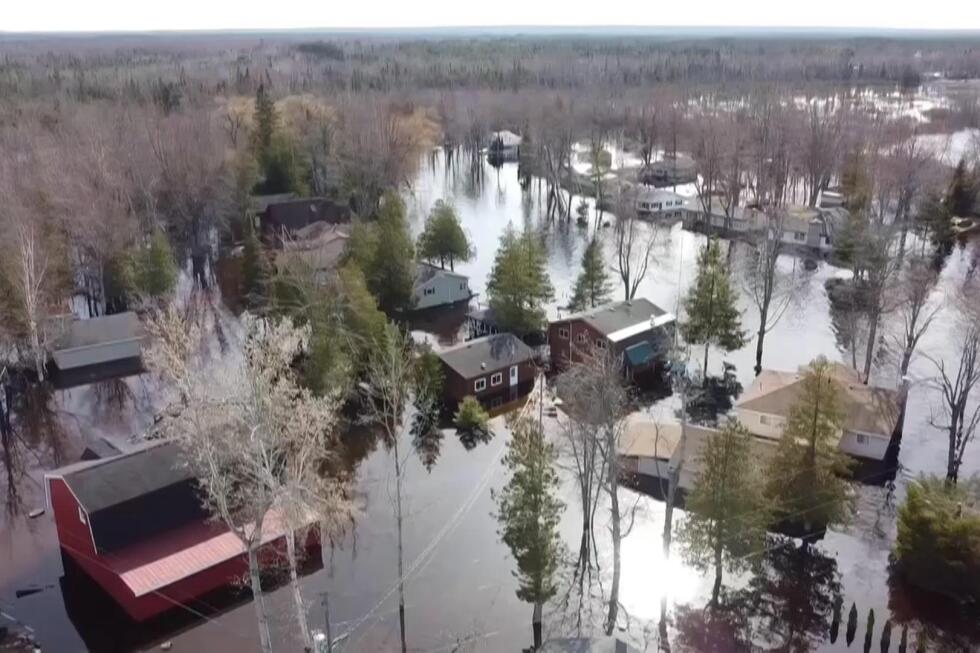
The recent severe flooding and ice-related disruptions in Michigan’s Lower Peninsula offer a potent reminder of the myriad challenges facing regional energy infrastructure and the broader implications for supply chain resilience. While localized, events like these underscore the constant need for vigilance in managing energy logistics and the potential for seemingly isolated incidents to ripple through investor sentiment. As senior analysts at OilMarketCap.com, we view such occurrences not just as news, but as critical data points informing our understanding of operational risks and investment landscapes in the energy sector.
Michigan’s Energy Infrastructure Under Strain
Communities across Cheboygan County, Michigan, have grappled with significant flooding and destructive ice movements, stemming from persistent spring rainfall and extensive winter snowmelt. Reports confirm that large ice sheets, described by observers as “mini glaciers,” have breached homes along Black Lake, devastating properties and overwhelming local waterways. The Black Lake, Black River, Cheboygan River, Burt Lake, Mullett Lake, and Sturgeon River have all surged beyond their banks, creating an unrecognizable expanse of water and necessitating evacuations from Black Lake’s west side.
A critical point of concern has been the Cheboygan Lock and Dam Complex, a vital piece of regional infrastructure. On April 9, a substantial ice chunk snapped a safety cable at the complex, forcing the Michigan Department of Natural Resources to close upstream and downstream access points. This incident highlights the vulnerability of essential control points to extreme weather phenomena. Crews have been actively working to prevent debris and ice from clogging the dam, employing pumps, restoring power to an old hydroelectric station, and utilizing cranes to remove water-retaining gates, all in an effort to manage the unprecedented water flow towards Lake Huron. Such efforts, while successful in mitigating further damage, represent considerable operational expenditure and stress on local resources.
Navigating Current Market Dynamics Amidst Local Disruptions
While the Michigan floods represent a localized challenge, they occur within a dynamic global energy market that investors are closely monitoring. As of today, Brent Crude trades at $103.95, marking a +2.22% gain for the day and demonstrating a robust upward trend from $94.75 on April 8 to $101.95 on April 27, an increase of 7.6%. WTI Crude follows suit at $98.46, up +2.17%, while gasoline prices stand at $3.41, reflecting a +1.49% daily increase. These global benchmarks are primarily influenced by broader geopolitical factors, OPEC+ decisions, and demand projections, rather than localized weather events.
However, the Michigan situation is instructive for understanding regional energy supply resilience. While direct impacts on global crude pricing are minimal, such events can disrupt local refined product distribution, impacting regional gasoline and natural gas supply lines. The logistical challenges of moving fuels through affected areas, even if temporary, can cause localized price spikes and delivery delays. For investors, these incidents serve as micro-level examples of the ‘tail risk’ associated with infrastructure vulnerability, particularly in regions reliant on complex waterway systems for transport or power generation.
Investor Focus: Beyond Benchmarks to Supply Chain Resilience
Our proprietary intent data reveals that investors are deeply engaged in understanding the drivers behind commodity price fluctuations, frequently asking questions such as “What would push Brent below $80?” or “What would push it above $120?” While the Michigan floods won’t individually trigger such shifts, they contribute to the broader narrative of supply chain fragility that can influence sentiment. The ability of infrastructure to withstand extreme weather, and the speed of recovery, are increasingly critical considerations for long-term energy investment.
The incident also subtly ties into larger discussions our readers are having, including the “impact of EV adoption on long-term oil demand projections.” Even as the energy transition progresses, the resilience of existing infrastructure for current and near-term energy needs remains paramount. Disruptions like those in Michigan highlight that the physical delivery of energy, whether crude, refined products, or natural gas, is susceptible to environmental factors. This necessitates continued investment in robust infrastructure and adaptive strategies, which carries cost implications for energy companies and, by extension, their valuations.
Forward View: Monitoring Infrastructure and Market Signals
Looking ahead, investors must track not only global supply and demand fundamentals but also the ongoing resilience of regional energy infrastructure. While the Michigan floods are a specific case, the broader theme of climate-related operational disruptions is one to watch. Upcoming energy events, such as the API Weekly Crude Inventory reports (scheduled for April 28, May 5, May 12) and the EIA Weekly Petroleum Status Reports (April 29, May 6), will provide crucial insights into national inventory levels, which can buffer against or exacerbate regional supply issues.
Furthermore, the Baker Hughes Rig Count (May 1, May 8) offers a pulse on upstream activity. While not directly related to Michigan’s flood situation, a robust and adaptable upstream sector is vital for overall energy security, which can be implicitly threatened by persistent infrastructure challenges elsewhere in the value chain. The EIA Short-Term Energy Outlook, due on May 2, will provide a comprehensive forecast that investors should cross-reference with observed local disruptions to gauge the overall health and adaptability of the U.S. energy system. These granular events, when viewed through the lens of broader market trends and future projections, offer valuable context for constructing a robust investment thesis in the dynamic oil and gas sector.


