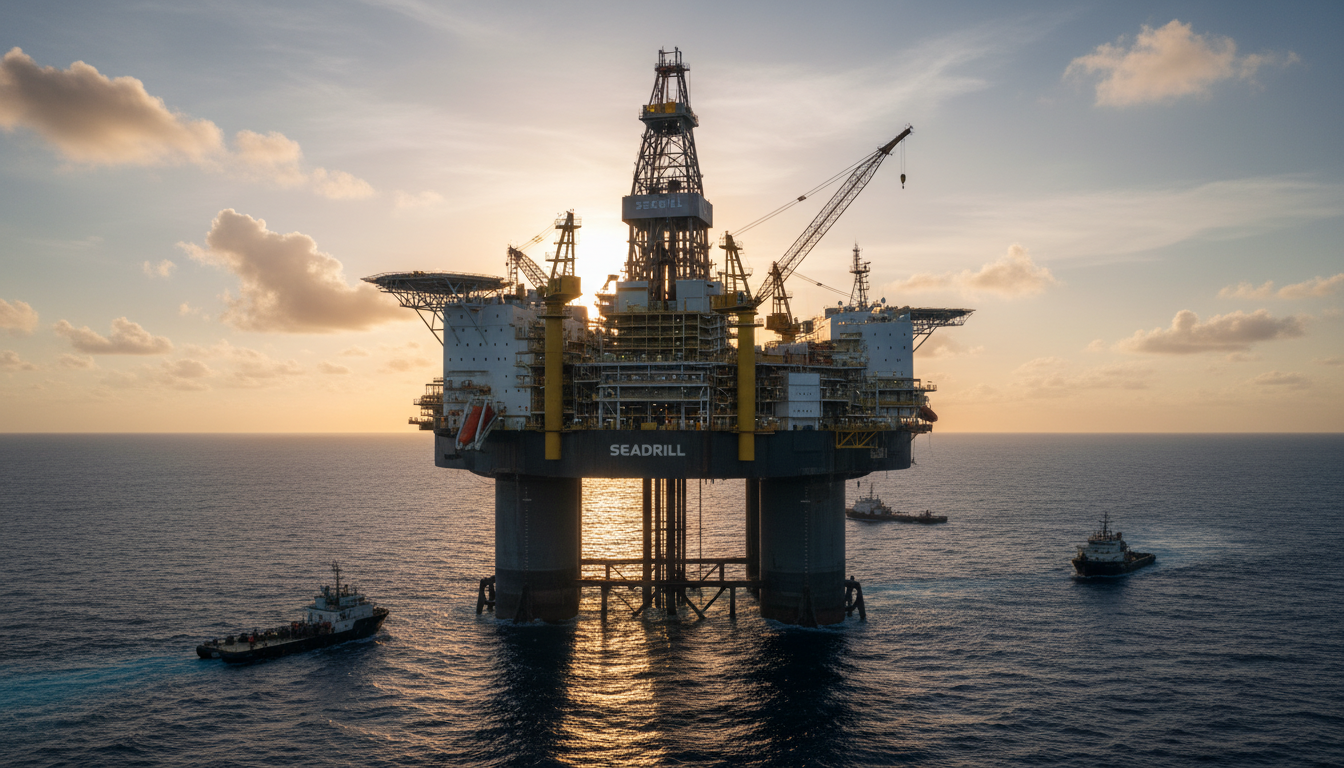
Seadrill has significantly bolstered its contract backlog with two new deepwater drilling awards in the U.S. Gulf of Mexico, totaling approximately $260 million. This substantial addition underscores continued investment in the region’s ultra-deepwater segment, signaling resilience and strategic long-term planning within the offshore sector. For investors, this move by a leading offshore driller offers a critical lens into the future trajectory of energy demand and the health of the exploration and production landscape, particularly as the market navigates a complex interplay of current pricing dynamics and anticipated future energy needs.
Strategic Backlog Expansion in the Gulf
The recent contract wins for Seadrill’s ultra-deepwater drillships, the West Neptune and West Vela, represent a robust vote of confidence in the Gulf of Mexico’s deepwater potential. The West Neptune secured a 365-day contract extension, slated to commence in September 2026, while the West Vela was awarded a 270-day contract, with operations expected to begin in August 2026. Both lucrative awards originate from LLOG Exploration, a subsidiary of Harbour Energy, extending a long-standing operational partnership. Seadrill’s CEO, Samir Ali, highlighted that these contracts are a testament to the strong operational performance of both rigs, directly contributing to enhanced revenue visibility and bolstering free cash flow generation. This expansion is particularly noteworthy as it occurs against a backdrop of what the company describes as “near-term softness” in the U.S. Gulf market, suggesting a strategic long-term view by operators willing to commit significant capital years in advance.
Current Market Signals and Investor Focus
The timing of Seadrill’s backlog growth is particularly interesting when viewed against the backdrop of current energy market conditions. As of today, Brent crude trades at $103.95, reflecting a solid 2.22% gain, while WTI crude closely follows at $98.46, up 2.17% within the day’s trading range of $96.24-$98.85. This bullish momentum is part of a broader trend; Brent crude has appreciated by over 7.6% in the last 14 days alone, climbing from $94.75 on April 8, 2026, to $101.95 by April 27, 2026. Such price strength underpins the economic viability of deepwater projects, which typically require higher breakeven costs than onshore alternatives.
Our proprietary reader intent data reveals a significant preoccupation among investors with crude price trajectories. Many are actively seeking a base-case Brent price forecast for the next quarter, alongside exploring scenarios that could push Brent below $80 or above $120. This indicates a market hungry for clarity amidst volatility. The commitment to long-duration deepwater drilling contracts, like those secured by Seadrill, offers a tangible signal from major operators that, despite short-term fluctuations or perceived softness, they foresee sustained high demand and robust pricing for crude well into the latter half of the decade. This contrasts with some concerns over long-term oil demand projections, particularly in light of increasing EV adoption, suggesting a nuanced outlook where deepwater remains critical for energy security and supply.
Forward Outlook and Key Catalysts
Seadrill’s management anticipates an improvement in global floater utilization heading into 2027, a forward-looking perspective that these new contracts perfectly align with, given their August and September 2026 start dates. This long-term contracting strategy positions the company to capitalize on the expected upcycle in deepwater drilling. For investors tracking this trend, several upcoming market events will offer crucial insights that could reinforce or challenge this outlook.
In the immediate future, the API Weekly Crude Inventory reports on April 28th and May 5th, followed by the EIA Weekly Petroleum Status Reports on April 29th and May 6th, will provide critical granular data on U.S. supply-demand balances. These weekly updates are vital for assessing immediate market tightness or surplus, which can influence short-term price movements and, indirectly, sentiment towards future E&P spending. Furthermore, the Baker Hughes Rig Count on May 1st and May 8th will offer a real-time pulse check on domestic drilling activity across all basins. Perhaps most impactful for the medium-term outlook, the EIA Short-Term Energy Outlook on May 2nd could recalibrate market expectations for supply, demand, and prices, directly impacting the investment calculus for capital-intensive deepwater projects and potentially validating Seadrill’s optimistic utilization forecast. These events collectively form a critical framework for understanding the macro forces shaping the offshore drilling landscape.
Investment Implications and Sector Positioning
For investors, Seadrill’s latest contract awards are more than just numbers; they are a strong indicator of the company’s operational strength and strategic positioning within the competitive offshore drilling market. The $260 million addition to the backlog not only enhances financial visibility but also validates the high performance and reliability of the West Neptune and West Vela drillships. This sustained demand for ultra-deepwater assets, particularly from a significant operator like LLOG Exploration, signals that despite the “near-term softness” mentioned by Seadrill’s CEO, there remains an unwavering commitment to unlocking complex, high-return deepwater reserves.
This commitment is crucial for the entire offshore drilling sector, which is characterized by high capital expenditures and long project lifecycles. The multi-year contracts provide a stable revenue stream, enabling Seadrill to potentially optimize its capital structure and invest further in its fleet. As global floater utilization is projected to improve into 2027, companies with secured backlogs are best positioned to benefit from increasing day rates and sustained demand. Investors should view these contracts as a testament to the long-term strategic importance of deepwater resources in meeting global energy needs, reinforcing the investment thesis for well-managed offshore drilling companies that can consistently secure and execute such complex projects.