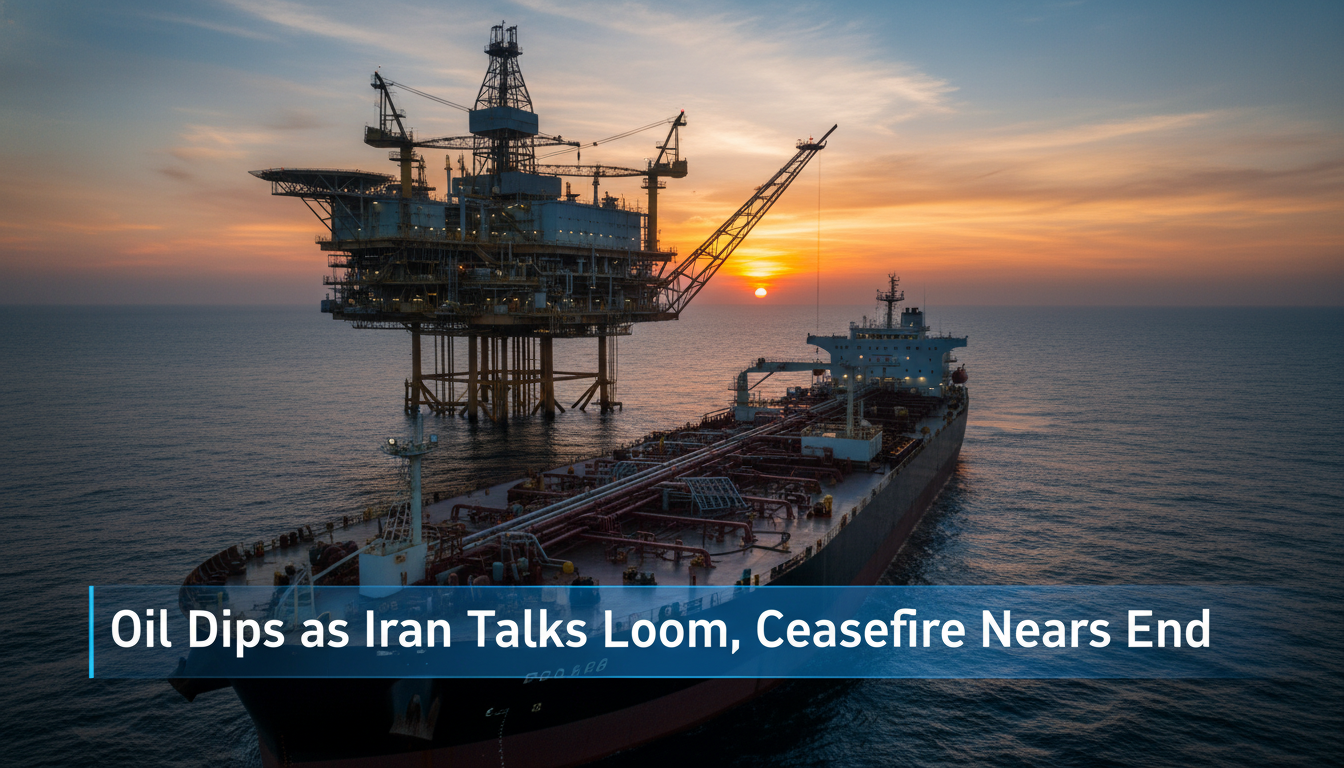
The global oil market is once again grappling with significant geopolitical headwinds, as crude prices experienced a slight downturn today amid conflicting signals surrounding potential U.S.-Iran negotiations and the imminent expiration of a temporary ceasefire. Investors are weighing the immediate implications of these diplomatic uncertainties against a backdrop of tight supply and persistent regional tensions. As of today, Brent Crude trades at $99.13 per barrel, down 0.22% within a daily range of $97.55 to $101.32. Similarly, U.S. West Texas Intermediate (WTI) Crude futures for May delivery are reflecting market caution, currently priced at $94.40 per barrel, a 1.51% decrease, having traded between $92.68 and $97.85 today. This dip follows a period of heightened volatility, where prices reversed sharp losses from the previous week, underscoring the market’s sensitivity to Middle East developments.
Geopolitical Crosscurrents Dictate Near-Term Oil Trajectory
The immediate downward pressure on crude prices stems directly from the opaque and often contradictory developments in U.S.-Iran relations. Last weekend, an escalation of tensions saw the U.S. seize an Iranian-flagged cargo vessel, prompting swift threats of retaliation from Tehran. In response, Iran once again closed the critical Strait of Hormuz to commercial shipping, a move that immediately injects significant risk premium into the market given that approximately one-fifth of the world’s oil supply transits this waterway. While the strait had briefly reopened, Iran cited an ongoing U.S. blockade of its ports and coastline as justification for its renewed closure.
President Donald Trump has maintained a firm stance, declaring that the naval blockade will remain in place until a comprehensive peace deal is achieved. This position complicates the prospect of constructive dialogue, even as Trump had previously indicated that fresh negotiations with Iran were anticipated this week, with a delegation reportedly poised to arrive in Pakistan on either Tuesday or Wednesday. However, Iranian officials, including Parliament Speaker Mohammad Bagher Ghalibaf, have publicly rejected talks conducted “under the shadow of threats” from Washington. Despite these public statements, private communications through regional mediators suggest Iran may indeed send a delegation, creating a state of deep uncertainty that keeps investors on edge and contributes to the current price fluctuations.
The Impending Ceasefire Expiry and Hormuz Disruptions
Adding another layer of urgency to the geopolitical landscape is the rapidly approaching end of a temporary two-week ceasefire, initially announced by President Trump on April 7 at 6:32 p.m. ET (22:32 GMT). While the precise expiry time remains unspecified, the clock is ticking, raising concerns about a potential return to open hostilities. This deadline coincides with the continued effective closure of the Strait of Hormuz, a choke point that remains largely inaccessible for commercial shipping. The persistent disruption in Hormuz is a critical factor for global oil supply, and any failure to extend the ceasefire or de-escalate tensions could solidify this blockade, sending significant shockwaves through the market.
Our proprietary data indicates that market participants are particularly sensitive to these supply-side risks. Over the past 14 days, Brent Crude has seen a decline from $109.27 on April 7 to $105.33 on April 24, a drop of 3.6%. While this period included the initial ceasefire announcement, the overall trend suggests underlying bearish sentiment potentially tied to the initial surge and subsequent uncertainty. Investors are keenly aware that sustained closure of the Strait of Hormuz could quickly push Brent well above the $120 mark, a scenario that would necessitate strategic reserve releases and significant demand destruction. Conversely, a breakthrough in talks and a lasting resolution could alleviate supply fears, potentially driving Brent below $80 per barrel, but such a scenario appears increasingly distant given current diplomatic stalemates.
Navigating Market Volatility: Upcoming Data Points for Investors
Amidst the fluid geopolitical environment, smart investors are also closely monitoring fundamental market data to gauge the true state of global oil supply and demand. While geopolitical events often trigger immediate price reactions, the underlying fundamentals provide crucial context and long-term directional cues. Over the next two weeks, a series of key reports will offer deeper insights into inventory levels, production trends, and demand projections, which will be vital for understanding market equilibrium beyond the headlines.
Specifically, investors should mark their calendars for the API Weekly Crude Inventory report on April 28, followed by the more comprehensive EIA Weekly Petroleum Status Report on April 29. These reports will provide the latest figures on U.S. crude oil and product inventories, refinery utilization, and import/export data – all critical components for assessing near-term supply-demand balances. Further insights into drilling activity will come from the Baker Hughes Rig Count on May 1 and May 8, offering a pulse check on future production capacity. Finally, the EIA Short-Term Energy Outlook on May 2 will provide updated forecasts for global supply, demand, and prices, allowing investors to adjust their strategies based on expert projections. These scheduled releases offer regular opportunities to recalibrate investment theses against the backdrop of ongoing geopolitical developments.
Investor Focus: Catalysts for Significant Price Shifts
Our first-party intent data reveals that a primary concern among investors this week centers on what specific catalysts could push Brent Crude outside its current trading range, particularly questioning what scenarios could drive it below $80 or above $120. The abstract from our AI assistant highlights the stalled broader U.S.-Iran negotiations, with President Trump ruling out nuclear options but also stating he won’t “rush” a deal, while Iran insists on the lifting of the U.S. blockade. This deadlock is the central factor for the immediate future of oil prices.
A sustained closure of the Strait of Hormuz due to a complete breakdown of the ceasefire and intensification of the U.S. blockade would undoubtedly be the primary catalyst for Brent to surge past $120. Such a scenario would represent an immediate and significant disruption to global supply, forcing a rapid re-evaluation of risk premiums and potentially triggering emergency measures from consuming nations. Conversely, for Brent to fall below $80, a dramatic and unexpected de-escalation of tensions would be required. This would likely entail a verifiable peace agreement between the U.S. and Iran, the full reopening of the Strait of Hormuz, and a clear path towards lifting sanctions that could eventually bring more Iranian crude to the global market. Furthermore, a significant weakening of global demand, perhaps due to an unforeseen economic downturn, would also contribute to such a decline. Currently, given the current diplomatic impasse and the ongoing regional instability, market sentiment remains poised for potential upside risks, yet the daily fluctuations remind us of the fragile equilibrium.