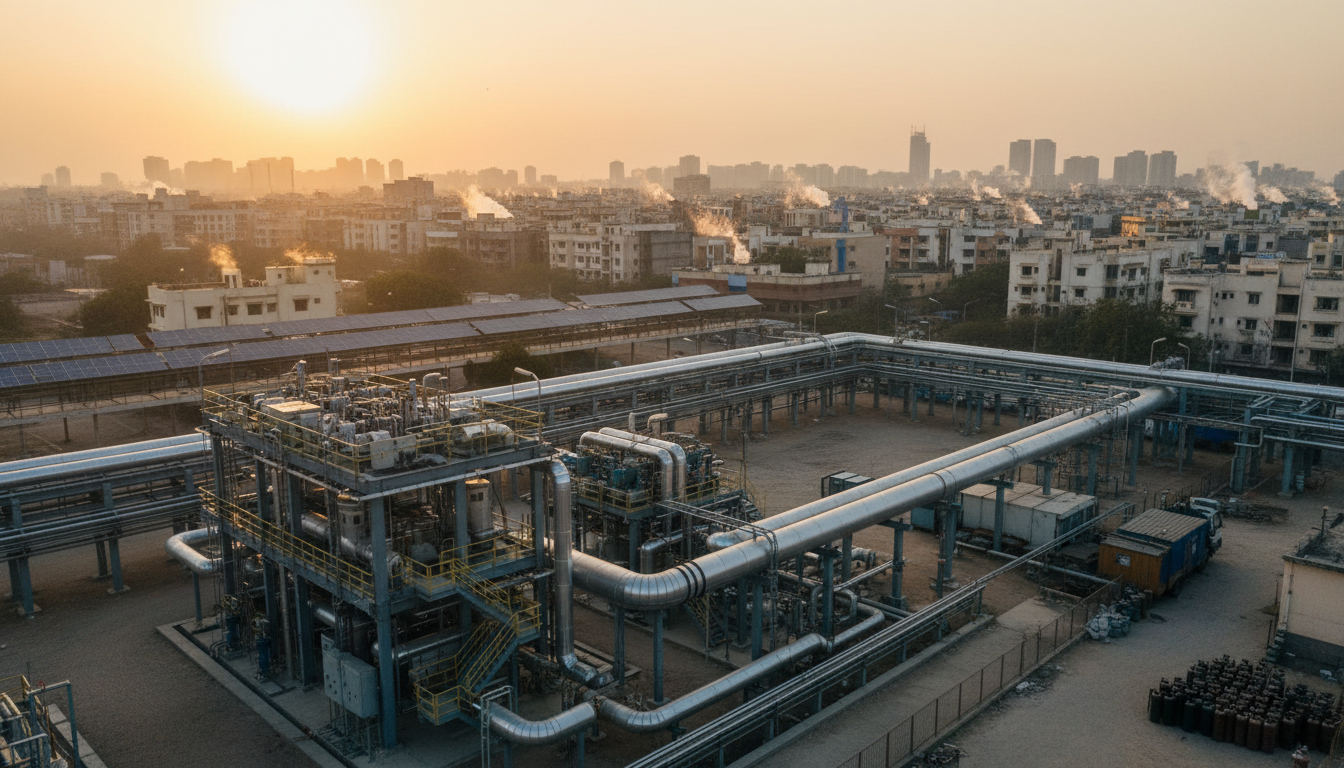
Indraprastha Gas Accelerates PNG Rollout Amidst Strategic Energy Shift
Indraprastha Gas Ltd (IGL) is executing an aggressive expansion strategy across Delhi-National Capital Region (NCR), rapidly increasing its piped natural gas (PNG) connections. This concerted effort aims to significantly reduce reliance on liquefied petroleum gas (LPG) and bolster India’s energy security, a critical focus following recent global supply disruptions. The company’s managing director highlights an ambitious target of establishing 5,000 new PNG connections daily, marking a substantial acceleration from previous installation rates.
The push for widespread PNG adoption has gained significant momentum in the wake of the West Asia conflict, which underscored vulnerabilities in traditional energy supply chains. Piped natural gas offers a more diversified sourcing profile compared to LPG, which is heavily dependent on imports, particularly from Gulf nations. This strategic shift aligns with governmental initiatives to promote PNG as a more convenient and resilient cooking gas alternative for both households and commercial entities.
Rapid Expansion Targets and Market Penetration
Before the geopolitical tensions in West Asia, IGL was averaging approximately 600-700 new PNG connections per day. This rate has now dramatically scaled up to between 2,100 and 2,200 daily connections. The ultimate objective is to achieve an impressive 5,000 new connections daily, demonstrating IGL’s commitment to swiftly transforming the region’s energy landscape. Over the next 90 days alone, IGL targets an impressive 4.85 lakh (485,000) new PNG connections across its operational geographical areas (GAs).
The expansion goes beyond residential kitchens. IGL is actively targeting commercial establishments, particularly fast-food chains that previously bore the brunt of LPG supply disruptions when the government prioritized household access. Over 100 outlets of two prominent fast-food chains have already integrated PNG, with a similar number currently in the process of conversion. IGL has identified 400 such commercial outlets for future connection, signaling a robust penetration into the commercial segment.
Furthermore, institutional users are also on IGL’s radar. The company is in the process of supplying PNG connections to every police station across Delhi. This move provides police station cafeterias and canteens with uninterrupted gas supply, eliminating the logistical challenges and constant need for refills associated with LPG cylinders.
Unlocking New Geographies: The Connaught Place Breakthrough
Historically, iconic commercial hubs like Connaught Place (CP) in New Delhi faced challenges in receiving PNG connectivity due to regulatory hurdles. However, with recent government relaxations aimed at accelerating PNG penetration, work has commenced to bring piped natural gas to this vital business district. The necessary pipeline infrastructure has already reached CP’s outer circle, paving the way for further connections and broader commercial adoption in a high-demand area.
India’s Natural Gas Advantage and Infrastructure Strength
India benefits from substantial domestic natural gas availability, which is efficiently piped to households, industries, and various commercial establishments such as hotels and restaurants. The nation currently produces approximately 92 million standard cubic meters per day of natural gas. Crucially, the total volume consumed by the city gas distribution (CGD) sector, encompassing both PNG and compressed natural gas (CNG), represents less than a third of this domestic production. This significant domestic supply contrast sharply with LPG, where a substantial portion, around 60% of India’s annual consumption of 31.3 million tonnes, is met through imports. A concerning 90% of these critical LPG imports transit through the Strait of Hormuz, a choke point susceptible to geopolitical instability.
IGL commands an extensive city gas distribution network, boasting over 28,000 kilometers of pipelines across key areas including Delhi, Noida, Greater Noida, Ghaziabad, Rewari, Gurugram, Karnal, Kaithal, Fatehpur, Ajmer, Pali, Rajsamand, Hamirpur, Shamli, Muzaffarnagar, Banda, and parts of Kanpur and Meerut. This robust infrastructure currently serves over 2.1 million vehicles through more than 950 CNG stations and provides PNG connections to over three million households within these regions.
Policy Mandate Drives LPG Displacement
To further accelerate the transition, the government has mandated households with existing PNG connectivity to switch from LPG. Faced with insufficient LPG supplies to cater to both domestic and commercial users, a directive was issued last month requiring consumers with access to both PNG and LPG to surrender their LPG connections within 90 days. Non-compliance will result in the discontinuation of cylinder supplies. Exemptions are granted only in cases where PNG connectivity is deemed technically infeasible, necessitating a no-objection certificate from the gas provider. This policy is a clear indicator of the government’s unwavering commitment to making PNG the preferred energy source where infrastructure permits.
In Delhi, IGL’s strategy focuses on identifying areas where 100 percent PNG penetration is achievable, transforming them into “LPG-free” zones. Successful implementations in areas like New Moti Bagh, East Kidwai Nagar, and West Kidwai Nagar exemplify this forward-thinking approach. This strategic pivot towards indigenous and diversified natural gas supply through an expanded PNG network not only enhances India’s energy security but also offers significant long-term benefits for consumers and investors alike in the evolving energy market.


